
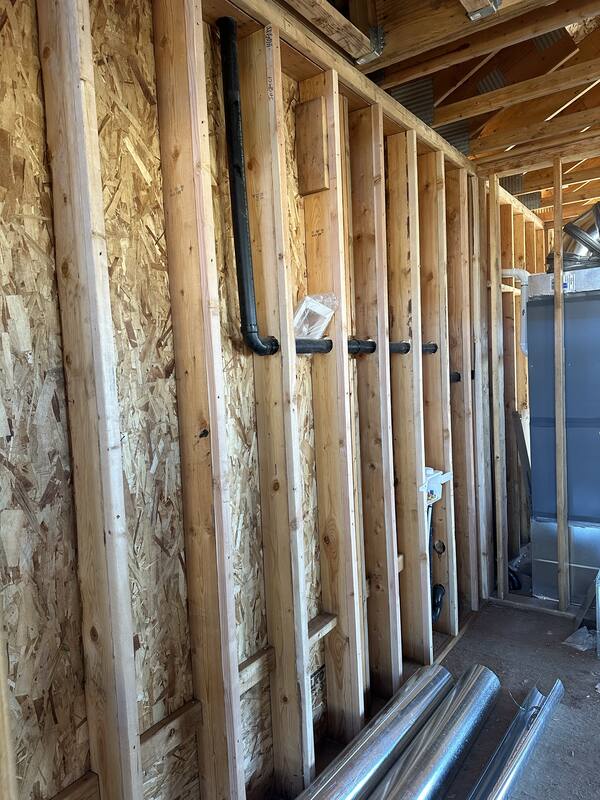
TL;DR: Whole house ventilation is required in every new Idaho home, and in Idaho it is not conditional the way it is in most of the country. The state deleted the national code’s leak-rate trigger and replaced it with a flat requirement: every dwelling unit gets a whole-house mechanical ventilation system. On a tight mountain house I install a balanced system with a recovery core, and west of the Tetons that core is almost always an ERV rather than an HRV.
Contents
- Why does a brand-new house even need whole house ventilation?
- Is whole house ventilation actually required by code in Idaho?
- How much fresh air does my house actually need?
- What are my three options, and which one do builders really install?
- HRV or ERV: which one belongs in a Teton Valley house?
- Where does the equipment go, and how much room does it take?
- What does a whole house ventilation system cost, and what is not in that number?
- Will running it wreck my heating bill?
- What about the range hood, the bath fans and the dryer?
- Does ventilation fix radon, wildfire smoke or a musty crawl space?
- What goes wrong when this gets done badly?
- When do we decide this on a SwagerBuilds build?
- Frequently asked questions about whole house ventilation
Why does a brand-new house even need whole house ventilation?
Because a house built to today’s standards does not leak enough to air itself out. That is the whole answer, and it surprises almost every client I walk through it.
The house your parents grew up in breathed through its own defects. Gaps at the sill plate, uninsulated rim joists, leaky windows, a chimney pulling air up out of the living room all day. It was drafty and expensive to heat, but it was never stuffy. Air changed over constantly whether anybody wanted it to or not.
Then we got good at air sealing. A house I frame and seal today, with a taped sheathing or fluid-applied air barrier and foam at every penetration, will typically test somewhere between 1.5 and 3 air changes per hour at 50 pascals on a blower door. That is tight. It is why the heating bill is low, why the floors are not cold, and why you cannot hear the wind. It is also why the air inside has nowhere to go.
Everything that happens inside a house puts something into the air. Cooking throws off grease, moisture and combustion byproducts. Showers and laundry add water vapor. People exhale carbon dioxide all night in a closed bedroom. New cabinets, new carpet, new paint and new furniture off-gas for months. A dog adds dander. Firewood stacked by the hearth adds mold spores. In a leaky house that load got diluted by accident. In a tight house it accumulates until you deliberately move it out.
That is what whole house ventilation is: a small, continuous, intentional air change that replaces the accidental one we engineered out of the building. The EPA’s own position is that inadequate ventilation raises indoor pollutant levels because not enough outdoor air comes in to dilute what is being emitted inside, and that outdoor air is one of the dilution paths a house needs. You can read their overview of improving indoor air quality if you want the public-health framing.
I will put it in plainer terms. I have walked into two-year-old homes in this valley with condensation running down the windows, a musty smell in the mechanical closet, and a homeowner who thinks the builder did something wrong with the windows. The windows were fine. Nobody gave the house a way to exhale.

Is whole house ventilation actually required by code in Idaho?
Yes, and Idaho is stricter about it than the national code is. This is the single most useful thing in this article, and most people building here have never been told.
The national model code, the 2018 International Residential Code, makes whole-house ventilation conditional. Its Section R303.4 only kicks in where a dwelling tests at 5 air changes per hour or less at 50 pascals. The logic was that a leaky house ventilates itself, so only tight houses need a fan.
Idaho threw that condition out. Under IDAPA 24.39.30, Section 600, the state adopts the 2018 IRC but deletes R303.4 and replaces it with one sentence: “Dwelling units shall be provided with whole-house mechanical ventilation in accordance with Section M1505.4.” No leak-rate trigger. No test result required to make it apply. Every new dwelling unit in Idaho gets a whole-house system, period.
That matters more than it looks, and here is why. Idaho also amended the energy code so that blower-door testing is only required on a 20 percent sample of each builder’s new single-family homes, with the other 80 percent allowed to pass on visual inspection instead. Idaho enforces the 2018 IECC with state amendments effective January 1, 2021, which you can confirm on the Department of Energy’s Idaho code status page. So under the national rule, four out of five Idaho houses would never produce the test number that triggers the ventilation requirement. Idaho closed that loophole by making the requirement unconditional.
The sizing rules themselves come from IRC Section M1505.4, in Chapter 15 of the 2018 IRC. Teton County, Idaho adopted the 2018 I-Codes in March 2021, so that is the book being enforced on a Driggs, Victor or Tetonia permit.
Two practical notes from permit sets I have run through this county. First, “required” does not mean “inspected well.” The inspector will look for the equipment and the controls; nobody is putting a flow hood on every register. Whether the system actually moves the air it was designed to move is on your builder, not the county. Second, a cheap compliance fan satisfies the letter of this rule. So does a balanced recovery system. The code sets a floor, not a target. I will come back to that.
How much fresh air does my house actually need?
Less than people expect. The code rate is a trickle, not a wind.
IRC Equation 15-1 sets the continuous whole-house rate at 0.01 times the floor area in square feet, plus 7.5 cfm for each bedroom plus one, with a 30 cfm floor. The “bedrooms plus one” part is the code’s stand-in for occupancy: a three-bedroom house is assumed to hold four people.
Run that on a real custom home. A 3,500 square foot, four-bedroom house needs 35 cfm for the floor area plus 37.5 cfm for five assumed occupants, which rounds to about 73 cfm continuous. That is roughly the output of one good bathroom fan, moving all day. Here is the code table for the sizes I actually build:
| Conditioned floor area | 2 bedrooms | 3 bedrooms | 4 bedrooms | 5+ bedrooms |
|---|---|---|---|---|
| 2,001 – 2,500 sq ft | 50 cfm | 55 cfm | 65 cfm | 70 cfm |
| 2,501 – 3,000 sq ft | 55 cfm | 60 cfm | 70 cfm | 75 cfm |
| 3,001 – 3,500 sq ft | 60 cfm | 65 cfm | 75 cfm | 80 cfm |
| 3,501 – 4,000 sq ft | 65 cfm | 70 cfm | 80 cfm | 85 cfm |
| 4,001 – 4,500 sq ft | 70 cfm | 75 cfm | 85 cfm | 90 cfm |
| 4,501 – 5,000 sq ft | 75 cfm | 80 cfm | 90 cfm | 95 cfm |
The code also lets the system run intermittently instead of continuously, as long as you multiply the rate by a run-time factor and the system runs at least half of every four-hour block. Run it 50 percent of the time and you double the airflow; run it 75 percent and you multiply by 1.3. I generally do not chase this. A small fan running continuously is quieter, gentler on the house and easier to balance than a big fan cycling on and off.
One thing worth knowing: the engineering world does not agree that the code rate is enough. ASHRAE Standard 62.2 uses the same per-occupant term but triples the floor-area coefficient to 0.03 cfm per square foot. On that 2,500 square foot three-bedroom house, the IRC asks for 55 cfm and 62.2 asks for about 105 cfm. Building Science Corporation’s own review of the two standards argues the higher 62.2 rate often produces worse outcomes in cold and dry climates, because you end up over-drying the house in winter for no measured health benefit. Their recommended winter indoor humidity floor is above 25 percent.
Where I land: size the equipment so it can hit the 62.2 number if you ever want it, then commission it at or slightly above the IRC rate and give the homeowner a boost switch. That is a design decision, not a product decision, and it costs nothing to get right on paper.
What are my three options, and which one do builders really install?
There are exactly three ways to ventilate a house, and the difference between them is which direction the air is pushed.
Exhaust-only runs a quiet fan that pulls air out continuously, usually from a bathroom or a central hallway. Fresh air comes in wherever the house leaks. It is the cheapest way to satisfy the Idaho rule and it is what most production builders install.
Supply-only does the opposite: a small duct brings outdoor air into the return side of the furnace or air handler, and the house pushes stale air out through its leaks. You get filtered, slightly pressurized incoming air, but you are also pulling outdoor air in through a cold duct in winter.
Balanced uses two fans in one box, one pushing out and one pulling in, through a core that transfers heat between the two air streams. That is an HRV or an ERV. You know where the air comes from, you know where it goes, and you keep most of the heat.
| Exhaust-only | Supply-only | Balanced (HRV / ERV) | |
|---|---|---|---|
| How fresh air gets in | Through leaks, wherever they are | Through one duct into the furnace return | Through a dedicated, filtered, ducted path |
| Heat recovered in winter | None | None | Typically 60–90% of the heat |
| Pressure effect on the house | Negative, pulls air in through walls, crawl space, garage | Positive, pushes moist indoor air into wall cavities | Neutral |
| Filtration of incoming air | None | Furnace filter only, when the fan runs | Yes, at the unit |
| Market installed cost (2026 market data, not SwagerBuilds pricing) | A few hundred dollars | Roughly $300–$2,000 | Roughly $1,200–$8,000 on new construction |
| What it does in a tight mountain house | Depressurizes it, the worst habit in cold-climate building | Works, but risks pushing moisture into cold assemblies | The right answer |
| My verdict | Code minimum only | Acceptable on a modest budget | What I spec |
Why I will not put exhaust-only in a house I build here: a negative-pressure house draws its makeup air from wherever the holes are. In Teton Valley that often means the crawl space, where the soil gas lives, or the attached garage, where the cars live. A house that is actively sucking air out of a crawl space is a house working against its own radon mitigation, and one actively pulling from a garage is a carbon-monoxide problem looking for a cold morning. On a house with an engineered crawl space or basement and a sealed envelope, you have spent real money building a controlled box. Depressurizing it on purpose throws that away.
Supply-only is defensible. I have no quarrel with it on a tighter budget. But it pushes warm, moist interior air outward through the wall assembly in winter, which is exactly the direction you do not want moisture moving in climate zone 6. It also leaves you running the big furnace blower to get ventilation, which costs more electricity than a 40-watt dedicated fan.
Balanced ventilation with a recovery core is what belongs in a $1M-and-up custom home in this climate. It is a small line item on a build of that size and it is the difference between a house that merely passes inspection and a house that actually works in February.
HRV or ERV: which one belongs in a Teton Valley house?
An ERV, almost always, and the reason is water, not heat.
Both units do the same basic job. Two air streams pass each other through a core and trade energy without mixing. An HRV, a heat recovery ventilator, transfers only heat. An ERV, an energy recovery ventilator, transfers heat and some moisture.
That moisture transfer is the whole decision. Cold air holds almost no water. When it is 5 degrees outside, the outdoor air you are bringing in is bone dry even at high relative humidity, and once you warm it to 70 degrees indoors its relative humidity collapses into the single digits. Ventilate a tight house all winter with an HRV and you will dry it out: cracking trim, gapping hardwood, static, split lips, instrument cases that will not hold tune. An ERV hands part of the indoor moisture back to the incoming stream, so the house stays in a livable range instead of sliding toward desert conditions.
Allison Bailes makes the same argument in his piece on why you probably need an ERV, not an HRV: ventilating a cold climate without moisture exchange produces very low winter humidity, because cold air is dry air. He also notes that the frost problems that gave early ERVs a bad reputation in very cold places have been engineered out, so the old objection no longer holds.
| HRV (heat recovery ventilator) | ERV (energy recovery ventilator) | |
|---|---|---|
| What the core transfers | Heat only | Heat plus some moisture |
| Winter effect on indoor humidity | Drops it, often hard | Holds it closer to a livable range |
| Best fit | Houses that run too humid in winter: high occupancy, indoor pool, lots of plants | Cold, dry climates: Teton Valley, Rigby, Idaho Falls, Jackson |
| Summer behavior here | Fine | Fine, and limits humid-day moisture gain |
| Frost control in deep cold | Mature | Mature on current equipment |
| Cost difference | Baseline | Usually a small premium |
| What I spec west of the Tetons | Only for a specific humidity problem | Default |
The exception is real, so I will name it. If you are putting six or seven people in a 2,400 square foot airtight house, or you want an indoor hot tub, or somebody keeps forty houseplants, the house makes its own moisture and an HRV’s drying effect becomes a feature. Some units take a swappable core so you can run an ERV core in summer and an HRV core in winter. I have not needed to do that here yet, but it exists.
What I will not do is let a mechanical sub pick this by habit. “We always use HRVs” is not a climate analysis. On our builds the ventilation strategy gets decided during design, alongside the heating system and the insulation assemblies, because all three interact.
Where does the equipment go, and how much room does it take?
A residential unit is roughly the size of a carry-on suitcase, hung from joists or wall-mounted. The box is not the problem. The ducting is.
A balanced system needs four duct paths: an intake from outdoors, an exhaust to outdoors, a supply distribution to the rooms where people sleep and sit, and a return pickup from the rooms that make the stale air. On top of that it needs a condensate drain, because a recovery core makes water.
Here is what I want in a set of plans before framing starts:
- A dedicated mechanical room or closet with real service clearance, not a unit buried above a soffit where nobody will ever change a filter.
- Exterior intake and exhaust hoods at least ten feet apart, so you are not re-breathing your own exhaust, and placed where drifting snow will not bury them. In this valley that means figuring snow accumulation into the elevation, not just the gable.
- Intake away from the driveway, the garage door, the dryer vent and the water heater flue.
- Short, straight runs in smooth metal duct. Flex duct crushed around a truss is how a 75 cfm system becomes a 30 cfm system.
- Insulated and vapor-sealed intake and exhaust ducts inside the conditioned space, or they will sweat and drip in January.
- A condensate path to a drain, with a trap and freeze protection.
- Supply into bedrooms and the main living area; return from bathrooms, laundry and the kitchen area, but not inside the range hood’s territory.
That list is why whole house ventilation is a design-phase item and not a purchase. The hardest ventilation retrofits I have been asked to look at were not hard because of the equipment. They were hard because the house was already finished and there was no honest path from the mechanical closet to the far bedrooms. On our projects the drawing set, the structural coordination and the mechanical layout all come out of the design agreement, so the duct path and the truss layout get resolved on paper by the same people instead of being fought out in the field.

What does a whole house ventilation system cost, and what is not in that number?
Third-party 2026 market data puts a residential HRV or ERV unit at roughly $700 to $2,500 for the equipment alone in the 50 to 200 cfm range, and roughly $1,200 to $6,000 installed on a house under 3,000 square feet, with complex jobs or all-new ductwork running $8,000 to $12,000. A simple fresh-air intake with an inline fan and damper comes in around $300 to $2,000 installed. Those are market figures from HVAC cost surveys, not SwagerBuilds numbers.
Now the part nobody prints. Here is what is usually not in a quoted ventilation price:
- The ducting itself, if the quote is equipment and hookup only. On a sprawling single-level floor plan the duct run is the expensive half.
- Exterior penetrations and hoods, flashed and sealed into the air barrier properly. Two more holes in a weather-resistive barrier that has to still work in twenty years.
- Commissioning, meaning somebody actually measures and balances the airflow instead of trusting the nameplate. This is the line item most often skipped and the one that decides whether the system works.
- The condensate drain and its freeze protection.
- Electrical: a dedicated circuit and a controller location somebody will actually use.
- Filters, forever. Budget for two sets a year. A clogged filter is the number one reason a working system quietly stops working.
- Range hood makeup air, if the kitchen hood is big. See below, because this one bites.
In the context of a custom home here, ventilation is a rounding error on the build and one of the highest-return dollars in the mechanical package. SwagerBuilds custom homes start at $400 per square foot and go up on the Idaho side of the pass, and start at $1,000 per square foot and go up in Jackson Hole, quoted on construction cost and conditioned square footage. Against that, a properly ducted and commissioned balanced system is a small fraction of one percent of the job. I have never had a client regret it. I have had clients regret a $90,000 kitchen in a house that smells like last night’s salmon at breakfast.
If you want the fuller cost picture, I lay out what drives the number on our cost per square foot to build in Teton Valley page, and the things that surprise people on energy efficient features worth paying for.
Will running it wreck my heating bill?
No, and a balanced system with a recovery core is cheaper to run than the alternatives, which is the part that gets lost.
Think about what you are paying for. Ventilation costs you two things: the electricity to turn the fans, and the heat that leaves with the outgoing air. A good residential ERV moving 75 cfm draws roughly as much power as a couple of LED bulbs. The heat is the real money, and that is precisely what the core is for: current equipment recovers something like 60 to 90 percent of it, depending on the unit and the conditions.
Compare that to exhaust-only. Every cubic foot you push out gets replaced by outdoor air at outdoor temperature, and you heat 100 percent of it from scratch. Running 75 cfm of 5-degree air up to 70 degrees, all winter, is not free. Exhaust-only is the cheap option to install and the expensive option to own.
There is a second-order benefit on our builds. Because the ventilation is ducted and balanced, I can size the heating equipment to the real load instead of padding it to cover a mystery. That matters whether you end up with a heat pump or a furnace, and it matters on a radiant floor house, where the slab is slow and a ventilation load you did not account for shows up as a room that never quite catches up.
One honest caveat: a recovery core only recovers when it is clean and when the airflows are actually balanced. An ERV with a plugged filter and an 80 cfm supply against a 40 cfm exhaust is pressurizing your house and recovering very little. That is a commissioning and maintenance problem, not an equipment problem, and it is why I put the filter schedule in the homeowner packet at closeout.
What about the range hood, the bath fans and the dryer?
They are a different job, and confusing the two is the most common mistake I see in mechanical plans.
Whole house ventilation is the slow, continuous background air change. Local exhaust is the fast, targeted removal of a specific mess at a specific moment. The code treats them separately, and so should your plan set. Under IRC Table M1505.4.4(1), kitchens need 100 cfm intermittent or 30 cfm continuous, and bathrooms need 50 cfm intermittent or 20 cfm continuous. Your 70 cfm ERV does not satisfy the bathroom requirement, and your bath fan does not satisfy the whole-house requirement.
Then there is the range hood, which is where tight houses get dangerous. Everybody wants the 1,200 cfm professional hood. In a house that tests at 1.5 ACH50, a 1,200 cfm hood cannot find 1,200 cfm of makeup air, so it depressurizes the house hard and starts pulling air down the nearest available chimney or flue. IRC Section M1503.6 requires makeup air for hoods exhausting more than 400 cfm, and the real-world trigger for danger is any naturally drafted combustion appliance inside the envelope: an atmospheric water heater, a gas fireplace, a wood stove.
How I handle it: either a powered makeup-air damper interlocked with the hood, so opening the hood opens a tempered air path, or a mechanical package with no atmospheric-draft appliances in the house at all, meaning direct-vent or sealed-combustion everything. The second is cleaner and is what I spec on new work. It also plays well with the fact that Teton County has no piped natural gas, so everything gas here is propane and worth treating with the same care.
Two more small things that bite. The clothes dryer is a 150 to 200 cfm exhaust fan that nobody counts, and it runs during the exact hours the house is most occupied. And a bath fan on a timer is not a whole-house system no matter how long the timer runs, because it is still just depressurizing the house without a controlled inlet. Inspectors sometimes accept it. I do not spec it.
Does ventilation fix radon, wildfire smoke or a musty crawl space?
Partly, and the honest answer is different for each one. People try to make ventilation do three jobs it was not designed for.
Radon: no. Diluting soil gas after it is already in the house is a losing strategy, and an exhaust-only system actively makes it worse by pulling harder on the soil under the slab. Radon gets solved under the slab with a passive or active sub-slab depressurization system, which is the whole point of putting the rough-in in during foundation work. A balanced ERV does help a little, because it does not depressurize, but the radon system is the fix and ventilation is not a substitute.
Wildfire smoke: yes, if you planned for it. This is a real summer issue here, and a balanced system is the only one of the three strategies that gives you a usable answer. Because the incoming air comes through one known duct at one known filter, you can put real filtration on it and you can shut the intake on a bad smoke day while keeping the house slightly positive. A leaky house with an exhaust fan has no such option. If you are already thinking about wildfire resistant construction, treat the ventilation intake as part of that package, not as an afterthought.
Musty crawl space or basement smell: no, and stop trying. That smell is a moisture problem with a source. Ventilating the house just moves crawl space air through your living room on the way out. Fix the source: ground vapor barrier, sealed and conditioned crawl, drainage, roof water taken away from the foundation. I cover the assembly choices in the basement versus crawl space versus slab breakdown.
Same logic applies to the one people never ask about: ventilation does nothing for hard water or for ice dams, even though both get blamed on “air” at some point in every build. Dilution is not a substitute for source control. That is Building Science Corporation’s framing and it is right.
What goes wrong when this gets done badly?
I would rather tell you the failure modes than the brochure. Every one of these is something I have seen or been called in to look at.
- The compliance fan. A bath fan wired to run continuously, nothing else. Satisfies the inspector, depressurizes the house, pulls crawl space and garage air into the living space, recovers no heat.
- Never commissioned. The unit is rated 90 cfm and delivers 38 because of flex duct, two hard elbows and a crushed run. Nobody measured, so nobody knows.
- Out of balance. Supply exceeds exhaust by 40 percent, so the house runs positive and pushes humid interior air into cold wall cavities all winter. This shows up as a moisture stain two years later and gets blamed on the siding.
- Intake in the wrong place. Six feet from the dryer vent, or under a snow drift, or next to where the truck idles on a January morning.
- No condensate plan. The core makes water, the water has nowhere to go, and in a cold mechanical space the drain freezes.
- Controls nobody understands. A unit with a dial in an attic nobody visits. If the homeowner cannot find the boost switch, the system is decoration.
- Filters never changed. The quiet killer. A plugged filter turns a well-designed balanced system into an expensive paperweight.
- A giant range hood with no makeup air. Covered above. This is the one that can actually hurt somebody.
Notice how few of those are equipment failures. Almost all of them are design and verification failures, which is exactly why I treat ventilation as a drawing-set item and a closeout-measurement item rather than a box on a materials list. The same thinking applies to the inspections that happen on your build: passing is the floor, not the goal.
When do we decide this on a SwagerBuilds build?
During design, before anything is framed. Not at mechanical rough-in, and definitely not at drywall.
The sequence on our projects looks like this. We lock scope, site conditions and finish direction in the design agreement. The drawing set gets developed with the mechanical layout coordinated against the structural layout, so the duct paths and the truss and joist layout are reconciled on paper. Our structural, civil and mechanical engineering relationships get looped in where the build needs them, which on a Teton Valley or Jackson Hole house it almost always does, because stamped snow-load engineering and setbacks drive the schedule. Interior selections, millwork from our Rigby shop, lighting and tile get sequenced so they do not blow the schedule. Then we bid and sign a fixed construction price.
Clients are sometimes surprised that all of that is in-house or handled through people I have worked with for twenty years. You are not supposed to go assemble an architect, an engineer, a mechanical designer and an interior designer yourself and then bring me the pieces. Design is sold as a fixed design fee, quoted per project, and if you want the detail on what that phase actually produces, I wrote it up in the design phase and the real number before signing.
I am involved in every phase of every build, and there are 24/7 site cameras on every job, so when I say the ventilation intake got placed where the drawing said, I can show you. If you are planning a custom home in Teton Valley, Driggs, Victor, Tetonia, Rigby, Idaho Falls or Jackson Hole and you want this decided properly instead of discovered later, call me at (208) 520-0636 or start with how we build in Driggs.
Built different. Built right.
Frequently asked questions about whole house ventilation
Is whole house ventilation required in Idaho?
Yes. Idaho deletes the 2018 IRC’s conditional Section R303.4 and replaces it under IDAPA 24.39.30, Section 600 with a flat requirement that dwelling units be provided with whole-house mechanical ventilation per IRC Section M1505.4. Unlike the national code, there is no blower-door threshold that has to be met before the requirement applies. Every new Idaho dwelling needs a system.
Should I get an HRV or an ERV in a cold climate?
In a cold, dry climate like Teton Valley or Eastern Idaho, an ERV is the better default. It transfers some moisture along with the heat, so it does not dry the house out in winter the way an HRV does. Choose an HRV only if the house has a specific excess-humidity load, such as high occupancy or an indoor pool. Frost control on current ERV equipment is mature.
How many CFM does my house need for whole house ventilation?
Under IRC Equation 15-1, the continuous rate is 0.01 times the conditioned floor area, plus 7.5 cfm per bedroom plus one, with a 30 cfm minimum. A 3,500 square foot four-bedroom house works out to about 73 cfm. ASHRAE 62.2 would ask for roughly three times the floor-area portion, so size equipment with headroom and commission at or just above the code rate.
Can a bathroom exhaust fan satisfy the whole-house requirement?
It can satisfy an inspector, but it is not a system I will spec. A continuous bath fan depressurizes the house, which pulls makeup air out of the crawl space, the attic and the attached garage, and recovers none of the heat that leaves. Local exhaust and whole-house ventilation are separate code requirements with separate airflow rates.
Does a whole house ventilation system increase my heating bill?
A balanced system with a recovery core is the cheapest of the three strategies to operate. The fans draw very little power and the core recovers roughly 60 to 90 percent of the heat leaving the house. Exhaust-only is the opposite: it is the cheapest to install and the most expensive to run, because every cubic foot of outgoing air is replaced by outdoor air you have to heat from scratch.


