
Contents
- What is a water-resistive barrier (WRB) and why does every home need one?
- The four categories of exterior waterproofing
- The four products that cover 90% of custom-home decisions in 2026
- How to actually pick: the decision matrix
- The questions to ask before you specify any WRB
- What we spec at SwagerBuilds — and why
- FAQ
- Want this for your build?
TL;DR: Exterior waterproofing — picking the right water-resistive barrier and air barrier — is one of the most important decisions in your build. Every modern wall needs a water-resistive barrier and an air barrier — sometimes the same product does both. The right choice depends on building type, climate, budget, and how forgiving you want the install to be. ZIP and LP WeatherLogic combine sheathing and WRB into one panel. Tyvek is the proven stapled house wrap. Fluid-applied is the premium air barrier for high-performance builds. This guide walks through how a custom builder actually picks.
What is a water-resistive barrier (WRB) and why does every home need one?
A water-resistive barrier is the layer in your wall assembly that keeps bulk water — wind-driven rain, snowmelt running down the sheathing, condensation — from reaching the framing and insulation. Without one, your wall will rot from the outside in. Modern building code (IRC Section R703.1) requires a WRB on every exterior wall.
An air barrier is a different job: it stops air from leaking in and out of the wall. Air carries moisture, so a leaky wall is also a wet wall. Some products do one job. Some do both.
The cleanest way to think about it: the WRB stops liquid water from getting in. The air barrier stops energy (and the water vapor that hitchhikes on it) from sneaking through. A well-built wall has both. For a deeper dive, Building Science Corporation publishes some of the clearest WRB and air-barrier research available.
The four categories of exterior waterproofing
The products on the market fall into four buckets:
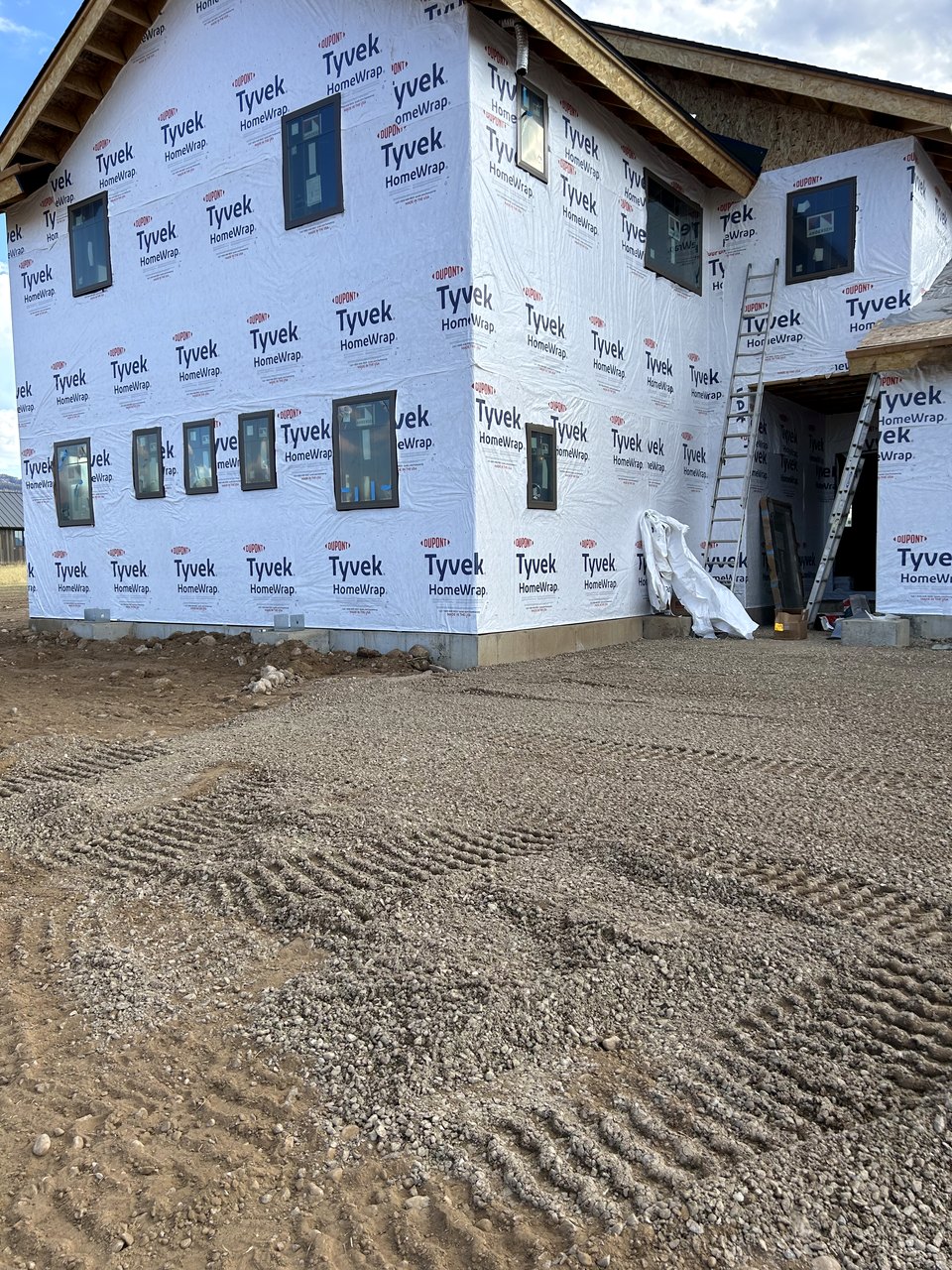
- Mechanically-attached house wraps — Tyvek HomeWrap, Typar, Barricade. A sheet membrane stapled over sheathing. The proven workhorse.
- Integrated structural sheathing — Huber ZIP System, LP WeatherLogic. OSB with a factory-bonded WRB face. Tape the seams and you have sheathing + WRB + air barrier in one product.
- Fluid-applied WRBs — Prosoco R-Guard Cat 5, Henry Air-Bloc 33MR, Tremco ExoAir 230, Sto Gold Coat, Polywall Blue Barrier. Rolled or sprayed onto sheathing, cures into a seamless air and water barrier.
- Self-adhered membranes — VaproShield, Henry Blueskin, Carlisle Barritech VP. Peel-and-stick sheets. Common on commercial work, occasionally specced on high-performance residential.
The four products that cover 90% of custom-home decisions in 2026
Almost every custom home in 2026 is going to use one of four systems: Tyvek over OSB, ZIP System, LP WeatherLogic, or a fluid-applied air barrier over OSB. Here’s how they compare on the specs that actually matter.
| System | What it is | Perm rating | Max UV exposure | Typical $/sq ft installed | Best use |
|---|---|---|---|---|---|
| Tyvek HomeWrap + OSB | Sheet membrane stapled over standard sheathing | ~56 perms (high) | 120 days | $0.25–$0.75 | Production homes, remodels, budget-conscious custom builds |
| Huber ZIP System | OSB with factory-bonded WRB + seam tape | 12–16 perms | 180 days | $1.50–$2.50 | Custom homes chasing air-tightness and a faster dry-in |
| LP WeatherLogic | OSB with SmartSide WRB face + seam tape | 5.35 perms | 180 days | $1.25–$2.25 | Custom homes where supplier carries LP, often slightly cheaper than ZIP |
| Fluid-applied (Cat 5, Air-Bloc, ExoAir) | Roller- or spray-applied seamless membrane over OSB | varies — most 10–25 perms | varies by product | $0.85–$1.00 (material + labor over OSB) | Passive House targets, complex geometries, commercial-grade residential |
Prices reflect 2026 supplier conversations in eastern Idaho. Confirm with your supplier — these move with OSB and resin markets.
How to actually pick: the decision matrix
Builders don’t pick a WRB in a vacuum. The decision is three-dimensional: building type × climate × budget. Here’s the shortcut.
- If you’re building a tight custom home in a cold climate and chasing low ACH numbers: ZIP System or a fluid-applied air barrier. The integrated WRB and air barrier earn their cost back in blower-door results.
- If you’re building a custom home in a mixed climate on a normal budget: Tyvek HomeWrap or CommercialWrap over standard OSB. Reliable, forgiving, repairable.
- If you’re building under stucco, fiber cement, or any reservoir cladding: Tyvek DrainWrap or CommercialWrap D. The drainage face matters more than the WRB itself.
- If you’re building a barndominium or shop home with metal siding: Tyvek HomeWrap or ZIP, with extra attention to the tape and the screw penetrations.
- If you’re chasing Passive House numbers or building something with crazy geometry: Fluid-applied. Seamless wins.
The questions to ask before you specify any WRB
Before you let your builder lock in a WRB, get answers to five questions. These flush out whether the system was actually chosen for the build or chosen because it’s what the lumberyard had on the truck.
- What’s the perm rating, and is that the right number for our climate?
- How long will it sit exposed before siding goes on, and is that within the manufacturer’s UV limit?
- What’s the tape or sealant system, and has the crew installed it before?
- How does it integrate with the window flashing details?
- What’s the warranty, and what voids it?
What we spec at SwagerBuilds — and why
On most of our Teton Valley custom builds, we lean toward ZIP System for the wall sheathing. The cold dry winters here want a vapor-permeable WRB that lets the wall dry outward, ZIP’s 12–16 perm rating fits, and the integrated air barrier helps us hit better blower-door numbers without specifying a separate fluid-applied product. On budget-conscious builds and on remodels where we’re tying into existing framing, Tyvek HomeWrap with proper flashing earns its keep. We’ve also been having more conversations with homeowners about Prosoco Cat 5 on the high-performance end — the math gets interesting on a Passive-House-curious build.
The honest answer is that the WRB is one decision in a system. The window flashing, the rain screen detail, the air-sealing at the rim joist — all of that matters as much as the brand on the wall. If a builder tells you ZIP is “the only right answer” or that Tyvek is “outdated,” you’re not getting a builder’s take. You’re getting a sales pitch.
FAQ
What is the best water-resistive barrier for a custom home in 2026?
There is no single best WRB. For a typical custom home in a cold mountain climate, ZIP System or Tyvek HomeWrap over standard OSB both work. ZIP gives a tighter air barrier when the tape is installed correctly. Tyvek is more forgiving and costs less. The right pick depends on climate, cladding, budget, and crew experience.
Do I need both an air barrier and a water barrier?
Yes. The water-resistive barrier keeps liquid water out of the wall. The air barrier keeps air (which carries water vapor) from leaking through. Some products do both jobs — ZIP System and fluid-applied membranes are common dual-purpose options. House wrap is primarily a water barrier; treating it as an air barrier requires meticulous taping that most jobsites skip.
Is ZIP System better than Tyvek?
ZIP System is faster to install and air-seals better when the tape is applied correctly. Tyvek is cheaper, more forgiving, and easier to repair. Neither is universally “better.” See our ZIP vs Tyvek head-to-head for the spec-by-spec read.
What is the difference between a structural sheathing system and house wrap?
Structural sheathing systems like ZIP and LP WeatherLogic combine the wall sheathing and the water-resistive barrier into one panel. Conventional framing uses OSB or plywood sheathing plus a separate house wrap stapled over the top. The integrated systems save a labor step; the conventional approach is cheaper in materials and easier to repair.
How long can a WRB be left exposed before siding goes on?
Tyvek HomeWrap is rated for 120 days of UV exposure. ZIP System has a 180-day exposure guarantee. LP WeatherLogic is also rated at 180 days. Fluid-applied products vary by formulation — check the data sheet. Exceeding the exposure window doesn’t guarantee failure but it does void the manufacturer warranty.
Does an integrated sheathing system replace house wrap?
Yes. When ZIP System or LP WeatherLogic is installed and taped per the manufacturer instructions, it functions as the code-required water-resistive barrier. Adding a layer of house wrap on top is not recommended — it can trap moisture against the sheathing face.
Want this for your build?
SwagerBuilds is based in Teton Valley, Idaho. We build custom homes in Driggs, Victor, Tetonia, and the surrounding corridor. If you’re trying to figure out the right WRB for a build, we’re happy to walk through it on the phone. Get in touch.
Leave a Reply