
TL;DR: A green custom home costs more to build than a code-minimum house, and in Idaho that gap is wider than most people expect, because the state still enforces the 2018 energy code. The certification plaque is rarely what pays you back. The envelope is. And as of July 2026 the federal tax credit that used to soften the cost is gone.
Contents
- What does a green custom home actually mean?
- Which green home certifications are worth chasing in 2026?
- Did the federal tax credit for green homes go away?
- What does a green custom home cost compared to a code-built one?
- Where does the money actually come back?
- What gets you most of the benefit without paying for a certification?
- When is certifying a green custom home actually worth it?
- What I do on a Teton Valley build
- Questions I get asked about green custom homes
What does a green custom home actually mean?
“Green” gets used for three different things, and they get mixed together in almost every conversation I have about it.
Energy performance. How much fuel the house burns to stay comfortable. This is what almost everyone actually means when they ask me about a green custom home.
Indoor air and health. Ventilation, filtration, combustion safety, low-emission finishes. Nobody asks for this by name, and it’s the part people notice most once they live in the house.
Materials and resources. Where the lumber came from, construction waste diversion, water use, site impact. This is the part that drives most of the paperwork in a certification and the least of the monthly bill.
A certification bundles all three and hands you a document. That bundling is the whole argument, for and against. You pay for categories you may not care about in order to get third-party proof of the one you do.
Which green home certifications are worth chasing in 2026?
There are five that come up on custom projects in Idaho and Wyoming. They are not interchangeable, and the effort required on a one-off custom build varies a lot.
| Program | What it’s really testing | Third-party verification | Effort on a one-off custom build | Who it’s actually for |
|---|---|---|---|---|
| ENERGY STAR Residential New Construction | Whole-house energy performance against a reference house, plus checklists for HVAC and thermal enclosure | Yes — certified rater, inspections during construction plus a blower door test | Moderate. The rater has to be in the schedule from framing on | Buyers who want a recognized, verifiable floor on performance without a research project |
| DOE Efficient New Homes (successor to Zero Energy Ready Home) | ENERGY STAR as the baseline, then a tighter envelope, better windows, and solar-ready provisions on top | Yes — same rater infrastructure, stricter targets | Higher. Affects window selection and mechanical design at schematic, not at framing | Owners who want the house close to net-zero-capable and are keeping it long-term |
| NGBS Green (Home Innovation Research Labs) | Points across energy, water, materials, indoor air and site, at Bronze through Emerald levels | Yes — accredited verifier, two site visits typical | Moderate, and flexible. You can hit a level several ways | Builders and owners who want a real standard with room to prioritize |
| LEED for Residential (USGBC) | Similar point categories to NGBS, with more weight on site, water and materials documentation | Yes — LEED-accredited verifier plus submitted documentation | Highest paperwork load of the five | Owners who specifically want the LEED name, often for institutional or resale reasons |
| PHIUS / Passive House | Absolute energy targets and extreme airtightness, not a percentage better than code | Yes — certified consultant involved from design, rigorous testing | Highest. It’s a design constraint, not a finish-out decision | Owners for whom performance is the point of the project |
The honest read: ENERGY STAR and DOE Efficient New Homes are the two that map cleanly onto how a custom home in this valley actually gets built. NGBS is a good fit if you want flexibility. LEED and Passive House are both real, and both change how the project runs from day one rather than adding a step at the end.
Did the federal tax credit for green homes go away?
Yes. This is the single biggest change to the math in 2026, and a lot of the advice still online was written before it happened.
The Section 45L New Energy Efficient Home Credit applied to qualified homes acquired after December 31, 2022 and before July 1, 2026. The One Big Beautiful Bill Act of 2025 moved that termination date up. While it was live, the credit was worth $2,500 for an ENERGY STAR certified home and $5,000 for a DOE Efficient New Homes certified one, per the U.S. Department of Energy.
If you’re signing a construction contract in late 2026, that $2,500 or $5,000 is not on the table. Any calculator or article that still folds it into a payback period is giving you a number that no longer exists.
The program itself continues. ENERGY STAR moved from EPA to the Department of Energy during 2026 — the agreement took effect June 1, 2026 and the transition plan was finalized August 28, 2026, with DOE named as the lead federal agency. Certification is still available; the federal check that came with it is not.
I’m a builder, not a CPA. Before you make a decision with tax consequences, put it in front of your accountant.
What does a green custom home cost compared to a code-built one?
First, the baseline matters more here than in most states. Idaho enforces the 2018 IECC with state amendments, effective January 1, 2021. That means “code minimum” in Idaho is a 2018 target. In a state on a newer code, the gap between code and a green custom home is narrower. Here it’s wider — which cuts both ways. There’s more room to improve, and more of the improvement is on your nickel.
SwagerBuilds custom homes start at $400/SF and go up on the Teton Valley and Idaho side, and start at $1,000/SF and go up in Jackson Hole. Those are construction cost on conditioned square footage, fixed price after design lock. There’s no separate “green package” price, because that’s not how it works. The decisions live inside the envelope and mechanical scope you were buying anyway.
What I can tell you is where the money goes, in order:
| Level | What you’re buying | Where the cost lands | What changes day to day |
|---|---|---|---|
| Code minimum | A legal house on the 2018 Idaho baseline | Nothing extra | Cold spots, bigger equipment, higher winter bills |
| Performance build, no certification | Air sealing target, continuous exterior insulation, better windows, right-sized and properly located mechanical | Framing, insulation, windows, HVAC design | Even temperatures, quieter house, smaller heating bills |
| Certified green custom home | Everything above, plus a rater in the schedule, testing, documentation and a registration fee | The above, plus verification fees and schedule coordination | Same daily experience as a performance build, plus a document you can hand a buyer or a lender |
Notice what that table says. The jump from code minimum to a performance build is where the comfort and the bills change. The jump from performance build to certified is where the proof changes. Those are two different purchases and they should be decided separately.
And the anxious follow-up, because everybody has it: none of those figures include the land, site work, well and septic, permits and impact fees, landscaping or furnishings. All-in typically runs meaningfully above construction cost. We cover that in detail in our Teton Valley cost breakdown.
Where does the money actually come back?
Heating season. Teton Valley runs a long, cold one. A house that leaks costs you every single one of those months, not a token amount in shoulder season. The colder the climate, the faster envelope money works.
Right-sized equipment. This is the payback nobody mentions. Tighten and insulate the house properly and the heat load drops, which means smaller equipment. That’s a real reduction in the mechanical line, in the same budget, offsetting part of what you just spent on the envelope.
Comfort you can feel. No cold floor over the garage. No room that never gets warm. Consistent temperature room to room. This is the part clients bring up years later, and it doesn’t show up on any payback spreadsheet.
Resale. Here’s where certification earns its keep. “It’s a well-built house” is what every seller says. A third-party certificate and a blower door number are things a buyer can verify without trusting anybody.
Quiet. An airtight, well-insulated house is a noticeably quieter house. Unintended benefit, consistently mentioned.
What gets you most of the benefit without paying for a certification?
If you do these five things and skip the plaque, you get the large majority of what a green custom home delivers:
- Set an air-tightness target and test it. A blower door test costs a fraction of a full certification. Put the target in the contract so it’s a requirement, not a hope.
- Continuous exterior insulation. Insulation between studs is interrupted by every stud. A continuous layer outside the framing is the single highest-value envelope upgrade in this climate.
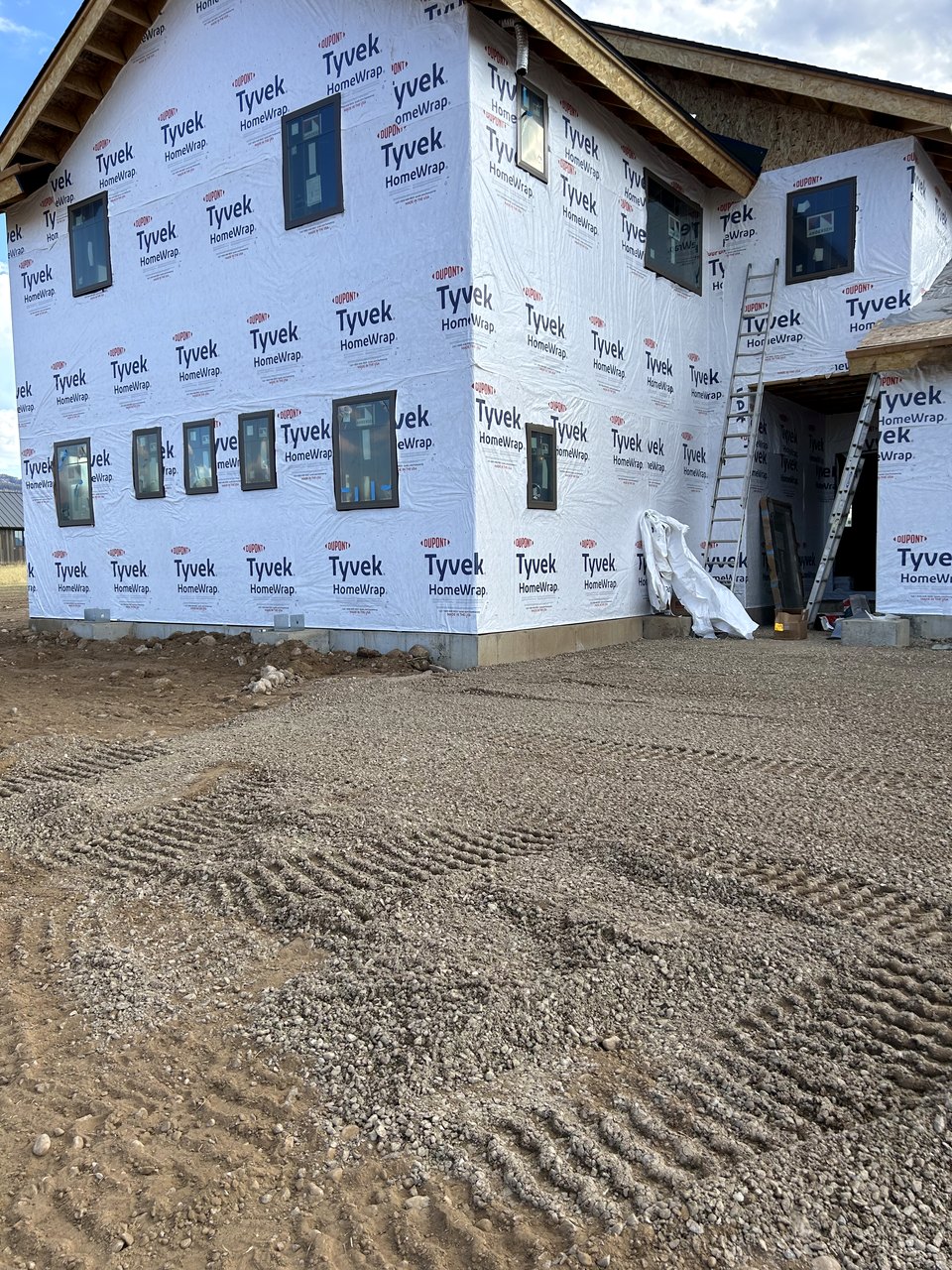
- Detail the air and water barrier properly. The product matters less than the detailing at every window, penetration and transition. We wrote up which weather-resistive barriers hold up in cold Mountain West climates.
- Keep ducts inside conditioned space and size the equipment to the real load. Ducts in a vented attic throw money outside. Oversized equipment short-cycles and never dehumidifies properly.
- Add mechanical ventilation. A tight house needs an HRV or ERV. This is not optional once you’ve sealed the shell — it’s how a tight house stays healthy.
If you want the itemized version of the features themselves, we published a full list of the energy efficient custom home features worth paying for. And for the broader question of which upgrades hold their value, see custom home upgrades worth the money in Idaho.
When is certifying a green custom home actually worth it?
Four situations where I’d tell you to certify:
You’re building from out of state. If you can’t walk the site weekly, an independent rater doing inspections is a second set of eyes you’re paying for anyway. That has value beyond the certificate.
Your lender or appraiser wants it. Some energy-efficient mortgage products and some appraisers will give documented performance real weight. Ask before you assume.
You expect to sell inside ten years. The certificate is a transferable, verifiable asset. If you’re building your last house, it matters much less.
Performance is the actual point of the project. If you want a house that approaches net-zero, the discipline of a program keeps the design honest and stops the target from eroding through value engineering.
Outside those four, I’d generally put the certification money into the envelope and test the result. You get the house either way. You just don’t get the paperwork.
What I do on a Teton Valley build
Twenty years in, here’s how I handle this. We settle the envelope during the design agreement, before there’s a construction price on anything. Wall assembly, window package, air-tightness target, mechanical approach. Those four decisions determine most of what a green custom home costs and nearly all of what it delivers, and they’re almost impossible to change once you’re framing.
You don’t have to go assemble that team yourself. Plan development, architectural drawings, structural and civil engineering coordination, and interior selections all run through us — that’s what the design phase is for, sold as a fixed design fee, quoted per project. Engineering coordination matters more here than most places: snow load, frost depth and wastewater all drive both the schedule and the envelope.
I’m involved in every phase of every build, and there are 24/7 cameras on every job, so you can watch the air sealing happen whether you’re in Driggs or California. Then we test it. A blower door number is a fact. Everything else is a claim.
My straight answer on whether a green custom home is worth it: the performance is worth it every time in this climate. The certification is worth it in the four situations above and is optional everywhere else. Anyone who tells you it’s always worth it is selling the certification, and anyone who tells you it’s never worth it hasn’t paid a February heating bill in Teton Valley.
Questions I get asked about green custom homes
Is a green custom home cheaper to run?
Yes, and in a cold climate the difference is not marginal. The savings come from the envelope and correctly sized mechanical equipment, not from the certification itself. A certified house and an uncertified house built to the same envelope spec will run about the same.
Can you still get a tax credit for building a green home in 2026?
Not the federal 45L credit. It applied to homes acquired before July 1, 2026 and has terminated. State, local or utility programs may still exist and change often — check current offerings and talk to your CPA before counting on anything.
Does a green custom home take longer to build?
Slightly, and mostly in design rather than construction. Certification adds rater inspections that have to be scheduled around framing and insulation, which can add days if they’re not planned for. Decided early, the schedule impact is small.
Do I need solar to call it a green home?
No. Solar is a generation decision, and it belongs after the envelope, not before. Reduce the load first, then size any system to the smaller load. Buying panels to power a leaky house is the expensive way around the problem.
Does a green custom home appraise for more in Idaho?
Sometimes, and it depends heavily on the appraiser and the comps available. Documented, third-party-verified performance gives an appraiser something to work with. An undocumented claim usually gives them nothing. That’s the strongest practical argument for certifying.
Thinking about building one?
If you’re weighing a green custom home in Teton Valley, Eastern Idaho or Jackson Hole, the envelope decisions need to happen in design, not during framing. Get in touch and we’ll talk through what actually makes sense for your lot, your climate exposure and how long you plan to keep the house.
Built different. Built right. Built by SwagerBuilds.