
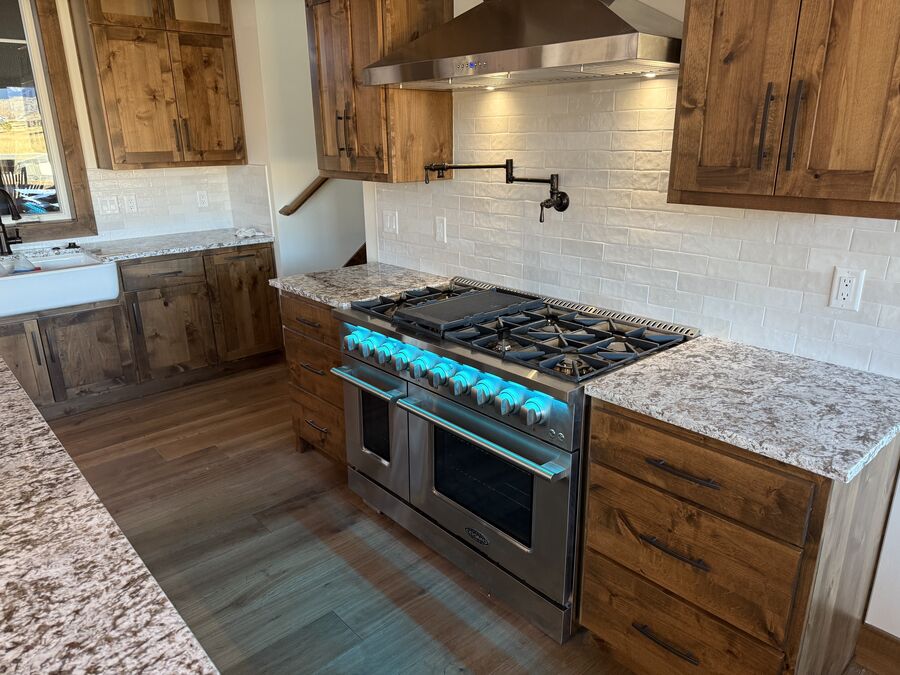
Construction allowances are the most misunderstood line items in a custom home contract — and the place where Idaho budgets most often come apart. If you have read reviews of Teton Valley or Jackson builders complaining that a home cost far more than quoted, construction allowances are usually the culprit. Here is a builder’s plain-English explanation of how construction allowances work, why so many get set too low, and how to keep them from wrecking your budget.
What are construction allowances in a custom home?
Construction allowances are dollar amounts a builder puts in your contract as placeholders for things you have not picked out yet. Think flooring, cabinets, countertops, lighting, plumbing fixtures, tile, and appliances. Instead of pricing the exact items, the builder writes in a number — “$18,000 cabinet allowance” — so the contract can be finished before you have made every selection. That is the legitimate purpose. The problem is what happens when the allowance and reality do not match.
Why builders set construction allowances too low
Builders set construction allowances too low for one simple reason: a lower headline price wins more bids. If three builders quote your home and two come in at $720,000 while one comes in at $640,000, the low number gets the handshake. But if that $640,000 was built on soft allowances — a $9,000 countertop allowance when your kitchen runs 60 square feet of quartz, a $4,000 lighting allowance for a 3,000-square-foot home — you will pay the difference later. The builder is not necessarily dishonest. But a builder who pads allowances down to win is handing you the overrun and calling it your choice.
How vague construction allowances wreck the budget
Vague construction allowances wreck the budget through death by a thousand cuts. Each category goes over a little: cabinets $7,000 hot, flooring $5,000 hot, fixtures $3,000, tile $4,000, appliances $6,000. Individually they feel small. Together they are a $25,000–$60,000 swing on a mid-size Idaho custom home, and they all land after you have committed, when walking away means losing your deposit and your build slot. By the time the overages show up, you have no leverage left.
How to protect your budget from construction allowance surprises
You protect your budget from construction allowance surprises by converting allowances into real prices before you sign. Make your big selections early — cabinets, counters, windows, flooring, appliances — and have the builder price the actual products. Where a true allowance is unavoidable, ask the builder to base it on what real clients actually spend, not a number that makes the bid look good. Get the allowance schedule in writing, line by line, and ask what the markup is on any overage. At SwagerBuilds we would rather lose a bid on an honest number than win it on a soft allowance and fight about it at drywall.
Questions to ask about construction allowances before signing
A few direct questions about construction allowances will tell you everything about a builder. Ask: “Which line items are allowances and which are real prices?” Ask: “What did your last few clients actually spend in each of these categories?” Ask: “If I go over an allowance, what is your markup on the difference?” Ask: “Can we convert these to fixed prices once I make selections?” A builder who prices honestly will welcome the questions. A builder leaning on soft allowances will start hedging — and that hedge is the sound of your future overrun.
The bottom line on construction allowances
Construction allowances are not the enemy — vague ones are. Used honestly, they keep a project moving while you finalize selections. Used to shave a bid, they are a budget bomb with a delayed fuse. The fix is to make as many allowances as possible into real, priced selections before you sign, and to demand realistic numbers on the rest. Clear pricing and detailed scopes are not a luxury; they are the difference between the price you agreed to and the price you actually pay.
Want a custom home quote with real prices instead of vague allowances? Reach out to SwagerBuilds for a fully detailed, line-item scope across Eastern Idaho, Teton Valley, and Jackson Hole.
Leave a Reply