SwagerBuilds LLC · 4510 E 168 N, Rigby, ID 83442 · (208) 520-0636

Tag: Fluid-Applied WRB

  • Fluid-Applied Air and Water Barriers: When Spray-On Beats House Wrap in 2026

    TL;DR: Fluid-applied WRBs are rolled or sprayed onto sheathing and cure into a seamless, monolithic air and water barrier. They cost roughly $0.85-$1.00 per sq ft installed vs $0.25-$0.75 for house wrap. Worth it on high-end custom builds chasing Passive House numbers, on complex geometries where taping a sheet barrier is a nightmare, and on commercial-grade residential. Not the default for a typical custom home.

    What is a fluid-applied WRB?

    A fluid-applied water-resistive barrier is a liquid coating applied to wall sheathing that cures into a continuous, seamless membrane. Most are silyl-terminated polymers (STP) or modified silicones. You spray, roll, or trowel them onto OSB, plywood, or exterior gypsum. The wet membrane cures in hours to a flexible, vapor-permeable, air-tight skin over the entire wall.

    Unlike a stapled sheet membrane, there are no fasteners, no overlaps, and no seams that depend on tape. The barrier is monolithic. That’s the value proposition.

    The leading brands at a glance

    ProductChemistryApplicationCoverageNotable feature
    Prosoco R-Guard Cat 5Silyl-terminated polymer (STP)Spray or roll50–100 sq ft/gal on OSBHurricane-tested to 155+ mph
    Henry Air-Bloc 33MRWater-based elastomericSpray or rollvaries — confirm with supplierUV and fire-resistant; vapor permeable
    Tremco ExoAir 230Monolithic elastomericSpray or roll48 wet mils min (25 dry)Vapor-permeable formulation
    Sto Gold CoatModified acrylicSpray, roll, or trowelvariesCommonly used in EIFS assemblies
    Polywall Blue Barrier Liquid Wrap 2300STPRoll, spray, or brushvariesSingle-component, fast skin
    Carlisle Barritech VPVapor-permeable elastomericSpray or rollvariesCommon on commercial work

    Application: spray vs roll vs trowel

    Spray application is the fastest method on large flat walls. A trained crew with an airless sprayer and the right tip can cover thousands of square feet a day. Setup time and overspray protection are the trade-offs. Roll application is the residential-scale method — a 9″ or 14″ roller with a thick nap handles most wall textures. Trowel application is the path for higher-build products and for detail work at transitions, penetrations, and corners.

    Coverage and cost: real per-sq-ft numbers

    Prosoco Cat 5 covers 50-100 sq ft per gallon on OSB or plywood. At roughly $250-$320 per 5-gallon pail (2026 supplier pricing), material cost runs $0.50-$1.30 per sq ft. Add liquid flashing at openings and the all-in material lands around $0.65-$1.50 per sq ft.

    Labor on a residential build adds $0.30-$0.60 per sq ft when crews are trained. Total installed cost typically lands between $0.85 and $1.50 per sq ft of wall area — meaningfully higher than house wrap at $0.25-$0.75.

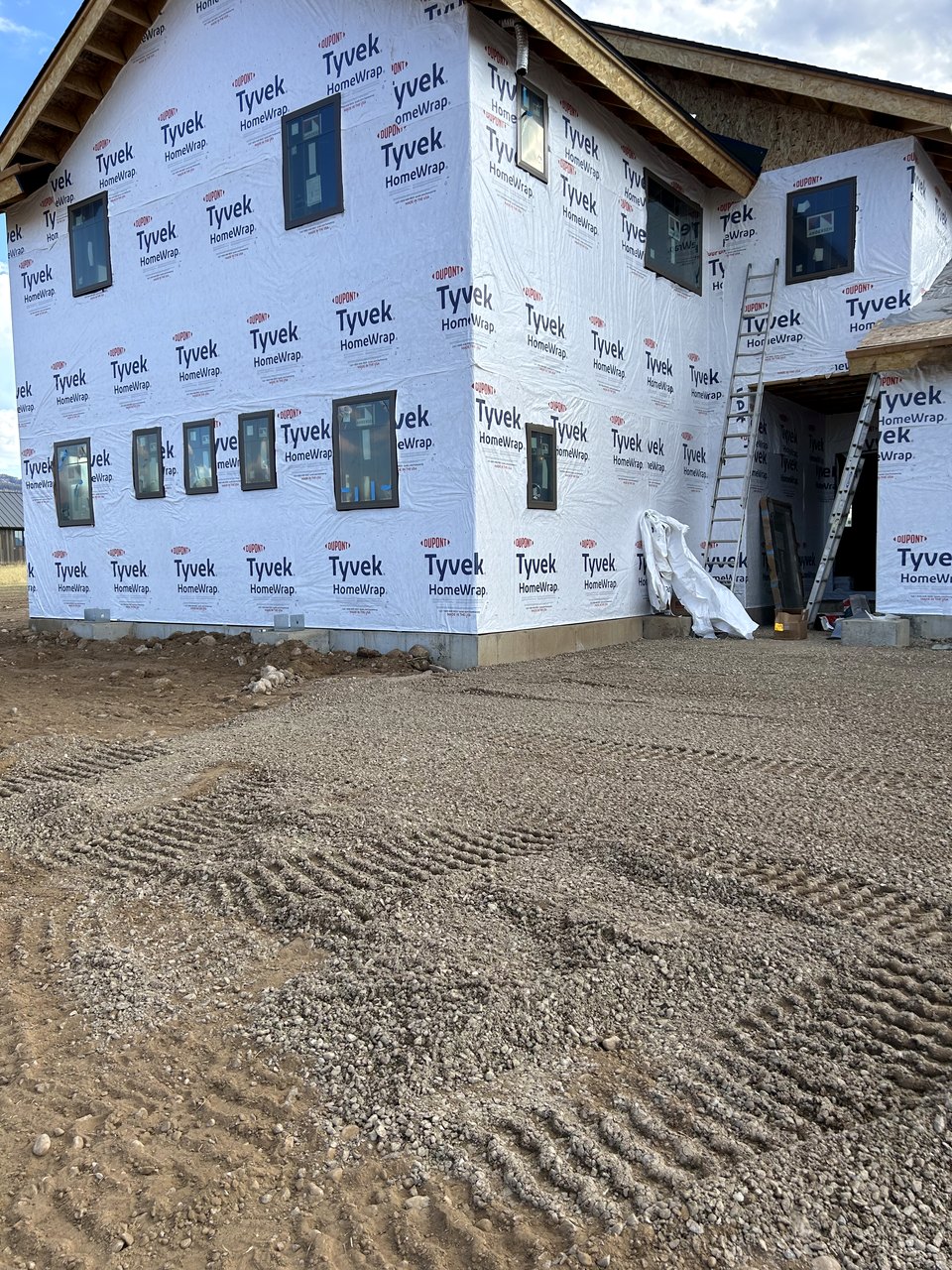
    For a 2,400 sq ft single-story home with 3,000 sq ft of wall area, expect $2,500-$4,500 in installed cost for a fluid-applied air and water barrier over standard OSB sheathing. Compare with $750-$1,200 for Tyvek over OSB.

    Cure time and substrate compatibility

    Most STP fluid-applied products skin in 30-90 minutes and reach full cure in 24-72 hours depending on temperature and humidity. Most work down to roughly 25-40°F — cold weather slows cure and can cause incomplete film formation. Check the data sheet for your specific climate window.

    Substrate compatibility is broader than house wrap. Cat 5 and similar STP products bond to OSB, plywood, exterior gypsum sheathing (DensGlass, GlasRoc), CMU, concrete, and most masonry. That makes them attractive on mixed-substrate assemblies.

    When a fluid-applied WRB makes sense

    • Passive House targets. Hitting 0.6 ACH50 or tighter is easier with a fluid-applied air barrier and the right window detailing.
    • Complex geometry. Walls with lots of corners, jogs, dormers, and transitions are where sheet membranes get cut and patched and taped. A fluid-applied just runs.
    • Mixed substrates. Wood-frame walls meeting CMU stem walls, gypsum-sheathed walls meeting OSB, parapets, complicated foundation transitions — all easier with a single coating system.
    • Commercial-grade residential. When the homeowner is treating the project like a commercial spec, the durability story of a monolithic membrane plays well.

    When we wouldn’t reach for fluid-applied

    • Tight-budget custom build. The cost premium is real.
    • Crew unfamiliar with the product. First-time install with wrong roller nap, wrong cure conditions, or wrong dry-film thickness gives you a worse barrier than a Tyvek wall installed by a crew that’s done it 100 times.
    • Cold-weather schedule risk. If you’re sheathing in January, the temperature window can become a critical-path problem.

    Where we are with it

    From our reading and the reps we’ve talked to, Prosoco Cat 5 is the most builder-friendly fluid-applied for single-family work in the Mountain West. It rolls well, the data sheet is clear, and it integrates with companion products for window flashing. We have not specified Cat 5 on a SwagerBuilds project yet — most of our builds have not penciled for the premium — but it’s the system we’d reach for when a homeowner wants Passive-House-level air-tightness on a Teton Valley custom build.

    FAQ

    What is a fluid-applied WRB?

    A liquid coating sprayed or rolled onto sheathing that cures into a seamless, monolithic water-resistive and air barrier. Common products include Prosoco Cat 5, Henry Air-Bloc 33MR, and Tremco ExoAir 230.

    How much does Prosoco Cat 5 cost?

    Material cost runs roughly $250-$320 per 5-gallon pail in 2026 supplier pricing. Coverage is 50-100 sq ft per gallon on OSB. All-in installed cost is typically $0.85-$1.50 per sq ft of wall area.

    Is a fluid-applied air barrier worth it for a custom home?

    It pays back on builds chasing Passive House numbers, on complex geometries, and on long-term-hold properties. On a typical custom build with rectangular walls, ZIP System or Tyvek with good flashing usually pencils better.

    Can I spray a fluid-applied WRB myself?

    Yes for trained applicators, but variables like wet mil thickness, cure conditions, and substrate prep are not forgiving. First-timers should get manufacturer rep support or hire a trained sub.

    What substrates work with fluid-applied air barriers?

    Most STP-based products bond to OSB, plywood, exterior gypsum sheathing, CMU, concrete, and most masonry.

    What’s the cure time?

    Most products skin in 30-90 minutes and reach full cure in 24-72 hours depending on temperature and humidity.

    Want to talk through the math?

    If you’re a homeowner trying to weigh a fluid-applied air barrier against ZIP or stapled house wrap on a Teton Valley build, give us a call. Contact SwagerBuilds.

    Related: pillar guide, cost in 2026, best WRB for Idaho.

  • What Does Exterior Waterproofing Cost in 2026? Real Numbers from a Builder

    TL;DR: Real exterior waterproofing cost in 2026: on a 2,400 sq ft single-story home with roughly 3,000 sq ft of wall area, exterior waterproofing runs roughly $750-$1,200 for house wrap + tape over standard OSB, $4,500-$6,000 for ZIP System (panels + tape + liquid flash), and $2,500-$4,500 for a fluid-applied air barrier over standard sheathing. Labor varies. Numbers below reflect 2026 supplier conversations in eastern Idaho.

    How to estimate your exterior waterproofing cost

    The exterior waterproofing line covers four things: the sheathing, the WRB, the seam and flashing materials, and the labor to install all three. Bids often roll some of those costs into “framing” or “exterior trim,” which makes it hard to compare systems apples-to-apples. Ask your builder to break out the WRB choice as its own line.

    Material costs by system

    Tyvek HomeWrap over standard OSB

    • 7/16″ 4×8 OSB: $14-$18 per sheet
    • Tyvek HomeWrap 9’×100′ roll: $180-$240 (varies by retailer and volume)
    • Tyvek tape 1.88″ × 165′: $20-$30 per roll
    • Sheathing staples and cap fasteners: $20-$40 per home

    ZIP System wall

    • 7/16″ 4×8 ZIP wall panel: $20-$28 per sheet (varies by volume)
    • ZIP tape 3.75″ × 90′: $35-$50 per roll
    • ZIP Stretch tape 6″ × 50′: $50-$75 per roll
    • ZIP Liquid Flash 20-oz tube: $40-$55
    • Cold-weather ZIP tape (when needed): premium of $5-$15 per roll

    LP WeatherLogic

    • 7/16″ 4×8 WeatherLogic panel: typically $2-$4 less than ZIP per sheet
    • LP acrylic seam tape: $25-$40 per roll

    Fluid-applied (Prosoco Cat 5 as the reference)

    • Cat 5 5-gallon pail: $250-$320 (covers 250-500 sq ft on OSB)
    • Prosoco companion liquid flashing (FastFlash): $40-$60 per 20-oz tube
    • Backup OSB sheathing required underneath: $14-$18 per sheet

    These are 2026 prices observed at supplier counters in eastern Idaho. For supplemental cost data, Fine Homebuilding publishes annual construction cost surveys. Confirm with your local supplier — OSB markets move fast.

    Labor costs (rough hours per system)

    SystemSheathing hours (3,000 sq ft wall)WRB hoursTape/flash hours
    OSB + Tyvek16–248–124–8
    ZIP System16–24integrated10–16
    OSB + fluid-applied16–24integrated16–28 (spray/roll + cure)

    At a loaded labor rate of $55–$75 per hour for a framing carpenter, total labor on the exterior envelope lands between $1,500 and $3,500 depending on system and crew familiarity.

    Real-numbers example: 2,400 sq ft home in Teton Valley

    Single-story 2,400 sq ft custom home. Roughly 3,000 sq ft of exterior wall area. Roughly 110 sheets of 4×8 sheathing.

    SystemMaterialsLaborTotal installed
    OSB + Tyvek HomeWrap$1,900-$2,500$1,500-$2,500$3,400-$5,000
    ZIP System$3,000-$4,200$1,500-$3,000$4,500-$7,200
    LP WeatherLogic$2,800-$3,800$1,500-$3,000$4,300-$6,800
    OSB + Prosoco Cat 5$3,200-$4,500$2,500-$4,000$5,700-$8,500

    Net premium over Tyvek + OSB:

    • ZIP: $1,100-$2,200 net
    • WeatherLogic: $900-$1,800 net
    • Fluid-applied (Cat 5): $2,300-$3,500 net

    Where the “ZIP saves labor” claim is and isn’t true

    Huber’s marketing talks about 25-30% labor savings on the exterior envelope vs OSB + house wrap. That number is real on a crew that’s installed ZIP many times and on a wall geometry that lets them tape on the deck before raising. On a first-time install or a complex wall plan with lots of corners and openings, the labor savings shrinks toward zero. Bid on what your specific crew can actually deliver.

    ROI: does a better WRB pay back?

    Two real ROI levers. First: energy savings from tighter air sealing. A typical custom build tightened from 3-5 ACH50 (standard) to 1.5-2.5 ACH50 (ZIP done well) saves roughly 8-15% of annual heating and cooling cost. At $2,500-$3,500 annual energy on a Teton Valley custom home, that’s $200-$525 per year. Simple payback on a $2,000-$3,000 ZIP premium: 5-10 years. Second: avoided moisture damage. Harder to quantify but real. A WRB and flashing system that holds for 30 years prevents the $20,000-$80,000 wall reskin a failed envelope can trigger.

    FAQ

    How much does ZIP System add to a custom home?

    Net premium over Tyvek + OSB runs $1,100-$2,200 on a 2,400 sq ft single-story home in 2026 eastern Idaho pricing. The premium scales roughly with wall area.

    How much does a fluid-applied air barrier cost?

    Net premium over Tyvek + OSB runs $2,300-$3,500 on a 2,400 sq ft home. Material cost is $0.65-$1.50 per sq ft of wall area. Installed cost is $0.85-$1.50 per sq ft.

    Is the ZIP labor savings claim real?

    On trained crews and rectangular wall geometry, yes — 25-30% labor savings is achievable. On first-time installs or complex wall plans, the savings shrink.

    Does a better WRB lower energy bills?

    Yes, modestly. A custom home tightened from 3-5 ACH50 to 1.5-2.5 ACH50 saves 8-15% on annual heating and cooling. On a typical Teton Valley custom home, $200-$525 per year.

    How much of my build budget should go to exterior waterproofing?

    Roughly 1-2% of the construction budget on a typical custom build. On a $1.2M home, $12,000-$24,000 across sheathing, WRB, tape, and flashing combined.

    Is a more expensive WRB always worth it?

    No. A well-installed budget system beats a poorly-installed premium system every time. Spend the premium on install quality first, product premium second.

    Want a real bid breakdown?

    If you’d like SwagerBuilds to walk through the exterior waterproofing line on your build, give us a call. Contact us.

    Related: pillar guide, ZIP vs Tyvek, fluid-applied guide.

  • The Builder’s Guide to Exterior Waterproofing: Choosing Your WRB in 2026

    TL;DR: Exterior waterproofing — picking the right water-resistive barrier and air barrier — is one of the most important decisions in your build. Every modern wall needs a water-resistive barrier and an air barrier — sometimes the same product does both. The right choice depends on building type, climate, budget, and how forgiving you want the install to be. ZIP and LP WeatherLogic combine sheathing and WRB into one panel. Tyvek is the proven stapled house wrap. Fluid-applied is the premium air barrier for high-performance builds. This guide walks through how a custom builder actually picks.

    What is a water-resistive barrier (WRB) and why does every home need one?

    A water-resistive barrier is the layer in your wall assembly that keeps bulk water — wind-driven rain, snowmelt running down the sheathing, condensation — from reaching the framing and insulation. Without one, your wall will rot from the outside in. Modern building code (IRC Section R703.1) requires a WRB on every exterior wall.

    An air barrier is a different job: it stops air from leaking in and out of the wall. Air carries moisture, so a leaky wall is also a wet wall. Some products do one job. Some do both.

    The cleanest way to think about it: the WRB stops liquid water from getting in. The air barrier stops energy (and the water vapor that hitchhikes on it) from sneaking through. A well-built wall has both. For a deeper dive, Building Science Corporation publishes some of the clearest WRB and air-barrier research available.

    The four categories of exterior waterproofing

    The products on the market fall into four buckets:

    1. Mechanically-attached house wraps — Tyvek HomeWrap, Typar, Barricade. A sheet membrane stapled over sheathing. The proven workhorse.
    2. Integrated structural sheathing — Huber ZIP System, LP WeatherLogic. OSB with a factory-bonded WRB face. Tape the seams and you have sheathing + WRB + air barrier in one product.
    3. Fluid-applied WRBs — Prosoco R-Guard Cat 5, Henry Air-Bloc 33MR, Tremco ExoAir 230, Sto Gold Coat, Polywall Blue Barrier. Rolled or sprayed onto sheathing, cures into a seamless air and water barrier.
    4. Self-adhered membranes — VaproShield, Henry Blueskin, Carlisle Barritech VP. Peel-and-stick sheets. Common on commercial work, occasionally specced on high-performance residential.

    The four products that cover 90% of custom-home decisions in 2026

    Almost every custom home in 2026 is going to use one of four systems: Tyvek over OSB, ZIP System, LP WeatherLogic, or a fluid-applied air barrier over OSB. Here’s how they compare on the specs that actually matter.

    SystemWhat it isPerm ratingMax UV exposureTypical $/sq ft installedBest use
    Tyvek HomeWrap + OSBSheet membrane stapled over standard sheathing~56 perms (high)120 days$0.25–$0.75Production homes, remodels, budget-conscious custom builds
    Huber ZIP SystemOSB with factory-bonded WRB + seam tape12–16 perms180 days$1.50–$2.50Custom homes chasing air-tightness and a faster dry-in
    LP WeatherLogicOSB with SmartSide WRB face + seam tape5.35 perms180 days$1.25–$2.25Custom homes where supplier carries LP, often slightly cheaper than ZIP
    Fluid-applied (Cat 5, Air-Bloc, ExoAir)Roller- or spray-applied seamless membrane over OSBvaries — most 10–25 permsvaries by product$0.85–$1.00 (material + labor over OSB)Passive House targets, complex geometries, commercial-grade residential

    Prices reflect 2026 supplier conversations in eastern Idaho. Confirm with your supplier — these move with OSB and resin markets.

    How to actually pick: the decision matrix

    Builders don’t pick a WRB in a vacuum. The decision is three-dimensional: building type × climate × budget. Here’s the shortcut.

    • If you’re building a tight custom home in a cold climate and chasing low ACH numbers: ZIP System or a fluid-applied air barrier. The integrated WRB and air barrier earn their cost back in blower-door results.
    • If you’re building a custom home in a mixed climate on a normal budget: Tyvek HomeWrap or CommercialWrap over standard OSB. Reliable, forgiving, repairable.
    • If you’re building under stucco, fiber cement, or any reservoir cladding: Tyvek DrainWrap or CommercialWrap D. The drainage face matters more than the WRB itself.
    • If you’re building a barndominium or shop home with metal siding: Tyvek HomeWrap or ZIP, with extra attention to the tape and the screw penetrations.
    • If you’re chasing Passive House numbers or building something with crazy geometry: Fluid-applied. Seamless wins.

    The questions to ask before you specify any WRB

    Before you let your builder lock in a WRB, get answers to five questions. These flush out whether the system was actually chosen for the build or chosen because it’s what the lumberyard had on the truck.

    1. What’s the perm rating, and is that the right number for our climate?
    2. How long will it sit exposed before siding goes on, and is that within the manufacturer’s UV limit?
    3. What’s the tape or sealant system, and has the crew installed it before?
    4. How does it integrate with the window flashing details?
    5. What’s the warranty, and what voids it?

    What we spec at SwagerBuilds — and why

    On most of our Teton Valley custom builds, we lean toward ZIP System for the wall sheathing. The cold dry winters here want a vapor-permeable WRB that lets the wall dry outward, ZIP’s 12–16 perm rating fits, and the integrated air barrier helps us hit better blower-door numbers without specifying a separate fluid-applied product. On budget-conscious builds and on remodels where we’re tying into existing framing, Tyvek HomeWrap with proper flashing earns its keep. We’ve also been having more conversations with homeowners about Prosoco Cat 5 on the high-performance end — the math gets interesting on a Passive-House-curious build.

    The honest answer is that the WRB is one decision in a system. The window flashing, the rain screen detail, the air-sealing at the rim joist — all of that matters as much as the brand on the wall. If a builder tells you ZIP is “the only right answer” or that Tyvek is “outdated,” you’re not getting a builder’s take. You’re getting a sales pitch.

    FAQ

    What is the best water-resistive barrier for a custom home in 2026?

    There is no single best WRB. For a typical custom home in a cold mountain climate, ZIP System or Tyvek HomeWrap over standard OSB both work. ZIP gives a tighter air barrier when the tape is installed correctly. Tyvek is more forgiving and costs less. The right pick depends on climate, cladding, budget, and crew experience.

    Do I need both an air barrier and a water barrier?

    Yes. The water-resistive barrier keeps liquid water out of the wall. The air barrier keeps air (which carries water vapor) from leaking through. Some products do both jobs — ZIP System and fluid-applied membranes are common dual-purpose options. House wrap is primarily a water barrier; treating it as an air barrier requires meticulous taping that most jobsites skip.

    Is ZIP System better than Tyvek?

    ZIP System is faster to install and air-seals better when the tape is applied correctly. Tyvek is cheaper, more forgiving, and easier to repair. Neither is universally “better.” See our ZIP vs Tyvek head-to-head for the spec-by-spec read.

    What is the difference between a structural sheathing system and house wrap?

    Structural sheathing systems like ZIP and LP WeatherLogic combine the wall sheathing and the water-resistive barrier into one panel. Conventional framing uses OSB or plywood sheathing plus a separate house wrap stapled over the top. The integrated systems save a labor step; the conventional approach is cheaper in materials and easier to repair.

    How long can a WRB be left exposed before siding goes on?

    Tyvek HomeWrap is rated for 120 days of UV exposure. ZIP System has a 180-day exposure guarantee. LP WeatherLogic is also rated at 180 days. Fluid-applied products vary by formulation — check the data sheet. Exceeding the exposure window doesn’t guarantee failure but it does void the manufacturer warranty.

    Does an integrated sheathing system replace house wrap?

    Yes. When ZIP System or LP WeatherLogic is installed and taped per the manufacturer instructions, it functions as the code-required water-resistive barrier. Adding a layer of house wrap on top is not recommended — it can trap moisture against the sheathing face.

    Want this for your build?

    SwagerBuilds is based in Teton Valley, Idaho. We build custom homes in Driggs, Victor, Tetonia, and the surrounding corridor. If you’re trying to figure out the right WRB for a build, we’re happy to walk through it on the phone. Get in touch.