SwagerBuilds LLC · 4510 E 168 N, Rigby, ID 83442 · (208) 520-0636

Tag: House Wrap

  • DuPont Tyvek HomeWrap, CommercialWrap, DrainWrap: 5 Variants Compared (2026)

    TL;DR: Tyvek HomeWrap is the standard residential house wrap. CommercialWrap is more durable with longer UV exposure. CommercialWrap D and DrainWrap add ≥98% drainage efficiency — important under stucco, fiber cement, and any reservoir cladding. ThermaWrap LE adds a reflective face for radiant heat. Pick by cladding type, not by what your lumberyard pushes.

    Why “Tyvek” is not one product

    Builders use “Tyvek” the same way people use “Kleenex” — as a generic term for house wrap. But DuPont sells five distinct Tyvek products for residential and light commercial walls. They’re not interchangeable. Pick the wrong one and your stucco wall has nowhere for bulk water to escape. Pick the right one and you’ve added a $300-$800 line to the bid that pays back for the life of the building.

    Tyvek HomeWrap — the residential standard

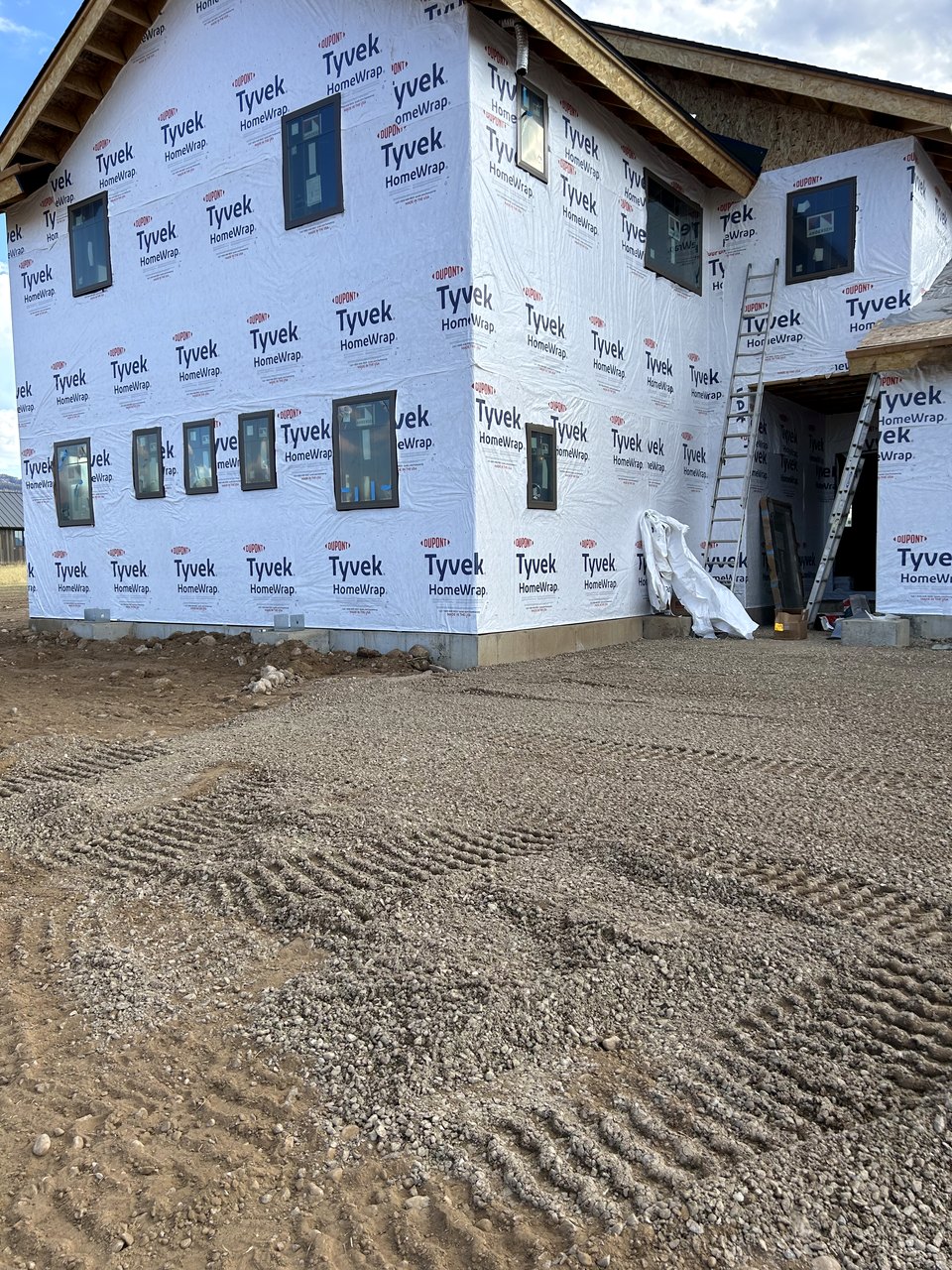
    HomeWrap is the entry point. A spunbonded polyethylene non-woven membrane stapled over OSB or plywood sheathing. Greater than 90% drainage efficiency per ASTM E2273. 120-day UV exposure limit. Meets ASTM E2556 Type II for vapor-permeable WRBs. This is the right call for most residential cladding situations — lap siding, board-and-batten, vinyl, metal panel — where the cladding sheds the bulk of the water.

    Tyvek CommercialWrap and CommercialWrap D — when to step up

    CommercialWrap is engineered for the rougher world of commercial construction — longer exposure, heavier abrasion, more demanding flashing details. UV exposure is rated at 9 months. Drainage efficiency is greater than 90%. CommercialWrap D adds greater than 98% drainage efficiency. The “D” stands for drainage. This is the wrap to spec when the cladding holds water against the wall — stucco, adhered manufactured stone, fiber cement in heavy rain regions.

    Tyvek DrainWrap — the drainage variant explained

    DrainWrap is HomeWrap with vertical grooves embossed into the surface. The grooves create a physical channel for bulk water to drain down and out the bottom of the wall instead of pooling against the sheathing. Greater than 98% drainage efficiency. UV exposure is 4 months. Spec DrainWrap under any cladding that can hold or store moisture: three-coat stucco, manufactured stone, fiber cement in wet climates, engineered wood lap siding without a separate rain screen.

    Tyvek ThermaWrap LE — when radiant heat matters

    ThermaWrap LE has a metallized reflective face designed to reflect radiant heat. It’s a high-permeability wrap that meets ASTM E2556 Type II. The application is specific: hot, sunny climates where reflecting solar gain off the wall is worth the cost upgrade, or assemblies that want a low-emissivity face inside a ventilated rain screen cavity. On a Teton Valley build, rarely the right call. On a desert Southwest build, it pencils.

    The most common Tyvek install mistakes

    • Reverse overlaps. Tyvek needs to lap shingle-style — upper sheet over lower sheet, by at least 6″. Reversed laps direct water into the wall.
    • No tape on the seams. Code allows stapled overlaps in some jurisdictions, but DuPont’s documented assembly uses Tyvek tape on horizontal seams to make the wrap function as both WRB and air barrier.
    • Unflashed window head. The window head is where water that runs down meets a horizontal interruption. Without head flashing lapped over the wrap, water finds the framing.
    • UV exposure past the rating. 120 days HomeWrap, 9 months CommercialWrap, 4 months DrainWrap. Past those windows the warranty is void.
    • Tucked instead of lapped at sill plates. Wrap needs to lap over the foundation flashing, not tuck behind it.

    Which Tyvek for which siding

    CladdingRecommended TyvekWhy
    Lap siding (LP SmartSide, James Hardie, wood)HomeWrapCladding sheds water; standard WRB sufficient
    Vertical siding (board-and-batten, metal panel)HomeWrapDrainage gap from cladding profile usually adequate
    Traditional 3-coat stuccoDrainWrap or CommercialWrap DStucco holds water; needs documented drainage plane
    Manufactured stone / adhered veneerDrainWrap, two layers per codeReservoir cladding; code typically requires two WRB layers behind
    Fiber cement in heavy rainDrainWrap or CommercialWrap DDrainage improves wall durability in wet conditions
    Metal siding on a barndo or shop homeHomeWrapCladding sheds; ribbed profile provides drainage

    What we spec at SwagerBuilds

    On most Teton Valley custom homes with lap or vertical siding, we run Tyvek HomeWrap with rigorous attention to the flashing details — that’s where wraps actually fail. On any build with stucco, manufactured stone, or stone veneer accents, we step up to DrainWrap. The cost upgrade is roughly $0.10–$0.15 per sq ft of wall area, and it removes a real long-term moisture risk.

    FAQ

    What’s the difference between Tyvek HomeWrap and CommercialWrap?

    HomeWrap is the residential standard with a 120-day UV exposure rating. CommercialWrap is heavier-duty with a 9-month UV rating and is engineered for commercial-grade abrasion. Both are 90%+ drainage efficient.

    Do I need DrainWrap or is HomeWrap enough?

    Spec DrainWrap if your cladding holds water — three-coat stucco, manufactured stone, fiber cement in wet climates. For lap siding, board-and-batten, metal panel, or vinyl, HomeWrap is sufficient.

    How long can Tyvek be left exposed before siding goes on?

    HomeWrap: 120 days. CommercialWrap: 9 months. CommercialWrap D: 9 months. DrainWrap: 4 months. Exceeding the limit voids the warranty.

    What’s Tyvek’s perm rating?

    Tyvek HomeWrap is rated at roughly 56 perms — very high permeability. All Tyvek wall wraps meet ASTM E2556 Type II.

    Can I install Tyvek under metal siding on a barndominium?

    Yes. Tyvek HomeWrap is a standard pairing with ribbed metal cladding on a barndo. The ribbed profile provides drainage channels. Attention to fastener-penetration sealing matters.

    What’s the most common Tyvek install mistake?

    Reverse overlap. Tyvek needs to lap shingle-style with upper sheets over lower sheets. A reversed overlap directs water into the wall.

    Need help picking?

    If you’re trying to decide which Tyvek variant fits your cladding, give us a call. Contact SwagerBuilds.

    Related: pillar guide, ZIP vs Tyvek, best WRB for Idaho.

  • ZIP System vs Tyvek: A Builder’s Honest Comparison

    TL;DR: ZIP System vs Tyvek is the most-asked WRB question in custom homebuilding. The short version: ZIP System is OSB sheathing with the water-resistive barrier built in. Tyvek is a separate house wrap stapled over standard OSB. ZIP saves a labor step and gives a tighter air barrier when taped right. Tyvek is more forgiving, less expensive, and easier to repair. Custom builds chasing air-tightness lean ZIP. Production builds and remodels lean Tyvek.

    ZIP System vs Tyvek: the 30-second answer

    Both products work when installed correctly. Both fail when installed badly. ZIP costs more upfront and earns it back in labor and air-tightness on a build that values both. Tyvek costs less upfront and stays more forgiving in real-world site conditions. The right answer is build-specific.

    What ZIP System actually is

    ZIP System is structural OSB sheathing with a resin-impregnated water-resistive barrier bonded to the panel face at the factory. The seams are sealed with Huber’s acrylic ZIP tape. Once installed and taped per spec, the assembly functions as the wall sheathing, the WRB, and the air barrier in one product. Permeability is 12-16 perms. Maximum exposure is 180 days. Warranty is 30 years on the assembly.

    What Tyvek actually is

    Tyvek is a spunbonded polyethylene sheet membrane stapled over standard OSB or plywood sheathing. The Tyvek line includes HomeWrap (the residential standard), CommercialWrap, DrainWrap, and ThermaWrap LE. All meet ASTM E2556 Type II for vapor-permeable WRBs. HomeWrap permeability is roughly 56 perms — higher than ZIP. Maximum UV exposure is 120 days for HomeWrap.

    Side-by-side: 8 specs that matter

    SpecZIP SystemTyvek HomeWrap + OSB
    Structural sheathingIntegratedSeparate OSB
    WRBFactory-applied on panel faceStapled sheet over OSB
    Air barrierYes, when tapedPossible with rigorous taping, often not achieved on a typical jobsite
    Perm rating12–16 perms~56 perms
    Max UV exposure180 days120 days
    Warranty30-year limited10-year limited (DuPont)
    Cost per sq ft installed$1.50–$2.50$0.25–$0.75
    Repair difficultyHard — requires panel + tapeEasy — patch with Tyvek tape

    Where ZIP fails

    • Tape peeling. The acrylic tape only adheres long-term when it’s rolled. Crews that skip the roller see peeling within weeks.
    • Cut-edge swelling. Exposed OSB at panel cuts can swell if it gets wet. Mitigated by tape or liquid flashing.
    • Cold-temperature tape application. Below Huber’s cold-weather window, the tape doesn’t bond. Cold-weather formulation exists but the install gets harder.
    • Repair after damage. A panel that’s been damaged after taping is harder to swap than re-cutting a section of stapled house wrap.

    Where Tyvek fails

    • Reverse overlaps. Stapled in the wrong direction, the wrap directs water into the wall.
    • UV degradation past 120 days. Builds with slow siding starts can exceed HomeWrap’s exposure window. Step up to CommercialWrap if delay is likely.
    • Sloppy taping makes it a poor air barrier. Most jobsites don’t tape Tyvek to the standard required for it to function as an air barrier.
    • Unflashed openings. Wraps fail at the window head when there’s no head flashing.

    The cost difference on a 2,400 sq ft home

    For a 2,400 sq ft single-story home with about 3,000 sq ft of wall area, Tyvek + OSB runs $750-$1,200 in materials. ZIP System runs $4,500-$6,000 in materials. Net premium for ZIP over Tyvek typically lands at $2,500-$4,500 after factoring in labor savings on the integrated system.

    When we’d pick ZIP

    • Custom home on a normal schedule with a homeowner who values air-tightness.
    • Builds chasing better-than-code blower-door results without specifying a separate fluid-applied product.
    • Crew that’s installed ZIP before and rolls the tape.

    When we’d pick Tyvek

    • Budget-conscious custom builds where the premium doesn’t pencil.
    • Remodels and additions that tie into existing OSB sheathing.
    • Crews unfamiliar with ZIP tape — better to do Tyvek well than ZIP badly.
    • Cladding that needs the higher drainage efficiency of a specific Tyvek variant (DrainWrap under stucco, CommercialWrap D under heavy cladding).

    FAQ

    Is ZIP System better than Tyvek?

    ZIP System is faster to install and air-seals better when the tape is applied correctly. Tyvek is cheaper, more forgiving, and easier to repair. Neither is universally better — the right pick depends on the build, the crew, and the budget.

    Is ZIP System worth the extra cost over Tyvek?

    On a custom home where the homeowner cares about air-tightness and energy performance, usually yes. Net premium runs $2,500-$4,500 on a typical 2,400 sq ft home. On budget builds and remodels, Tyvek with careful flashing is often the better-value answer.

    Do I need house wrap if I have ZIP System?

    No. ZIP System is the code-required WRB when installed and taped per the manufacturer instructions. Adding house wrap on top is discouraged — it can trap moisture against the ZIP face.

    Which has the better warranty, ZIP or Tyvek?

    ZIP System carries a 30-year limited warranty on the assembly. Tyvek HomeWrap typically carries a 10-year limited warranty. Both have install-quality conditions that can void the warranty.

    Can ZIP System get wet during construction?

    Yes. ZIP’s 180-day exposure guarantee covers the panel and taped seams against UV and weather exposure for six months. Cut edges and exposed OSB at openings should be sealed with ZIP tape or ZIP Liquid Flash.

    Which is easier to install, ZIP or Tyvek?

    Tyvek is easier — staple a sheet membrane. ZIP requires more precision on tape application but eliminates the separate wrap step entirely.

    What’s the perm rating difference?

    ZIP measures 12-16 perms. Tyvek HomeWrap measures roughly 56 perms. Both qualify as high-permeability WRBs.

    Talk to a builder, not a sales rep

    If you’re a homeowner trying to decide between ZIP and Tyvek on a Teton Valley build, give us a call. Contact SwagerBuilds.

    Related: pillar guide, Huber ZIP deep dive, Tyvek variants, cost in 2026.

  • The Builder’s Guide to Exterior Waterproofing: Choosing Your WRB in 2026

    TL;DR: Exterior waterproofing — picking the right water-resistive barrier and air barrier — is one of the most important decisions in your build. Every modern wall needs a water-resistive barrier and an air barrier — sometimes the same product does both. The right choice depends on building type, climate, budget, and how forgiving you want the install to be. ZIP and LP WeatherLogic combine sheathing and WRB into one panel. Tyvek is the proven stapled house wrap. Fluid-applied is the premium air barrier for high-performance builds. This guide walks through how a custom builder actually picks.

    What is a water-resistive barrier (WRB) and why does every home need one?

    A water-resistive barrier is the layer in your wall assembly that keeps bulk water — wind-driven rain, snowmelt running down the sheathing, condensation — from reaching the framing and insulation. Without one, your wall will rot from the outside in. Modern building code (IRC Section R703.1) requires a WRB on every exterior wall.

    An air barrier is a different job: it stops air from leaking in and out of the wall. Air carries moisture, so a leaky wall is also a wet wall. Some products do one job. Some do both.

    The cleanest way to think about it: the WRB stops liquid water from getting in. The air barrier stops energy (and the water vapor that hitchhikes on it) from sneaking through. A well-built wall has both. For a deeper dive, Building Science Corporation publishes some of the clearest WRB and air-barrier research available.

    The four categories of exterior waterproofing

    The products on the market fall into four buckets:

    1. Mechanically-attached house wraps — Tyvek HomeWrap, Typar, Barricade. A sheet membrane stapled over sheathing. The proven workhorse.
    2. Integrated structural sheathing — Huber ZIP System, LP WeatherLogic. OSB with a factory-bonded WRB face. Tape the seams and you have sheathing + WRB + air barrier in one product.
    3. Fluid-applied WRBs — Prosoco R-Guard Cat 5, Henry Air-Bloc 33MR, Tremco ExoAir 230, Sto Gold Coat, Polywall Blue Barrier. Rolled or sprayed onto sheathing, cures into a seamless air and water barrier.
    4. Self-adhered membranes — VaproShield, Henry Blueskin, Carlisle Barritech VP. Peel-and-stick sheets. Common on commercial work, occasionally specced on high-performance residential.

    The four products that cover 90% of custom-home decisions in 2026

    Almost every custom home in 2026 is going to use one of four systems: Tyvek over OSB, ZIP System, LP WeatherLogic, or a fluid-applied air barrier over OSB. Here’s how they compare on the specs that actually matter.

    SystemWhat it isPerm ratingMax UV exposureTypical $/sq ft installedBest use
    Tyvek HomeWrap + OSBSheet membrane stapled over standard sheathing~56 perms (high)120 days$0.25–$0.75Production homes, remodels, budget-conscious custom builds
    Huber ZIP SystemOSB with factory-bonded WRB + seam tape12–16 perms180 days$1.50–$2.50Custom homes chasing air-tightness and a faster dry-in
    LP WeatherLogicOSB with SmartSide WRB face + seam tape5.35 perms180 days$1.25–$2.25Custom homes where supplier carries LP, often slightly cheaper than ZIP
    Fluid-applied (Cat 5, Air-Bloc, ExoAir)Roller- or spray-applied seamless membrane over OSBvaries — most 10–25 permsvaries by product$0.85–$1.00 (material + labor over OSB)Passive House targets, complex geometries, commercial-grade residential

    Prices reflect 2026 supplier conversations in eastern Idaho. Confirm with your supplier — these move with OSB and resin markets.

    How to actually pick: the decision matrix

    Builders don’t pick a WRB in a vacuum. The decision is three-dimensional: building type × climate × budget. Here’s the shortcut.

    • If you’re building a tight custom home in a cold climate and chasing low ACH numbers: ZIP System or a fluid-applied air barrier. The integrated WRB and air barrier earn their cost back in blower-door results.
    • If you’re building a custom home in a mixed climate on a normal budget: Tyvek HomeWrap or CommercialWrap over standard OSB. Reliable, forgiving, repairable.
    • If you’re building under stucco, fiber cement, or any reservoir cladding: Tyvek DrainWrap or CommercialWrap D. The drainage face matters more than the WRB itself.
    • If you’re building a barndominium or shop home with metal siding: Tyvek HomeWrap or ZIP, with extra attention to the tape and the screw penetrations.
    • If you’re chasing Passive House numbers or building something with crazy geometry: Fluid-applied. Seamless wins.

    The questions to ask before you specify any WRB

    Before you let your builder lock in a WRB, get answers to five questions. These flush out whether the system was actually chosen for the build or chosen because it’s what the lumberyard had on the truck.

    1. What’s the perm rating, and is that the right number for our climate?
    2. How long will it sit exposed before siding goes on, and is that within the manufacturer’s UV limit?
    3. What’s the tape or sealant system, and has the crew installed it before?
    4. How does it integrate with the window flashing details?
    5. What’s the warranty, and what voids it?

    What we spec at SwagerBuilds — and why

    On most of our Teton Valley custom builds, we lean toward ZIP System for the wall sheathing. The cold dry winters here want a vapor-permeable WRB that lets the wall dry outward, ZIP’s 12–16 perm rating fits, and the integrated air barrier helps us hit better blower-door numbers without specifying a separate fluid-applied product. On budget-conscious builds and on remodels where we’re tying into existing framing, Tyvek HomeWrap with proper flashing earns its keep. We’ve also been having more conversations with homeowners about Prosoco Cat 5 on the high-performance end — the math gets interesting on a Passive-House-curious build.

    The honest answer is that the WRB is one decision in a system. The window flashing, the rain screen detail, the air-sealing at the rim joist — all of that matters as much as the brand on the wall. If a builder tells you ZIP is “the only right answer” or that Tyvek is “outdated,” you’re not getting a builder’s take. You’re getting a sales pitch.

    FAQ

    What is the best water-resistive barrier for a custom home in 2026?

    There is no single best WRB. For a typical custom home in a cold mountain climate, ZIP System or Tyvek HomeWrap over standard OSB both work. ZIP gives a tighter air barrier when the tape is installed correctly. Tyvek is more forgiving and costs less. The right pick depends on climate, cladding, budget, and crew experience.

    Do I need both an air barrier and a water barrier?

    Yes. The water-resistive barrier keeps liquid water out of the wall. The air barrier keeps air (which carries water vapor) from leaking through. Some products do both jobs — ZIP System and fluid-applied membranes are common dual-purpose options. House wrap is primarily a water barrier; treating it as an air barrier requires meticulous taping that most jobsites skip.

    Is ZIP System better than Tyvek?

    ZIP System is faster to install and air-seals better when the tape is applied correctly. Tyvek is cheaper, more forgiving, and easier to repair. Neither is universally “better.” See our ZIP vs Tyvek head-to-head for the spec-by-spec read.

    What is the difference between a structural sheathing system and house wrap?

    Structural sheathing systems like ZIP and LP WeatherLogic combine the wall sheathing and the water-resistive barrier into one panel. Conventional framing uses OSB or plywood sheathing plus a separate house wrap stapled over the top. The integrated systems save a labor step; the conventional approach is cheaper in materials and easier to repair.

    How long can a WRB be left exposed before siding goes on?

    Tyvek HomeWrap is rated for 120 days of UV exposure. ZIP System has a 180-day exposure guarantee. LP WeatherLogic is also rated at 180 days. Fluid-applied products vary by formulation — check the data sheet. Exceeding the exposure window doesn’t guarantee failure but it does void the manufacturer warranty.

    Does an integrated sheathing system replace house wrap?

    Yes. When ZIP System or LP WeatherLogic is installed and taped per the manufacturer instructions, it functions as the code-required water-resistive barrier. Adding a layer of house wrap on top is not recommended — it can trap moisture against the sheathing face.

    Want this for your build?

    SwagerBuilds is based in Teton Valley, Idaho. We build custom homes in Driggs, Victor, Tetonia, and the surrounding corridor. If you’re trying to figure out the right WRB for a build, we’re happy to walk through it on the phone. Get in touch.