
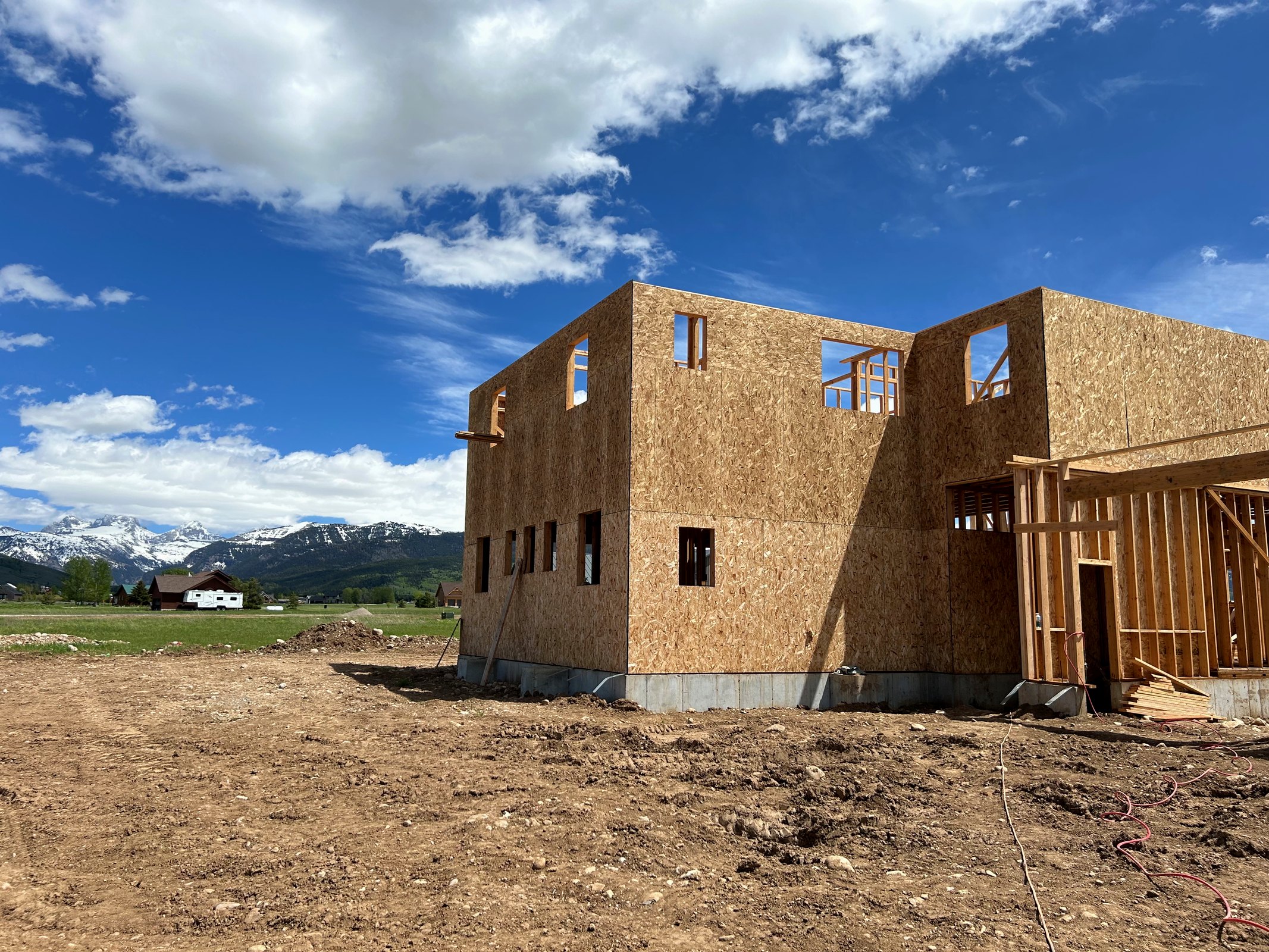
Building in Tetonia: should I buy a lot in West Ridge Ranch or raw acreage? If you want to be in the ground in 2027 with a known site cost, a one-acre West Ridge Ranch lot wins: community water is already authorized to every lot, power and fiber are at the lot line, the roads are county-maintained, and the covenants are light. If you want five or more acres, horses, a shop the size of a barn, or no neighbors in sight, raw Tetonia acreage wins, and you should budget roughly $40,000 to $120,000 more than a serviced lot, and six to twelve months, to make it buildable. Septic and a driveway are on you either way; the extra on raw ground is the well, the power run, the survey and a longer road.
I am Bryce Swager, owner of SwagerBuilds. We hold eleven West Ridge Ranch lots and we build on raw acreage across the north valley, so I have no reason to steer you either way. My family has built in Teton Valley since my great-grandfather ran a mine here, and Tetonia is where we are putting our own money in 2027.
What does building in Tetonia cost on either kind of lot?
The house costs the same. SwagerBuilds construction starts at $450 per square foot of interior living space whether the lot is in a subdivision or out on the bench. What changes is everything between the road and the foundation. A West Ridge Ranch lot has most of that work done. Raw acreage has almost none of it done, and the gap is where budgets get surprised.
| Line | West Ridge Ranch one-acre lot | Raw Tetonia acreage |
|---|---|---|
| Lot price | 2026 listings run roughly $110,000 to $160,000 | Roughly $150,000 to $500,000 for 1 to 5 acres; view parcels more |
| Water | Community system, all 120 lots authorized, hookup fee per the HOA (about $2,000 on current listings) | Drill a well: permit through Idaho Department of Water Resources, depth sets the cost |
| Septic | Required. Owner septic at the back of the lot on a standard permit | Required. Perc test first; poor soils or a high water table can mean an engineered system at two to three times the cost |
| Well + septic combined | Septic only, no well to drill | $25,000 to $45,000 combined, more if engineered |
| Power | At the lot line | Line extension quoted per foot by the utility; a long run is a five-figure line item |
| Internet | Fiber at the lot line | Depends on the road; some benches are fixed wireless or satellite |
| Road and driveway | County-maintained roads to the lot; you build the driveway, usually short | Approach permit, culvert, a longer gravel drive, and winter plowing that is yours to arrange |
| Rules | Light CC&Rs: 1,200 SF minimum, design approval, guest house allowed | County zoning only, no HOA |
| Time to break ground | Design agreement to permit, then spring 2027 | Add six to twelve months for well, perc, survey, access and power |
What is not in either column: the lot itself, permits and county fees (billed at cost), structural engineering (billed at cost), the design fee (fixed, starting at $25,000 and quoted per project, credited in full to your first construction invoice), landscaping and furniture. All-in, plan on about 30 percent above construction cost on a serviced lot and more on raw ground. What a well and septic cost in rural Idaho has the line items behind the $25,000 to $45,000 figure.
What do I actually get with a West Ridge Ranch lot?
A flat, one-acre, Teton-view lot in a 332-acre subdivision with about 200 acres of open space, nine miles from Tetonia, thirteen from Driggs and about 22 from Grand Targhee. Community water is authorized to all 120 lots, so there is no well to drill and no gamble on depth. Power, phone and fiber are at the lot line. Roads are county-maintained, which matters more in February than it does when you are walking the lot in July. Covenants are minimal: a 1,200 square foot minimum, design approval, and a primary plus a guest residence allowed. Septic and the driveway are yours, like any lot; the septic sits at the back of the lot on a standard permit.
SwagerBuilds has eleven of these lots secured with the landowner. We will build three-bedroom, 1,500 to 1,800 square foot spec homes with two-car garages on some of them, priced per plan once the design is locked, and fully custom homes at $450 per square foot and up on the rest. Construction begins in 2027. Signing a design agreement is what holds a lot; there is no separate deposit. The Tetonia custom home builder page has the north-valley details and the lots are discussed on the planning call.
What does it take to make raw Tetonia acreage buildable?
Seven things, in roughly this order, and most of them have to finish before a building permit is worth applying for.
- Survey and title. Pins on the ground, easements on paper. Irrigation ditches and canal easements cross a lot of Tetonia ground and they decide where the house can sit.
- Access. A county approach permit, a culvert, and a driveway built to the rural driveway rules so the fire district and the concrete truck can both get in.
- Perc test and septic design. Through Eastern Idaho Public Health. A failed perc on a high-water-table parcel means an engineered septic system, and that can move the house.
- Well. Permit through the Idaho Department of Water Resources, then a driller. Depth and water quality are unknown until the rig is on site.
- Power. The utility quotes the line extension per foot. The farther the parcel sits from the last pole, the bigger the number.
- Engineering for the site. Tetonia sits below 6,600 feet, so Teton County’s 85 psf ground snow load applies on most parcels, with 100 psf on the benches above it. What snow load a Teton Valley home needs explains what that does to the structure.
- Winter access. Nobody plows a private road but you. Budget it, or plan to be dried in before winter and let the interior crews work behind a plowed drive.
SwagerBuilds coordinates all seven inside the design agreement. You do not go find a surveyor, a driller and a septic designer yourself. The Teton County permit path and the county’s building department requirements are published on the Teton County, Idaho Building Department site.
Which one should I pick?
Pick West Ridge Ranch if any of these are true: you want keys in 2027 or early 2028; your budget is a number, not a range; you are building from out of state and cannot babysit a well driller; you want a guest house without a zoning fight; or you want neighbors within shouting distance but not within earshot.
Pick raw acreage if any of these are true: you need five acres or more; you are bringing horses, a hay barn or a shop over 2,000 square feet; you want no design review at all; you have a specific view or creek frontage that no subdivision offers; or you are two years out and the extra site work is time you have anyway.
The honest tiebreaker is schedule. A West Ridge Ranch lot can go from design agreement this winter to foundation in spring 2027 and dried in before winter the same year. Raw acreage bought this winter usually breaks ground the following year, because the well, perc and access work has to clear first. When to start to be dried in before winter lays out that calendar.
Common questions
Can I build a modular or a smaller home in West Ridge Ranch?
The covenants allow modular with design approval and set a 1,200 square foot minimum. Our spec plans start at 1,500 square feet because that is where a three-bedroom plan with a real mudroom and a two-car garage stops feeling tight.
How far is West Ridge Ranch from Driggs and Jackson?
About 13 miles to Driggs, 21 to Victor, 22 to Grand Targhee, 45 to Jackson and 63 to Idaho Falls. Tetonia itself is nine miles.
Is Tetonia land really cheaper than Driggs or Victor?
Per acre, usually 30 to 50 percent less than Victor for comparable buildable ground. The house costs the same to build. The savings are in the dirt, and on raw acreage some of them go back out in site work.
Do you pour foundations in winter in Tetonia?
No. Foundations go in during the open season and every SwagerBuilds home is dried in before winter, roof, windows and doors, so interior work runs through the cold months inside a closed shell.
Want to walk a West Ridge Ranch lot, or price your own acreage?
Bring the parcel, or tell me you want one of ours, on a 15-minute planning call. I will tell you which path fits your budget and your calendar, and what the design agreement would produce for you.
Building elsewhere in the valley? See the custom home builder in Driggs page or the Teton Valley custom home builder page for Victor.