
Contents
- What is a fluid-applied WRB?
- The leading brands at a glance
- Application: spray vs roll vs trowel
- Coverage and cost: real per-sq-ft numbers
- Cure time and substrate compatibility
- When a fluid-applied WRB makes sense
- When we wouldn’t reach for fluid-applied
- Where we are with it
- FAQ
- Want to talk through the math?
TL;DR: Fluid-applied WRBs are rolled or sprayed onto sheathing and cure into a seamless, monolithic air and water barrier. They cost roughly $0.85-$1.00 per sq ft installed vs $0.25-$0.75 for house wrap. Worth it on high-end custom builds chasing Passive House numbers, on complex geometries where taping a sheet barrier is a nightmare, and on commercial-grade residential. Not the default for a typical custom home.
What is a fluid-applied WRB?
A fluid-applied water-resistive barrier is a liquid coating applied to wall sheathing that cures into a continuous, seamless membrane. Most are silyl-terminated polymers (STP) or modified silicones. You spray, roll, or trowel them onto OSB, plywood, or exterior gypsum. The wet membrane cures in hours to a flexible, vapor-permeable, air-tight skin over the entire wall.
Unlike a stapled sheet membrane, there are no fasteners, no overlaps, and no seams that depend on tape. The barrier is monolithic. That’s the value proposition.
The leading brands at a glance
| Product | Chemistry | Application | Coverage | Notable feature |
|---|---|---|---|---|
| Prosoco R-Guard Cat 5 | Silyl-terminated polymer (STP) | Spray or roll | 50–100 sq ft/gal on OSB | Hurricane-tested to 155+ mph |
| Henry Air-Bloc 33MR | Water-based elastomeric | Spray or roll | varies — confirm with supplier | UV and fire-resistant; vapor permeable |
| Tremco ExoAir 230 | Monolithic elastomeric | Spray or roll | 48 wet mils min (25 dry) | Vapor-permeable formulation |
| Sto Gold Coat | Modified acrylic | Spray, roll, or trowel | varies | Commonly used in EIFS assemblies |
| Polywall Blue Barrier Liquid Wrap 2300 | STP | Roll, spray, or brush | varies | Single-component, fast skin |
| Carlisle Barritech VP | Vapor-permeable elastomeric | Spray or roll | varies | Common on commercial work |
Application: spray vs roll vs trowel
Spray application is the fastest method on large flat walls. A trained crew with an airless sprayer and the right tip can cover thousands of square feet a day. Setup time and overspray protection are the trade-offs. Roll application is the residential-scale method — a 9″ or 14″ roller with a thick nap handles most wall textures. Trowel application is the path for higher-build products and for detail work at transitions, penetrations, and corners.
Coverage and cost: real per-sq-ft numbers
Prosoco Cat 5 covers 50-100 sq ft per gallon on OSB or plywood. At roughly $250-$320 per 5-gallon pail (2026 supplier pricing), material cost runs $0.50-$1.30 per sq ft. Add liquid flashing at openings and the all-in material lands around $0.65-$1.50 per sq ft.
Labor on a residential build adds $0.30-$0.60 per sq ft when crews are trained. Total installed cost typically lands between $0.85 and $1.50 per sq ft of wall area — meaningfully higher than house wrap at $0.25-$0.75.
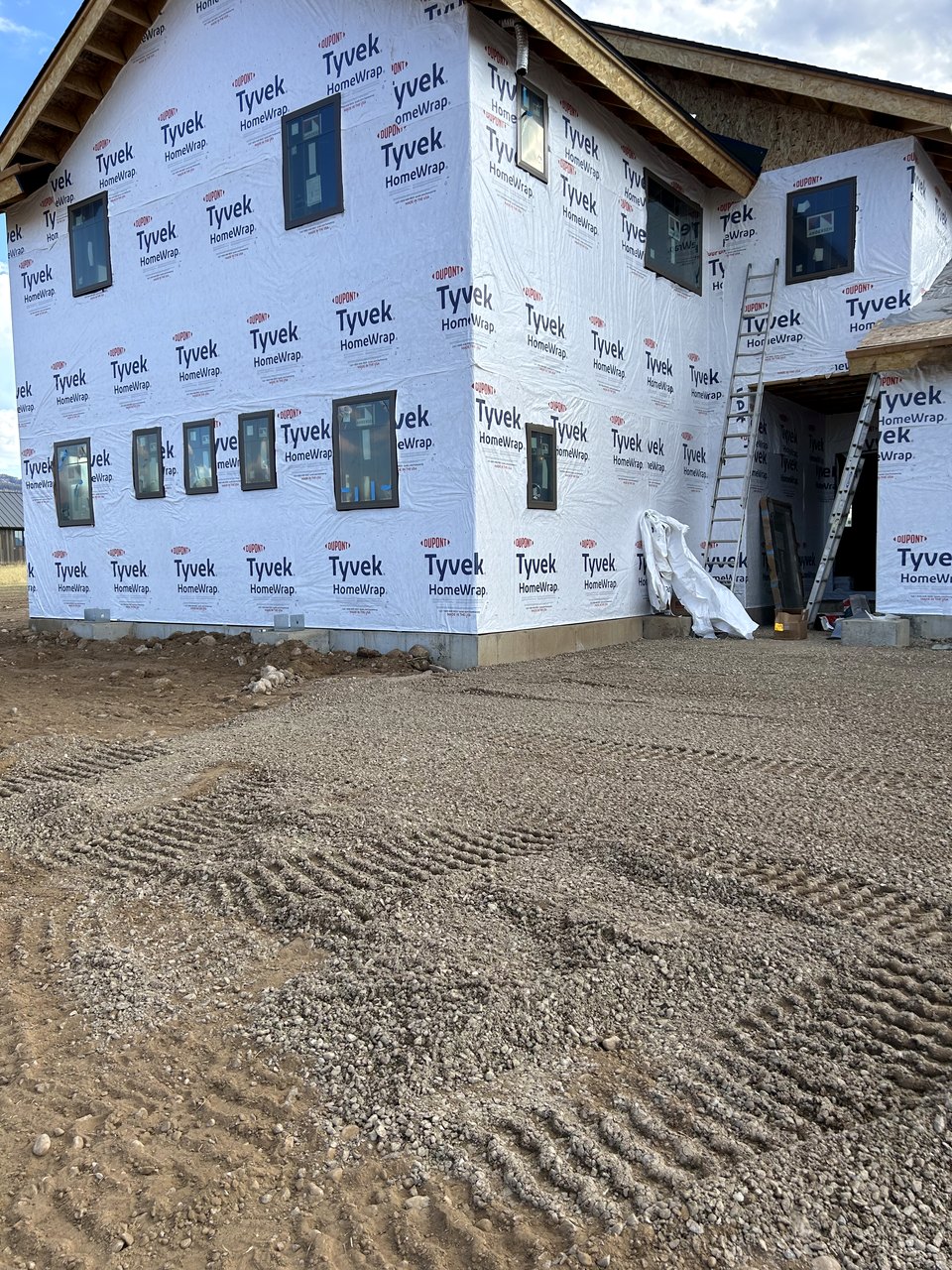
For a 2,400 sq ft single-story home with 3,000 sq ft of wall area, expect $2,500-$4,500 in installed cost for a fluid-applied air and water barrier over standard OSB sheathing. Compare with $750-$1,200 for Tyvek over OSB.
Cure time and substrate compatibility
Most STP fluid-applied products skin in 30-90 minutes and reach full cure in 24-72 hours depending on temperature and humidity. Most work down to roughly 25-40°F — cold weather slows cure and can cause incomplete film formation. Check the data sheet for your specific climate window.
Substrate compatibility is broader than house wrap. Cat 5 and similar STP products bond to OSB, plywood, exterior gypsum sheathing (DensGlass, GlasRoc), CMU, concrete, and most masonry. That makes them attractive on mixed-substrate assemblies.
When a fluid-applied WRB makes sense
- Passive House targets. Hitting 0.6 ACH50 or tighter is easier with a fluid-applied air barrier and the right window detailing.
- Complex geometry. Walls with lots of corners, jogs, dormers, and transitions are where sheet membranes get cut and patched and taped. A fluid-applied just runs.
- Mixed substrates. Wood-frame walls meeting CMU stem walls, gypsum-sheathed walls meeting OSB, parapets, complicated foundation transitions — all easier with a single coating system.
- Commercial-grade residential. When the homeowner is treating the project like a commercial spec, the durability story of a monolithic membrane plays well.
When we wouldn’t reach for fluid-applied
- Tight-budget custom build. The cost premium is real.
- Crew unfamiliar with the product. First-time install with wrong roller nap, wrong cure conditions, or wrong dry-film thickness gives you a worse barrier than a Tyvek wall installed by a crew that’s done it 100 times.
- Cold-weather schedule risk. If you’re sheathing in January, the temperature window can become a critical-path problem.
Where we are with it
From our reading and the reps we’ve talked to, Prosoco Cat 5 is the most builder-friendly fluid-applied for single-family work in the Mountain West. It rolls well, the data sheet is clear, and it integrates with companion products for window flashing. We have not specified Cat 5 on a SwagerBuilds project yet — most of our builds have not penciled for the premium — but it’s the system we’d reach for when a homeowner wants Passive-House-level air-tightness on a Teton Valley custom build.
FAQ
What is a fluid-applied WRB?
A liquid coating sprayed or rolled onto sheathing that cures into a seamless, monolithic water-resistive and air barrier. Common products include Prosoco Cat 5, Henry Air-Bloc 33MR, and Tremco ExoAir 230.
How much does Prosoco Cat 5 cost?
Material cost runs roughly $250-$320 per 5-gallon pail in 2026 supplier pricing. Coverage is 50-100 sq ft per gallon on OSB. All-in installed cost is typically $0.85-$1.50 per sq ft of wall area.
Is a fluid-applied air barrier worth it for a custom home?
It pays back on builds chasing Passive House numbers, on complex geometries, and on long-term-hold properties. On a typical custom build with rectangular walls, ZIP System or Tyvek with good flashing usually pencils better.
Can I spray a fluid-applied WRB myself?
Yes for trained applicators, but variables like wet mil thickness, cure conditions, and substrate prep are not forgiving. First-timers should get manufacturer rep support or hire a trained sub.
What substrates work with fluid-applied air barriers?
Most STP-based products bond to OSB, plywood, exterior gypsum sheathing, CMU, concrete, and most masonry.
What’s the cure time?
Most products skin in 30-90 minutes and reach full cure in 24-72 hours depending on temperature and humidity.
Want to talk through the math?
If you’re a homeowner trying to weigh a fluid-applied air barrier against ZIP or stapled house wrap on a Teton Valley build, give us a call. Contact SwagerBuilds.
Related: pillar guide, cost in 2026, best WRB for Idaho.
Leave a Reply