
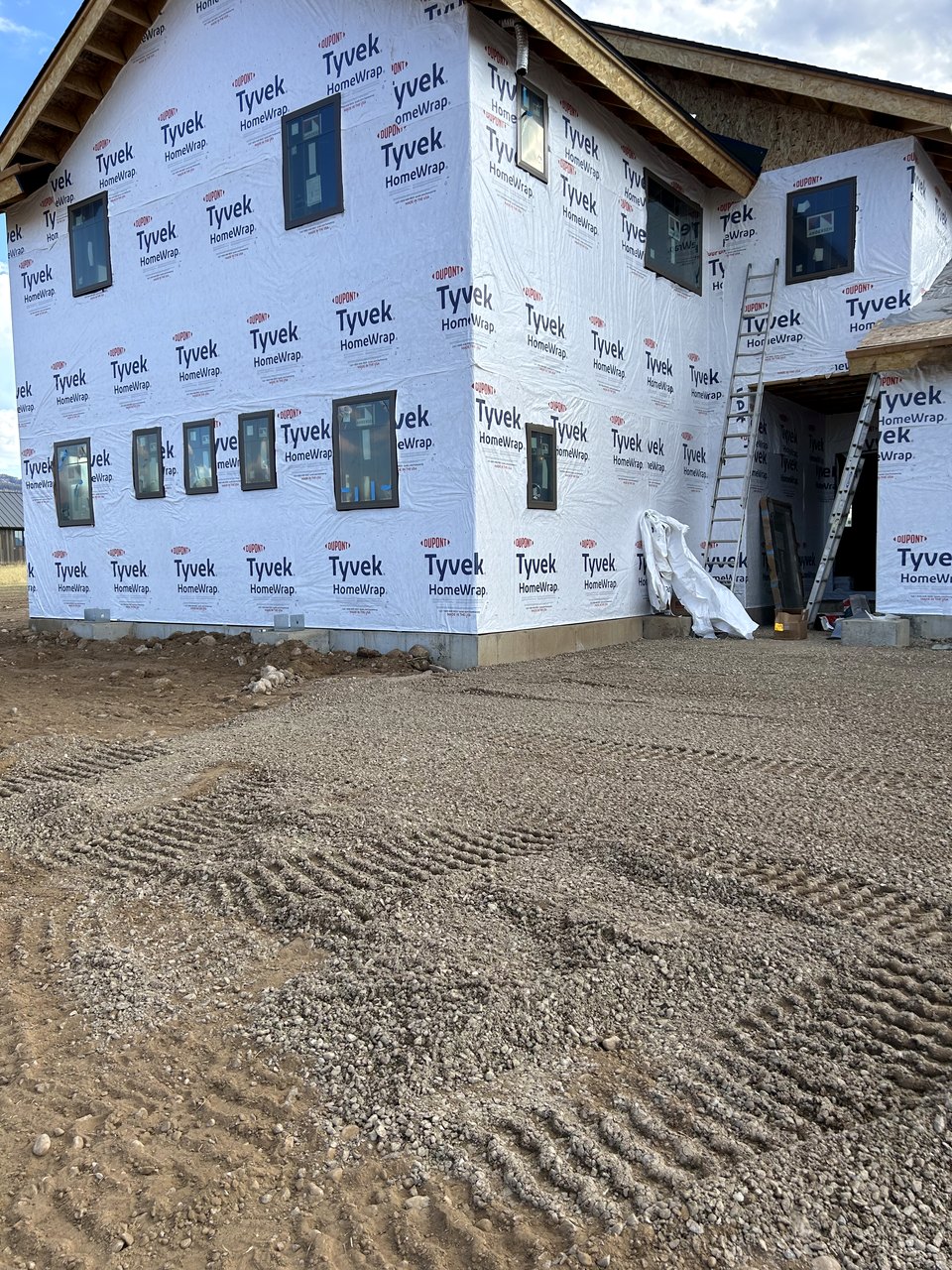
TL;DR: ZIP System vs Tyvek is the most-asked WRB question in custom homebuilding. The short version: ZIP System is OSB sheathing with the water-resistive barrier built in. Tyvek is a separate house wrap stapled over standard OSB. ZIP saves a labor step and gives a tighter air barrier when taped right. Tyvek is more forgiving, less expensive, and easier to repair. Custom builds chasing air-tightness lean ZIP. Production builds and remodels lean Tyvek.
ZIP System vs Tyvek: the 30-second answer
Both products work when installed correctly. Both fail when installed badly. ZIP costs more upfront and earns it back in labor and air-tightness on a build that values both. Tyvek costs less upfront and stays more forgiving in real-world site conditions. The right answer is build-specific.
What ZIP System actually is
ZIP System is structural OSB sheathing with a resin-impregnated water-resistive barrier bonded to the panel face at the factory. The seams are sealed with Huber’s acrylic ZIP tape. Once installed and taped per spec, the assembly functions as the wall sheathing, the WRB, and the air barrier in one product. Permeability is 12-16 perms. Maximum exposure is 180 days. Warranty is 30 years on the assembly.
What Tyvek actually is
Tyvek is a spunbonded polyethylene sheet membrane stapled over standard OSB or plywood sheathing. The Tyvek line includes HomeWrap (the residential standard), CommercialWrap, DrainWrap, and ThermaWrap LE. All meet ASTM E2556 Type II for vapor-permeable WRBs. HomeWrap permeability is roughly 56 perms — higher than ZIP. Maximum UV exposure is 120 days for HomeWrap.
Side-by-side: 8 specs that matter
| Spec | ZIP System | Tyvek HomeWrap + OSB |
|---|---|---|
| Structural sheathing | Integrated | Separate OSB |
| WRB | Factory-applied on panel face | Stapled sheet over OSB |
| Air barrier | Yes, when taped | Possible with rigorous taping, often not achieved on a typical jobsite |
| Perm rating | 12–16 perms | ~56 perms |
| Max UV exposure | 180 days | 120 days |
| Warranty | 30-year limited | 10-year limited (DuPont) |
| Cost per sq ft installed | $1.50–$2.50 | $0.25–$0.75 |
| Repair difficulty | Hard — requires panel + tape | Easy — patch with Tyvek tape |
Where ZIP fails
- Tape peeling. The acrylic tape only adheres long-term when it’s rolled. Crews that skip the roller see peeling within weeks.
- Cut-edge swelling. Exposed OSB at panel cuts can swell if it gets wet. Mitigated by tape or liquid flashing.
- Cold-temperature tape application. Below Huber’s cold-weather window, the tape doesn’t bond. Cold-weather formulation exists but the install gets harder.
- Repair after damage. A panel that’s been damaged after taping is harder to swap than re-cutting a section of stapled house wrap.
Where Tyvek fails
- Reverse overlaps. Stapled in the wrong direction, the wrap directs water into the wall.
- UV degradation past 120 days. Builds with slow siding starts can exceed HomeWrap’s exposure window. Step up to CommercialWrap if delay is likely.
- Sloppy taping makes it a poor air barrier. Most jobsites don’t tape Tyvek to the standard required for it to function as an air barrier.
- Unflashed openings. Wraps fail at the window head when there’s no head flashing.
The cost difference on a 2,400 sq ft home
For a 2,400 sq ft single-story home with about 3,000 sq ft of wall area, Tyvek + OSB runs $750-$1,200 in materials. ZIP System runs $4,500-$6,000 in materials. Net premium for ZIP over Tyvek typically lands at $2,500-$4,500 after factoring in labor savings on the integrated system.
When we’d pick ZIP
- Custom home on a normal schedule with a homeowner who values air-tightness.
- Builds chasing better-than-code blower-door results without specifying a separate fluid-applied product.
- Crew that’s installed ZIP before and rolls the tape.
When we’d pick Tyvek
- Budget-conscious custom builds where the premium doesn’t pencil.
- Remodels and additions that tie into existing OSB sheathing.
- Crews unfamiliar with ZIP tape — better to do Tyvek well than ZIP badly.
- Cladding that needs the higher drainage efficiency of a specific Tyvek variant (DrainWrap under stucco, CommercialWrap D under heavy cladding).
FAQ
Is ZIP System better than Tyvek?
ZIP System is faster to install and air-seals better when the tape is applied correctly. Tyvek is cheaper, more forgiving, and easier to repair. Neither is universally better — the right pick depends on the build, the crew, and the budget.
Is ZIP System worth the extra cost over Tyvek?
On a custom home where the homeowner cares about air-tightness and energy performance, usually yes. Net premium runs $2,500-$4,500 on a typical 2,400 sq ft home. On budget builds and remodels, Tyvek with careful flashing is often the better-value answer.
Do I need house wrap if I have ZIP System?
No. ZIP System is the code-required WRB when installed and taped per the manufacturer instructions. Adding house wrap on top is discouraged — it can trap moisture against the ZIP face.
Which has the better warranty, ZIP or Tyvek?
ZIP System carries a 30-year limited warranty on the assembly. Tyvek HomeWrap typically carries a 10-year limited warranty. Both have install-quality conditions that can void the warranty.
Can ZIP System get wet during construction?
Yes. ZIP’s 180-day exposure guarantee covers the panel and taped seams against UV and weather exposure for six months. Cut edges and exposed OSB at openings should be sealed with ZIP tape or ZIP Liquid Flash.
Which is easier to install, ZIP or Tyvek?
Tyvek is easier — staple a sheet membrane. ZIP requires more precision on tape application but eliminates the separate wrap step entirely.
What’s the perm rating difference?
ZIP measures 12-16 perms. Tyvek HomeWrap measures roughly 56 perms. Both qualify as high-permeability WRBs.
Talk to a builder, not a sales rep
If you’re a homeowner trying to decide between ZIP and Tyvek on a Teton Valley build, give us a call. Contact SwagerBuilds.
Related: pillar guide, Huber ZIP deep dive, Tyvek variants, cost in 2026.
Leave a Reply