
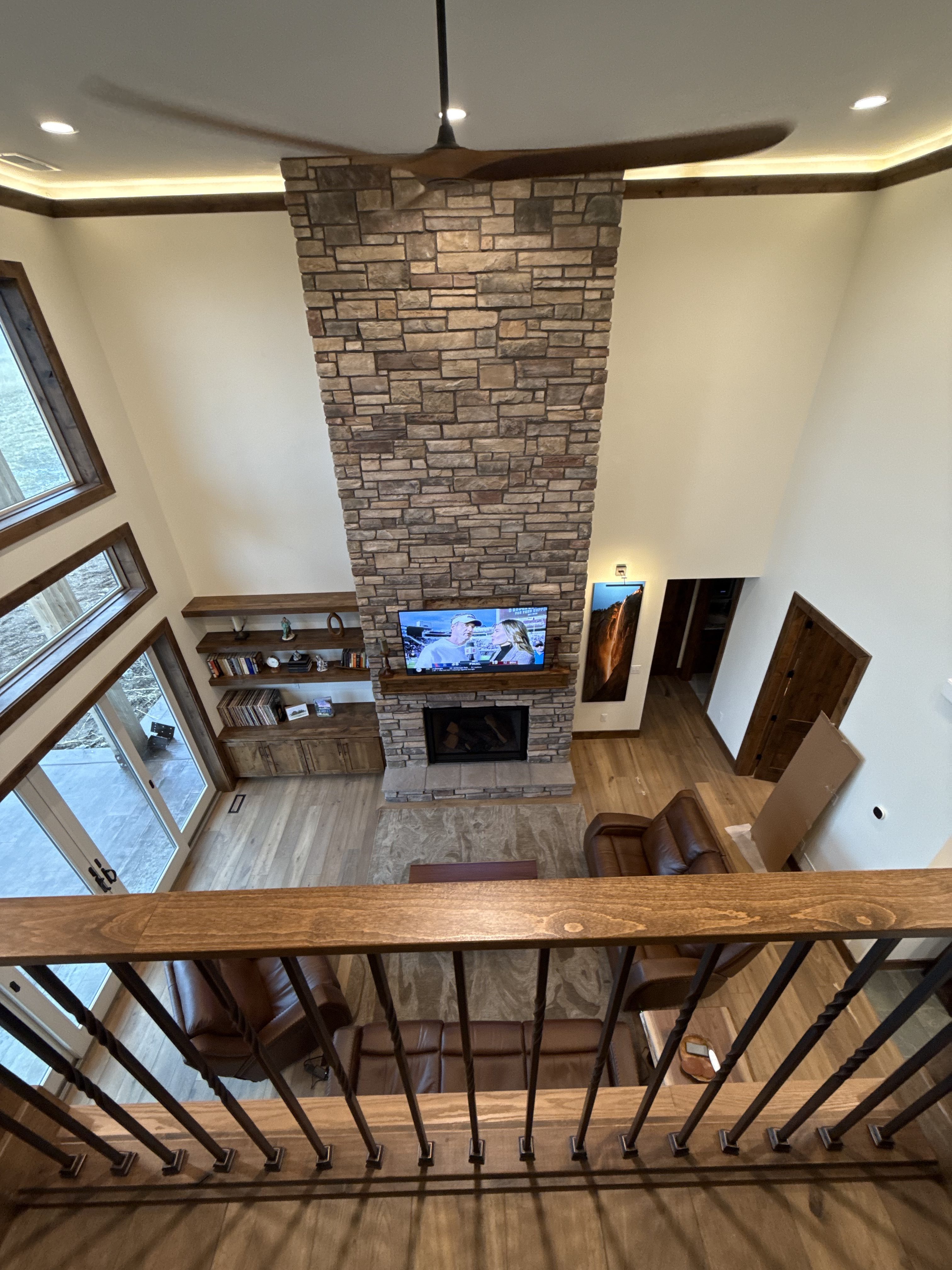
TL;DR: A wood stove is the right call in a Teton Valley custom home when you want real heat that works with the power out, you have a place to stack three cords, and you accept a chimney that runs all the way through the roof. A direct-vent gas fireplace is the right call when you want heat on a thermostat, no ash, and a vent that goes straight out a sidewall. Electric is for ambiance only. The decision is not really about the appliance. It is about venting, clearances and framing, and all three have to be settled before anybody frames the great room wall. I have spent twenty years in construction and I am involved in every phase of every build, and the hearth is one of the few selections that is genuinely hard to change after drywall.
Contents
- What a wood stove actually asks of your house
- Wood stove, gas fireplace or electric: how they compare
- Venting is the real decision
- Clearances, hearths and the framing you cannot undo
- What Idaho code actually requires
- A tight house changes the math
- What it costs, honestly
- How I would decide on a Teton Valley build
- Frequently asked questions
What a wood stove actually asks of your house
Every winter somebody tells me they want a wood stove because the power goes out on their road. That is a good reason. It is also the only reason that survives a hard look, because everything else a wood stove gives you, a gas appliance gives you with less work.
So before we talk about brands or doors or soapstone, here is what a wood stove asks of the building:
- A chimney that goes up and out the roof. Not a sidewall. A solid-fuel chimney is a vertical run, and in snow country it has to come through the roof in a spot that does not create an ice problem or sit in the path of a sliding snow load.
- A non-combustible floor under and in front of it. Hearth pads are not decoration. They are a code item with real dimensions.
- Clearance to combustibles on every side. That clearance comes from the appliance’s own listing, not from a rule of thumb, and it eats floor area in a room you already drew furniture into.
- Somewhere to put three cords of wood that is dry, close to a door, and not in the way of the snowplow.
- Combustion air. On a modern tight envelope this is not optional, and it is the part people skip.
None of that is a reason to avoid a wood stove. It is a reason to decide early. I would rather have this conversation at schematic design than get a call in February about a stove that smokes every time the bath fan runs.
Wood stove, gas fireplace or electric: how they compare
Here is the comparison the way I actually lay it out for clients. I have left dollar figures out on purpose, because appliance prices move and the installed cost depends far more on the venting path than on the box you pick.
| Wood stove | Direct-vent gas | Electric | |
|---|---|---|---|
| Works with the power out | Yes, fully | Usually, with a standing pilot or battery igniter | No |
| Real heat output | High, hard to control | Moderate, thermostat controlled | Low, resistance heat only |
| Venting | Vertical chimney through the roof | Sealed coaxial vent, sidewall or roof | None |
| Combustion air | Must be planned for | Sealed, draws its own from outside | Not applicable |
| Hearth and clearances | Largest footprint | Smaller, per listing | Minimal |
| Daily effort | Hauling, loading, ash, chimney sweeping | Flip a switch, annual service | None |
| Framing impact | Chase, roof penetration, structural coordination | Chase or shallow wall box | Recess only |
| Best for | Off-grid resilience, people who like the work | Most mountain custom homes | Ambiance in a bedroom or office |
If I had to generalize across the builds I have been part of in Teton Valley: most clients who say they want a wood stove end up happiest with a direct-vent gas fireplace in the great room, and a wood stove somewhere it earns its keep, like a shop-adjacent mudroom or a lower-level family room. The ones who should actually put a wood stove in the main living space know it already, because they have heated with wood before and they are not romanticizing it.
Venting is the real decision
This is the part I wish more people understood before they fell in love with a photo.
A wood stove needs a Class A insulated chimney running vertically from the appliance to above the roof. That run needs a chase if it passes through conditioned space, it needs to clear the roof by the required height, and in a snow-load climate it needs to land somewhere that a roof avalanche will not shear it off. On a vaulted great room with scissor trusses, that chase and that penetration have to be coordinated with the truss layout before the package is ordered. You do not move a chimney after the trusses are set.
A direct-vent gas fireplace uses a sealed coaxial pipe: the inner pipe exhausts, the outer pipe pulls combustion air in from outdoors. The firebox never opens to room air. That is why it can terminate on a sidewall, why it does not depressurize your house, and why it is the appliance I steer most mountain-home clients toward. It is also the only common hearth appliance that behaves itself in a very tight building.
B-vent gas — the older atmospheric type that draws room air for combustion and vents up a flue — still exists and still gets specified. I avoid it in new construction here. It needs room air to burn, so it fights with every exhaust fan in the house, and it needs a vertical vent anyway, so you take on the chimney problem without getting the wood stove benefit.
Ventless gas I will not install. It puts combustion moisture and byproducts into the living space, several states prohibit it outright, and in a house built to a modern air-tightness standard it is a bad idea on physics alone.
Clearances, hearths and the framing you cannot undo
The clearance numbers that govern a listed appliance come from that appliance’s own instructions, and they vary a lot. A modern wood stove with a heat shield might sit much closer to a wall than an older one. The inspector checks against the label and the manual, not against a generic table.
For a site-built masonry fireplace, though, the code dimensions are fixed, and they are worth knowing because they size the whole hearth wall. Fine Homebuilding’s walkthrough of the clearance requirements lays them out clearly, and the ones that drive design are these:
- Hearth extension. For a fireplace opening under 6 square feet, the hearth has to run at least 16 inches in front of the opening and 8 inches past each side. At 6 square feet or more, that goes to 20 inches in front and 12 inches past each side.
- Hearth thickness. Generally at least 2 inches of concrete or masonry, which can drop to 3/8 inch of approved non-combustible material if the firebox opening is raised at least 8 inches above the top of the extension. That is exactly why so many mountain-home fireplaces sit on a raised hearth.
- Framing setback. Wood framing stays at least 2 inches off the sides and front of the firebox and 4 inches off the back.
- Mantel and trim. A projecting combustible mantel keeps 12 inches of clearance above the opening. Combustible trim on the face can start as close as 6 inches out, but its projection is capped at 1/8 inch for every inch of height above the opening. Go non-combustible and those limits change.

Notice what those numbers do to a room. A 20-inch hearth extension plus a raised curb is roughly two feet of floor you cannot put a sofa on, in the exact spot everyone wants the sofa. That is a plan-level decision, not a finish-level one, which is why the hearth gets settled long before the rest of the finish selections.
What Idaho code actually requires
Idaho does not write its own residential code from scratch. The state adopts the international codes with amendments, and per the Idaho Division of Occupational and Professional Licenses list of adopted codes, what is in force is:
- The 2018 International Residential Code, parts I, II, III and IX, with Idaho amendments, collectively called the Idaho Residential Code (2020 Edition)
- Parts V and VI of the 2018 IRC, plus the 2018 International Mechanical Code and the 2018 International Fuel Gas Code
- The 2018 International Energy Conservation Code with amendments, called the Idaho Energy Conservation Code (2020 Edition)
One detail that trips people up, and the state says so directly: the “2020 Edition” label is not an effective date. It is an identifier for the legislative session in which the amendments were adopted. The underlying code is the 2018 edition.
Worth knowing what that list does not settle. I went through Teton County’s residential permit submittal checklist and it does not mention fireplaces, wood stoves, chimneys, hearths or combustion air anywhere. That is not an oversight and it does not mean you are off the hook. It means the hearth appliance gets caught at mechanical inspection and against the manufacturer’s listing, not at plan review. So the drawing set can sail through while the install still has to satisfy an inspector in the field. Jurisdictions also amend, and the city and the county are not always identical, so confirm locally before you order anything. That is the kind of thing I would rather chase down in design than discover at rough-in. The same checklist does require energy compliance by either REScheck or the prescriptive form, which matters more than it sounds like for the next section.
On the appliance itself, the EPA certifies residential wood heaters. Under the 2015 New Source Performance Standards the particulate limit was 4.5 grams per hour, and in 2020 it dropped to 2.0 grams per hour tested with crib wood, or 2.5 grams per hour tested with cord wood. Cord wood is normal firewood and is the better measure of how a stove behaves in a real house. You can check a specific model against the EPA certified wood heater database. One honest caveat: EPA’s Burn Wise program ran from 2009 to 2025 and the agency stopped updating that guidance material in October 2025, so verify current requirements rather than trusting a page that may be frozen.
A tight house changes the math
This is where I see the most expensive mistakes, and it is a building-science problem rather than a hearth problem.
A custom home built the way we build them now is tight. Between a continuous air barrier, modern insulation detailing and good windows, the house no longer leaks enough air to feed an open-combustion appliance. Then you add a range hood, two bath fans, a dryer and a whole-house ventilation system, and every one of those is pulling air out.
Put an atmospheric wood stove or a B-vent gas fireplace in that house and the appliance is competing for air with the exhaust equipment. When it loses, the chimney back-drafts. You get smoke in the room, or worse, combustion byproducts you cannot see. People blame the stove. The stove is fine. The house changed.
There are two real answers. Use a sealed, direct-vent appliance that brings its own combustion air from outdoors and never touches room air. Or, if you want the wood stove, specify a model with a listed outside-air kit, install it, and plan the makeup-air strategy alongside the range hood instead of after it. Both work. What does not work is pretending the problem away.
This is also why the hearth conversation has to happen in the same room as the primary heating system conversation. A wood stove is not a heating system. It is a supplement with a personality, and a very good one on the third day of an outage.
What it costs, honestly
I am not going to publish an appliance price, because any number I print is wrong by the time you read it and because the appliance is the small part. What actually moves the cost on a hearth:
- The venting run. A sidewall direct-vent termination two feet from the firebox is a different job from a Class A chimney running thirty feet up through a vaulted ceiling and out a steep roof. This is the single biggest variable.
- The roof penetration. Flashing a chimney through a standing-seam roof with real snow load, and detailing it so it does not become an ice dam or get taken out by sliding snow, is skilled work.
- The surround. Full-height stone to a 20-foot ceiling costs a multiple of a drywall surround with a simple mantel. The photo at the top of this post is a full-height stone stack, and the stone is the expensive part of that wall, not the firebox.
- Structural coordination. A masonry fireplace and chimney is a real load that the foundation and framing have to carry. A listed metal firebox in a framed chase is not.
- How many. Two hearths is not twice one hearth, it is two venting problems.
For whole-project context: our custom home pricing starts at $400 per square foot and goes up on the Teton Valley and Idaho side, and starts at $1,000 per square foot and goes up on the Jackson Hole side. Design is a fixed design fee, quoted per project. If you want the full breakdown of how a build gets priced here, I wrote that up in the Teton Valley cost guide.
How I would decide on a Teton Valley build
Four questions, in order.
1. Do you lose power, and for how long? If you are on a road that goes dark for two days every couple of winters and you are not putting in a generator, a wood stove is a genuinely good answer. If you have a standby generator, the resilience argument mostly evaporates and gas wins on convenience.
2. Will you actually do the work? Three cords is a lot of splitting, stacking, hauling and ash. Some people find that satisfying. Some people find out in year two that they do not. Be honest now, because the chimney is permanent.
3. Where does it go, and what does the roof look like above it? Walk the roof plan with your builder before you commit to a spot. If the only chimney location puts a penetration in the path of a snow slide or in a valley, that is a real constraint, not a detail.
4. What is the room actually for? If the great room is where you entertain, a direct-vent gas fireplace that comes on with a switch is going to get used far more than a stove you have to start forty minutes early. If the lower-level family room is the winter hangout, that is where a wood stove shines.
My usual recommendation on a Teton Valley custom home: direct-vent gas in the great room, and if you want wood, put a properly vented wood stove with an outside-air kit in the space where you will actually tend it. Decide both at schematic design so the chases, the roof penetrations and the hearth framing are in the drawings from the start.
If you are working through this on a build in Teton Valley, Driggs, Victor, Tetonia or the Idaho Falls area, call me at (208) 520-0636 and we will walk the plan before it gets framed.
Frequently asked questions
Do I need a permit for a wood stove in Idaho?
Generally yes. A solid-fuel appliance and its chimney are part of the mechanical work on the permit for a new custom home, and a retrofit into an existing house typically needs its own permit and inspection. Teton County’s residential submittal checklist does not call out fireplaces or wood stoves specifically, so the appliance gets reviewed against the manufacturer’s listing at inspection rather than at plan review. Requirements vary between the county and the cities, so confirm with your jurisdiction before you order.
Is a wood stove or a fireplace more efficient?
A modern EPA-certified wood stove is substantially more efficient than an open masonry fireplace, which can actually be a net heat loss because it pulls heated room air up the chimney. A sealed direct-vent gas fireplace falls between them and has the advantage of thermostatic control. If heat output is the goal rather than the look of an open fire, a stove or a sealed insert beats an open firebox every time.
Can I put a wood stove in a very airtight house?
Yes, but it has to be planned. Specify a stove that offers a listed outside-air kit, install that kit, and coordinate the makeup-air strategy with your range hood and ventilation system. Without outside combustion air, a tight house plus a strong exhaust fan can back-draft the chimney and push smoke into the room. This is the most common wood stove problem I see in new construction, and it is entirely preventable at design.
How much clearance does a wood stove need?
It depends entirely on the model. Clearance to combustibles comes from the appliance’s own listing and instructions, and a modern stove with integral heat shields can sit considerably closer to a wall than an older one. The inspector checks the install against that label and manual. Get the specific model’s clearance diagram before you finalize the furniture plan, because clearances plus the hearth extension can take up more floor area than people expect.
Should the chimney go through the roof or up an outside wall?
For a wood stove, through the roof is almost always better in this climate. An interior chimney stays warm, drafts better and is less prone to creosote and cold-start smoking than one chased up an exterior wall. The tradeoff is a roof penetration that has to be flashed and located carefully around snow load and slide paths. A direct-vent gas appliance is the exception, since it can terminate on a sidewall and avoids the roof entirely.