SwagerBuilds LLC · 4510 E 168 N, Rigby, ID 83442 · (208) 520-0636

Category: Cost & Budget

Real cost numbers, budget breakdowns, and pricing guidance for custom homes in Driggs, Teton Valley, and Eastern Idaho.

  • Cost to Build a Custom Home in Driggs, Idaho (2026 Update)

    Cost to Build a Custom Home in Driggs, Idaho (2026 Update)

    Primary bath with walk in glass shower and stone top vanity from the Arbogast custom home build by SwagerBuilds, Driggs, Idaho (Teton Valley), 2025

    If you’re trying to figure out what it actually costs to build a custom home in Driggs in 2026, the honest answer is between $400 and $650 per square foot, all in. A 3,500 sq ft custom build runs $1.4M to $2.3M before land. A higher end mountain modern with timber accents and big glass walls? $2.5M and up.

    That’s a wide range, and the reason isn’t builder margin. It’s the four cost drivers I’ll walk you through below. By the end of this guide, you’ll be able to ballpark your own build within about 10 percent before you ever sign a contract.

    I’m Bryce Swager, founder of SwagerBuilds. We’ve been building custom homes in Eastern Idaho since 2016, including a growing roster of luxury projects in Teton Valley and Jackson Hole. The numbers below come from real, current jobs, not a national average that gets quoted on every blog and ages out by spring.

    What does it cost to build a custom home in Driggs, Idaho in 2026?

    Between $400 and $650 per square foot for a luxury custom build. A typical 3,000 to 3,500 sq ft Teton Valley home runs $1.5M to $2.3M before land costs. Add 15 to 25 percent for site work, septic, well, and access if your lot is undeveloped. Land in Driggs ranges from $250K to $2M and up depending on view, acreage, and access.

    Why Driggs Costs More Than Idaho Falls (And Why It Should)

    If you’ve gotten quotes in Idaho Falls or Rexburg and now you’re getting Driggs numbers, the gap probably feels brutal. It’s not arbitrary. Building in Teton Valley is a different job than building on the valley floor, for four reasons.

    • Mountain logistics. Material delivery to Driggs is 60 to 90 minutes from the major suppliers. Concrete trucks, lumber yards, and equipment rentals all add freight.
    • Climate engineering. Teton Valley sees lows of 25 below, more than 12 feet of snow a year, and winds that hammer a roof line. Code minimum insulation gets you a comfortable home in Boise. In Driggs, code minimum gets you ice dams and a $900 heating bill. We build well above code here, and that costs more.
    • Subcontractor scarcity. Idaho Falls has more than 200 HVAC contractors. Teton Valley has fewer than 20 who’ll work on a luxury build, and the best ones are booked 9 to 12 months out. When the good crews are scarce, the price goes up.
    • Permitting and jurisdictional fees. Teton County permits cost more than the lower valley, especially with the new wildfire zone overlays.
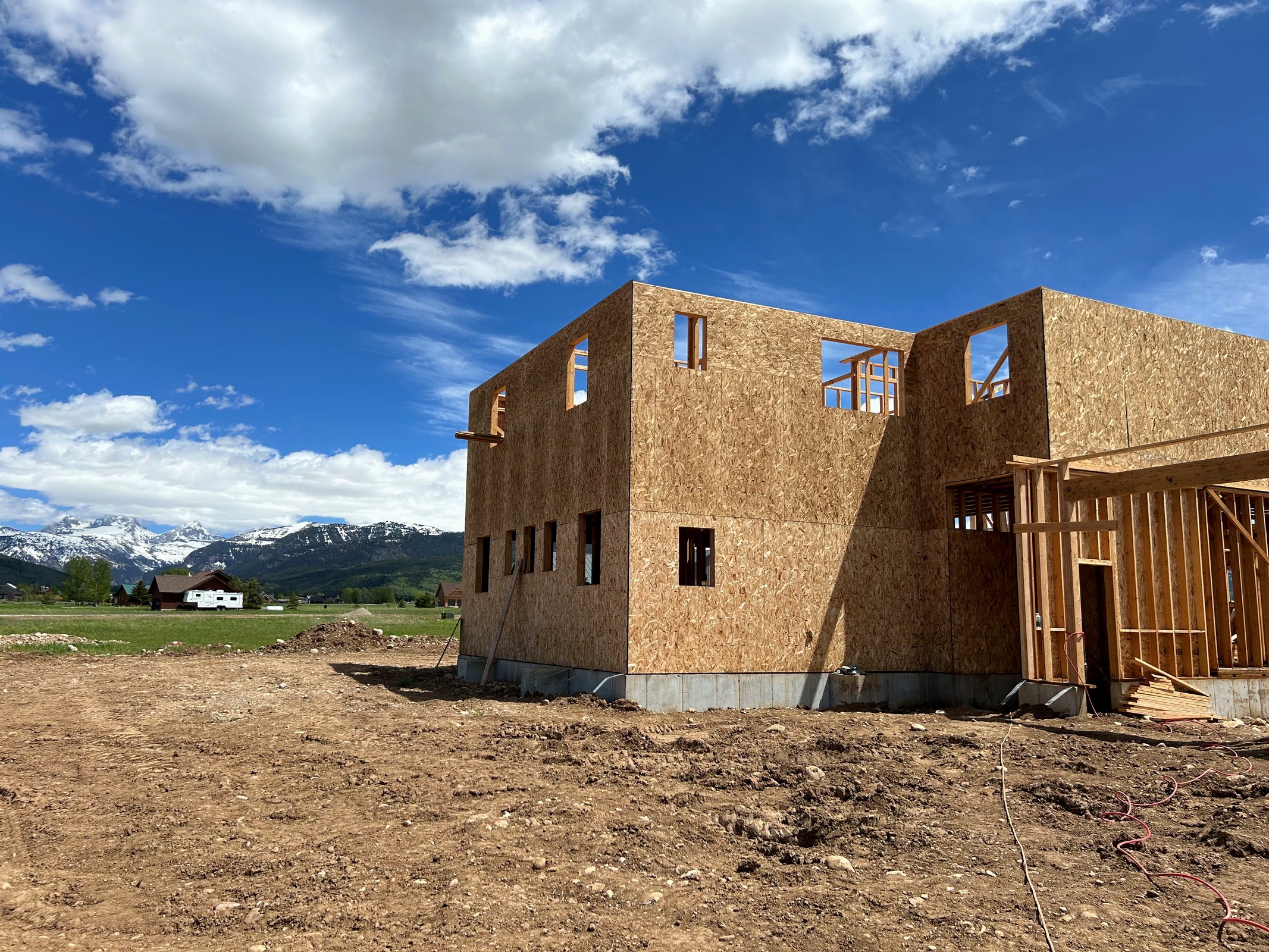
    The Arbogast Home, framing stage with Teton Range backdrop from a full GC custom luxury home build, 1791 Mt Moran Rd, Driggs, Idaho (Teton Valley), 2025

    The honest builder math: a $300 a square foot Idaho Falls build is roughly the same scope of work as a $440 a square foot Driggs build. The home isn’t 47 percent nicer. The job is 47 percent harder.

    The Real Cost Breakdown: Where Every Dollar Goes

    Here’s the actual line item split for a $1.8M Teton Valley custom home (3,500 sq ft, $515 a square foot). Numbers are 2026 averages from SwagerBuilds active jobs.

    Cost Category% of Total$ on $1.8M Build
    Site work (excavation, septic, well, drive)12%$216,000
    Foundation and framing18%$324,000
    Exterior (siding, roof, windows, doors)17%$306,000
    Plumbing, HVAC, electrical14%$252,000
    Interior finishes (flooring, trim, paint)12%$216,000
    Kitchen and bathrooms (cabinets, counters, fixtures)13%$234,000
    Permits, fees, insurance, builder overhead8%$144,000
    Builder profit6%$108,000
    Total100%$1,800,000

    A few things to notice. First, kitchen and bath finishes alone are $234K, and that’s a luxury but not over the top spec. Push toward Wolf, Sub-Zero, and stone slab counters and you’re at $350K easy. Second, builder profit is 6 percent, not 30. Anyone quoting you a 30 percent builder fee in Teton Valley is either misinformed or padding hard.

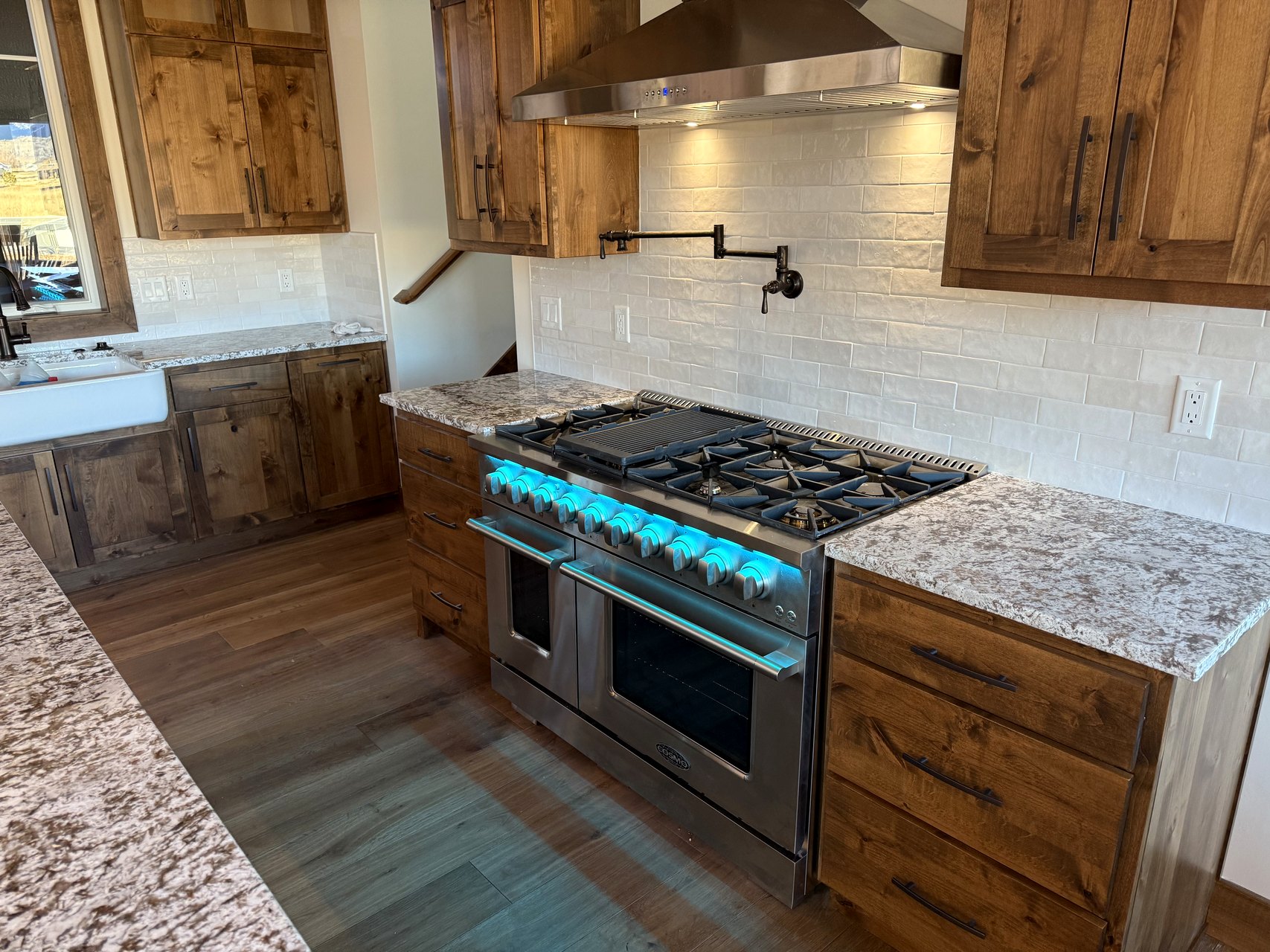
    The Arbogast Home, finished kitchen with custom alder cabinets and granite island from a full GC custom luxury home build, 1791 Mt Moran Rd, Driggs, Idaho (Teton Valley), 2025

    What Drives the $400 to $650 Per Square Foot Spread

    Most of the price spread comes down to four specific decisions. Each one moves the needle 5 to 10 percent on total cost.

    • Glass to wall ratio. A standard window package on 3,500 sq ft runs $35,000 to $50,000. The big window mountain modern look with Marvin or Sierra Pacific 8 foot panels runs $90,000 to $130,000. That single decision is a $50,000 to $80,000 swing.
    • Roof complexity. A simple gable is cheapest. Hips with dormers, complex valleys, and exposed timber rafter tails run 25 to 35 percent more.
    • Mechanical systems. A standard 95 percent AFUE furnace with a ducted system is included. In floor radiant with a ducted HRV and a heat pump for shoulder seasons runs $40,000 to $65,000 extra. Worth it for the efficiency, but a real budget lever.
    • Cabinet and millwork level. Big box semi custom cabinets run $45,000 to $60,000 for a full house. Local custom millwork, built for the job out of real wood, runs $90,000 to $140,000.

    If you want to spend less, the highest leverage cuts are usually scaling back the window package, simplifying the roof, and using semi custom cabinets in the secondary spaces like the laundry and mudroom. That’s typically $80,000 to $120,000 back into the budget without the home looking cheap.

    Hidden Costs Most Builders Won’t Bring Up

    These don’t show on a builder estimate, but they hit your wallet just as hard. Plan for them or you’ll be over budget by $80,000 to $200,000 when you move in.

    • Septic system in Teton County: $18,000 to $35,000 depending on soil and lot. Often $45,000 and up if you need a pressure dosed mound system.
    • Well drilling: $15,000 to $25,000 typical. If you hit a dry hole or have to drill past 600 feet, $35,000 to $55,000.
    • Access road and snow plowing: $10,000 to $30,000 to build. Then $3,000 to $6,000 a winter for plowing if you’re not on a county maintained road.
    • Propane tank and line: $4,000 to $8,000. Most Teton lots aren’t on natural gas.
    • Soft costs: architect ($25,000 to $75,000), interior designer ($15,000 to $50,000), construction loan interest, county impact fees, and builder’s risk insurance. Easily another $80,000 to $150,000 total.

    Real Project Spotlight: The Arbogast Build

    The Arbogast home in Driggs is one of our recent benchmark projects. 3,200 sq ft modern mountain on 5 acres, glass heavy with timber accents, in floor radiant, and a custom kitchen built around entertaining.

    The Arbogast Home, full height custom stone fireplace, built in walnut shelving, and timber mantel. SwagerBuilds craftsmanship detail, Driggs, Idaho.

    Final numbers:

    • Land cost: $640K (5 acres, west facing Teton view)
    • Site work, septic, and well: $185K
    • Build cost: $1,920K, about $600 a square foot including the high end finish package
    • Soft costs: $115K (architect, designer, financing, insurance)
    • Total all in: $2,860K

    The Arbogasts came in $40K under their $2.9M budget, finished on schedule, and moved into a home that’s already appraising 8 percent above project cost. That’s what a clean Teton Valley luxury build looks like in 2026.

    Common Questions About Building in Driggs

    How much does it cost to build a 2,500 sq ft custom home in Driggs?

    Between $1.0M and $1.6M for a luxury build, plus land. At the lower end you’re getting builder grade finishes. At the upper end, real custom millwork, premium windows, and high efficiency mechanicals.

    Is it cheaper to buy or build in Teton Valley?

    In 2026, building is roughly 5 to 15 percent cheaper per square foot than buying comparable luxury inventory in Driggs and Victor, but only if you already own the land or buy a good lot. Add the land cost and they’re close to even, with the build giving you exactly what you want.

    How much should I budget for upgrades and change orders?

    Plan 8 to 12 percent of total build cost. On a $1.8M build, that’s $145,000 to $215,000 for the inevitable “let’s change this” decisions during construction. Builders who tell you they never have change orders aren’t being honest about how a real custom build actually goes.

    What’s the cheapest way to build in Driggs without it looking cheap?

    Three biggest levers: simplify the roof line, use a smaller premium window package paired with bigger windows in only the great room, and put your custom millwork budget into the kitchen and primary bath only. You can save $150,000 to $250,000 and still get a knockout home.

    How long will it take to build my custom home in Driggs?

    14 to 18 months from contract signing to keys in hand for most luxury builds. We break down every phase in How Long Does It Take to Build a Custom Home in Idaho.


    Ready to talk numbers on your build?

    If you’re inside 12 months of breaking ground in Driggs, Victor, Tetonia, or Felt, let’s talk. We do a free 30 minute discovery call where we look at your land, your wishlist, and your budget, and tell you straight whether the math works.

    Schedule a discovery call

    Or DM “BUILD” to @swagerbuilds on Instagram and we’ll send you a sample budget breakdown for a Teton Valley build at your size.

  • What Does Exterior Waterproofing Cost in 2026? Real Numbers from a Builder

    TL;DR: Real exterior waterproofing cost in 2026: on a 2,400 sq ft single-story home with roughly 3,000 sq ft of wall area, exterior waterproofing runs roughly $750-$1,200 for house wrap + tape over standard OSB, $4,500-$6,000 for ZIP System (panels + tape + liquid flash), and $2,500-$4,500 for a fluid-applied air barrier over standard sheathing. Labor varies. Numbers below reflect 2026 supplier conversations in eastern Idaho.

    How to estimate your exterior waterproofing cost

    The exterior waterproofing line covers four things: the sheathing, the WRB, the seam and flashing materials, and the labor to install all three. Bids often roll some of those costs into “framing” or “exterior trim,” which makes it hard to compare systems apples-to-apples. Ask your builder to break out the WRB choice as its own line.

    Material costs by system

    Tyvek HomeWrap over standard OSB

    • 7/16″ 4×8 OSB: $14-$18 per sheet
    • Tyvek HomeWrap 9’×100′ roll: $180-$240 (varies by retailer and volume)
    • Tyvek tape 1.88″ × 165′: $20-$30 per roll
    • Sheathing staples and cap fasteners: $20-$40 per home

    ZIP System wall

    • 7/16″ 4×8 ZIP wall panel: $20-$28 per sheet (varies by volume)
    • ZIP tape 3.75″ × 90′: $35-$50 per roll
    • ZIP Stretch tape 6″ × 50′: $50-$75 per roll
    • ZIP Liquid Flash 20-oz tube: $40-$55
    • Cold-weather ZIP tape (when needed): premium of $5-$15 per roll

    LP WeatherLogic

    • 7/16″ 4×8 WeatherLogic panel: typically $2-$4 less than ZIP per sheet
    • LP acrylic seam tape: $25-$40 per roll

    Fluid-applied (Prosoco Cat 5 as the reference)

    • Cat 5 5-gallon pail: $250-$320 (covers 250-500 sq ft on OSB)
    • Prosoco companion liquid flashing (FastFlash): $40-$60 per 20-oz tube
    • Backup OSB sheathing required underneath: $14-$18 per sheet

    These are 2026 prices observed at supplier counters in eastern Idaho. For supplemental cost data, Fine Homebuilding publishes annual construction cost surveys. Confirm with your local supplier — OSB markets move fast.

    Labor costs (rough hours per system)

    SystemSheathing hours (3,000 sq ft wall)WRB hoursTape/flash hours
    OSB + Tyvek16–248–124–8
    ZIP System16–24integrated10–16
    OSB + fluid-applied16–24integrated16–28 (spray/roll + cure)

    At a loaded labor rate of $55–$75 per hour for a framing carpenter, total labor on the exterior envelope lands between $1,500 and $3,500 depending on system and crew familiarity.

    Real-numbers example: 2,400 sq ft home in Teton Valley

    Single-story 2,400 sq ft custom home. Roughly 3,000 sq ft of exterior wall area. Roughly 110 sheets of 4×8 sheathing.

    SystemMaterialsLaborTotal installed
    OSB + Tyvek HomeWrap$1,900-$2,500$1,500-$2,500$3,400-$5,000
    ZIP System$3,000-$4,200$1,500-$3,000$4,500-$7,200
    LP WeatherLogic$2,800-$3,800$1,500-$3,000$4,300-$6,800
    OSB + Prosoco Cat 5$3,200-$4,500$2,500-$4,000$5,700-$8,500

    Net premium over Tyvek + OSB:

    • ZIP: $1,100-$2,200 net
    • WeatherLogic: $900-$1,800 net
    • Fluid-applied (Cat 5): $2,300-$3,500 net

    Where the “ZIP saves labor” claim is and isn’t true

    Huber’s marketing talks about 25-30% labor savings on the exterior envelope vs OSB + house wrap. That number is real on a crew that’s installed ZIP many times and on a wall geometry that lets them tape on the deck before raising. On a first-time install or a complex wall plan with lots of corners and openings, the labor savings shrinks toward zero. Bid on what your specific crew can actually deliver.

    ROI: does a better WRB pay back?

    Two real ROI levers. First: energy savings from tighter air sealing. A typical custom build tightened from 3-5 ACH50 (standard) to 1.5-2.5 ACH50 (ZIP done well) saves roughly 8-15% of annual heating and cooling cost. At $2,500-$3,500 annual energy on a Teton Valley custom home, that’s $200-$525 per year. Simple payback on a $2,000-$3,000 ZIP premium: 5-10 years. Second: avoided moisture damage. Harder to quantify but real. A WRB and flashing system that holds for 30 years prevents the $20,000-$80,000 wall reskin a failed envelope can trigger.

    FAQ

    How much does ZIP System add to a custom home?

    Net premium over Tyvek + OSB runs $1,100-$2,200 on a 2,400 sq ft single-story home in 2026 eastern Idaho pricing. The premium scales roughly with wall area.

    How much does a fluid-applied air barrier cost?

    Net premium over Tyvek + OSB runs $2,300-$3,500 on a 2,400 sq ft home. Material cost is $0.65-$1.50 per sq ft of wall area. Installed cost is $0.85-$1.50 per sq ft.

    Is the ZIP labor savings claim real?

    On trained crews and rectangular wall geometry, yes — 25-30% labor savings is achievable. On first-time installs or complex wall plans, the savings shrink.

    Does a better WRB lower energy bills?

    Yes, modestly. A custom home tightened from 3-5 ACH50 to 1.5-2.5 ACH50 saves 8-15% on annual heating and cooling. On a typical Teton Valley custom home, $200-$525 per year.

    How much of my build budget should go to exterior waterproofing?

    Roughly 1-2% of the construction budget on a typical custom build. On a $1.2M home, $12,000-$24,000 across sheathing, WRB, tape, and flashing combined.

    Is a more expensive WRB always worth it?

    No. A well-installed budget system beats a poorly-installed premium system every time. Spend the premium on install quality first, product premium second.

    Want a real bid breakdown?

    If you’d like SwagerBuilds to walk through the exterior waterproofing line on your build, give us a call. Contact us.

    Related: pillar guide, ZIP vs Tyvek, fluid-applied guide.

  • Barndominium Cost Per Square Foot in Idaho (2026): A Builder’s Real Numbers

    Barndominium Cost Per Square Foot in Idaho (2026): A Builder’s Real Numbers

    Barndominium cost in Idaho ranges from $185-$425 per square foot in 2026, depending on finish level, location, snow load, and whether you’re buying a kit or commissioning a stamped-engineered build. A basic barndo shell with minimal finish runs $185-$235/sq ft in Eastern Idaho. A mid-finish barndo with quality interior runs $235-$325/sq ft. A high-finish luxury barndo (custom home in a barndo wrapper) runs $325-$425+/sq ft, especially in Teton Valley or mountain-snow-load zones. The cheap-barndo number you see online is a kit number, not a real build number — and a kit is rarely what an Idaho buyer actually wants.

    The honest answer on barndominium cost per square foot in Idaho

    A barndominium in Idaho costs $185-$425 per square foot in 2026 for the actual built cost, before land, septic, well, road access, or design fees.

    The reason most online barndominium cost articles are misleading: they quote either the kit cost (the steel shell delivered on a truck) or the “starter” cost (shell + concrete + minimum-spec interior). Neither is what a custom buyer in Idaho is actually pricing.

    Here’s the honest breakdown by finish tier, for a barndominium built in Eastern Idaho (Rigby, Idaho Falls, Rexburg, Bingham County) at standard snow load:

    TierCost per sq ft (2026)What you get
    Kit-style basic$135-$185/sq ftSteel shell, concrete, minimum interior. Not what most buyers actually want.
    Standard finish$185-$235/sq ftInsulated, drywalled, finished kitchen and baths, residential-grade systems, mid-grade finishes.
    Mid-range finish$235-$325/sq ftHigher-grade cabinets, flooring, fixtures. Custom millwork. Better HVAC, better insulation, structurally engineered.
    High-finish / luxury$325-$425+/sq ftCustom millwork, stone or wood accents, high-spec windows, ICF or advanced wall assemblies. A real custom home with barndo aesthetics.

    For Teton Valley, mountain Boise County (Crouch, Garden Valley), or Jackson-adjacent builds, add 20-40% to each tier for snow load, sub-trade pricing, and winter logistics.

    What drives the per-square-foot number on an Idaho barndominium

    1. Snow load. A Rigby or Idaho Falls barndo at 30 psf ground snow load needs lighter structural steel than a Teton Valley or Crouch barndo at 60-80 psf. The structural package alone can add $15-$30/sq ft for high snow load zones.

    2. Finish level on the residential portion. A barndo with a 1,500 sq ft residence wrapped in a 3,500 sq ft shop is priced by zone — the shop side might be $80-$100/sq ft, the residence side $250-$400/sq ft. Don’t average them in your head.

    3. Site work and infrastructure. Well, septic, road, power drop, and pad work can add $40,000-$150,000+ to the total project cost depending on parcel. This is not “per square foot” cost — it’s a separate line.

    4. Engineering and stamped drawings. A stamped-engineered barndo is meaningfully more expensive than a kit, and meaningfully more durable. SwagerBuilds builds with stamped structural drawings on every project.

    5. Insulation and air-sealing. A barndo that’s insulated and air-sealed to perform like a custom home costs more up front and runs cheaper for the next 30 years. The cheap-insulation barndo is the most expensive long-term decision you can make in Idaho’s climate.

    Kit vs. stamped-engineered barndominium build

    The biggest single decision driving cost: are you buying a kit or commissioning a stamped-engineered build?

    A kit barndominium is a steel shell shipped on a truck. You (or your general contractor) erect it, pour the slab, and build out the interior to whatever spec you want. Kits look cheap on paper because they are — they’re just the shell. The actual built cost lands on top of the kit price, and the kit’s structural design is generic, not specific to your lot’s snow load, wind exposure, or seismic zone.

    A stamped-engineered build starts from drawings designed for your lot. The structural package is sized to your specific snow load and wind exposure. The wall assembly is designed for Idaho’s climate. The mechanical, electrical, and plumbing systems are designed integrated, not retrofitted into a shell that wasn’t planned for them.

    A kit barndo can work if you’re building a working barn with a small living quarter. For a primary residence or a serious shouse, a stamped-engineered build is almost always the better long-term decision.

    Where you build in Idaho changes the cost

    Same finish level, different location:

    LocationCost multiplier vs. Eastern Idaho baseline
    Rigby, Idaho Falls, Rexburg1.0× (baseline)
    Bingham County (Blackfoot, Shelley)0.95-1.0×
    Pocatello1.0-1.05×
    Crouch / Garden Valley (Boise County mountain)1.20-1.30×
    Driggs / Victor / Tetonia (Teton Valley)1.25-1.40×
    Jackson Hole, Wyoming1.50-1.80×

    Use the baseline cost per square foot, then apply the multiplier.

    How SwagerBuilds builds barndominiums

    SwagerBuilds builds barndominiums and shouses across Eastern Idaho and Teton Valley with the same system used on every custom home:

    • Stamped structural drawings on every build. Snow load, wind, and seismic specified to the parcel.
    • Fixed-price contracts after design. No cost-plus surprises.
    • Daily JobTread photo logs. Morning photo updates from the jobsite.
    • 24/7 jobsite cameras. Pull up the build from anywhere.
    • Written change orders before work moves.
    • Direct phone access to Bryce. Owner-operator.

    See the location pages for context on barndo builds in specific markets: Rigby, Victor, Driggs, and Crouch.

    Frequently asked questions about barndominium cost in Idaho

    How much does a barndominium cost per square foot in Idaho in 2026?

    $185-$425 per square foot for a stamped-engineered build in Idaho in 2026, depending on finish tier and location. Eastern Idaho runs the baseline; Teton Valley and mountain Boise County run 20-40% above baseline.

    Is a barndominium cheaper than a custom home in Idaho?

    Sometimes — a basic-finish barndo is cheaper than a comparable custom home on the same lot. A high-finish luxury barndo lands at custom-home cost per square foot, because the residential portion gets built to the same standard as any other custom home.

    Do I need a permit for a barndominium in Idaho?

    Yes. Every Idaho county requires building permits and stamped structural drawings for a residential barndominium. Specific requirements vary by county — Jefferson, Bonneville, Madison, Teton (ID), and Boise County all have their own review processes.

    Can a barndominium be built year-round in Idaho?

    Yes, but productivity drops 30-40% in winter (December-March) in mountain zones (Teton Valley, Crouch). Eastern Idaho is more forgiving but still slower in deep cold. A capable builder sequences foundation and structural work for late summer and fall.

    Does SwagerBuilds build barndominiums in Rigby, Idaho Falls, and Teton Valley?

    Yes. Barndominiums and shouses are a specialty — large parcels in Jefferson and Bonneville County and the larger lots in Teton Valley make this region one of the best in the United States for the format. Built with stamped structural drawings, not from a kit.

    How long does a custom barndominium take to build in Idaho?

    A SwagerBuilds barndominium typically takes 9-14 months from contract to move-in for Eastern Idaho builds, 12-16 months for Teton Valley and mountain Boise County builds.

    Ready to talk about your barndominium build?

    Tell Bryce about your lot, your timeline, and your vision. He’ll personally read it and reply within one business day.

    Book a Planning Call →

    SwagerBuilds LLC · 4510 E 168 N, Rigby, ID 83442 · (208) 520-0636 · swagerbuilds@gmail.com

    Bryce Swager is a 4th-gen Rigby builder. His family has operated Swager Ford and Swager & Swager in Rigby for nearly a century. He builds custom homes, luxury remodels, and stamped-engineered barndominiums and shouses across Eastern Idaho, Teton Valley, and Jackson Hole.

  • Building a Second Home in Teton Valley as a California Homeowner: The Honest Cost + Timeline

    Building a Second Home in Teton Valley as a California Homeowner: The Honest Cost + Timeline

    If you live in San Francisco, Palo Alto, Marin, Newport Beach, or anywhere else in California, and you’re thinking about building a second home in Teton Valley — Driggs, Victor, Tetonia, or Alta — this guide is for you. Specifically for you.

    I get on a Zoom every week with a California family who’s flown into Jackson once or twice, fallen for the west side of the Tetons, and started running the numbers. The questions are always the same: what does it really cost compared to California, how long will it take, do my California architect’s drawings work in Idaho, and — the question nobody says out loud — can I actually trust a builder 800 miles away.

    I’m Bryce Swager. I own SwagerBuilds, based in Rigby, Idaho. We build custom homes in Teton Valley and across Eastern Idaho. About a third of our active projects right now are owned by California families building their second home here. This post is the honest version of the conversation we have on that first Zoom.

    How Idaho build costs actually compare to California

    The first thing to know: Teton Valley is not the cost-relief story you might be told over dinner in Atherton. It’s still cheaper than Bay Area or Orange County construction — but the gap is smaller than buyers expect, and it’s been closing every year.

    Here’s the realistic 2025 picture for a comparable, mid-to-high-finish home:

    • Bay Area or Orange County custom: roughly $800–$1,400+ per square foot, depending on neighborhood and finish tier
    • Teton Valley custom (Driggs / Victor): roughly $450–$800+ per square foot, with most second-home builds landing $500–$700/sqft
    • Eastern Idaho — Idaho Falls, Rigby, Rexburg: roughly $300–$500/sqft for the same finish — but that’s not where most California families are buying

    So a 3,500 sq ft Teton Valley second home with mid-to-high finishes typically runs $1.8M to $2.6M for the house alone, before land. Land in Driggs or Victor adds another $200K to $800K+ depending on lot, view, and acreage. Most California second-home builds we work on land in the $2M to $4M total range (house + land + site work). Higher-end builds regularly cross $5M total.

    The cost gap vs. California is real, but it’s not the 50%+ savings some buyers expect from a Zillow scroll. Teton Valley trades cost more than Idaho Falls trades because the labor pool is smaller and competes with Jackson on the other side of the pass. Lumber, steel, and finished goods all carry an upcharge for freight. Snow load engineering raises every structural number. The honest cost gap vs. comparable California construction is closer to 30–45%, not 60%. For the full breakdown, the Idaho custom home cost guide walks every line item.

    The Teton County permit timeline — what California buyers need to know

    This is the part that surprises Californians the most. Not because Teton County, Idaho is slow — it’s actually faster than most California jurisdictions — but because the shape of the timeline is different. Plan review and permit issuance is typically 6–10 weeks for a clean engineering package, vs. 4–12+ months in many CA jurisdictions. Septic permitting through Eastern Idaho Public Health runs in parallel (add 2–6 weeks if soils tests get complicated). Plat-specific design review applies in many Driggs and Victor subdivisions — CC&Rs can dictate roof pitch, exterior materials, and color palette. Read them before you finalize plans. No CEQA equivalent. NEPA only matters on federal land, which most lots aren’t on.

    The county follows the 2018 IRC with local amendments. The Teton County Idaho Building Department is reasonable to work with if your plans are clean. It is unforgiving if they’re not — which is the bigger point.

    PhaseDurationNotes
    Design + engineering3–6 monthsFaster if you reuse an existing plan
    Permits + soils + septic6–12 weeksRuns partly parallel with design
    Build (groundbreak to keys)12–16 monthsShort build season at 6,200 ft
    Punch list + landscape close-out2–4 monthsUsually after move-in

    So from “we have a lot and a builder” to “we have keys” is typically 18–24 months. Plan to keep your California life going during that time — most clients fly in 2–4 times during the build.

    Snow load, frost depth, water rights — the structural realities

    This is where California architectural assumptions break down most often. Snow load. Ground snow loads in Driggs and Victor run 70 to 90 psf, some sites 100+. Trusses, foundations, and framing all change. Frost depth. Teton County engineers to a 42-inch frost depth. Foundations go deeper. Water rights. Idaho is a prior-appropriation water state. If your lot is on a well — most rural Teton Valley lots are — confirm water rights with the Idaho Department of Water Resources before closing. Confirm before closing on the lot. This is the single biggest mistake out-of-state buyers make. Septic. Soils tests through Eastern Idaho Public Health are required and can take weeks. Septic itself is typically a $25K–$60K line item, more on tougher soils. Floodplain. Check the FEMA Flood Map Service Center and the USGS National Hydrography Dataset before committing to a lot.

    If you’re building from California: factor in one trip to Idaho before you close on the lot. Walking the site with your builder before purchase saves more money than any other single decision you can make in the first 60 days.

    Will your California architect’s plans work in Teton Valley?

    Sometimes. Mostly with modifications. Almost never as-is. The most common issues we see when a California architect’s drawings come in:

    • Roof structure sized for CA snow loads (typically 30 psf or less) — re-engineered for 70–90 psf.
    • Foundation has to go deeper for the 42″ frost depth.
    • Insulation and envelope upgraded for Climate Zone 6 — typically R-30 walls, R-49+ roof, high-spec windows.
    • Mechanical sized for mild winters has to handle real cold. Snow melt at entries and driveways is common.
    • Roof pitch and shed direction — California flat-and-low aesthetics often reworked for snow shed and ice management.

    Path 1: Keep your California architect, partner with an Idaho structural engineer. The CA architect drives design intent; an Idaho-licensed structural engineer adapts the package to local code. Cleanest path for high-design California families. Path 2: Use a Teton Valley architect from the start. Teton Valley architects know snow, ice, view orientation, and local design review by default. The wrong path is bringing CA drawings to Teton County and assuming nothing changes.

    How we manage your build while you’re 800 miles away

    The question nobody asks first but everyone has: can I really trust a builder I can’t show up unannounced to check on? The honest answer is yes — but only if the builder is set up for it. Most aren’t. Here’s what we do:

    • Live job-site cameras on every active build. Log in from Palo Alto or Newport Beach and see what’s happening this minute.
    • JobTread daily logs. Every day, your PM posts photos, notes, and what’s planned for tomorrow.
    • Dedicated PM per job — not the owner. A project manager responsible for your specific build who you can text directly.
    • Weekly Loom updates. A 5–10 minute walk-through of the week, every Friday. Watch it Saturday morning over breakfast.
    • Full line-item budget visibility in JobTread. Every change order, every invoice, every PO. No mystery.
    • Inspector schedule transparency. You know what inspections are coming and what passed.

    That stack is what makes a remote build trustworthy. If a builder doesn’t have something like it, they’re not set up for California ownership. Walk. The deeper version of how this works is in How California Homeowners Manage a Custom Home Build From 800 Miles Away.

    A realistic budget + timeline for a Bay Area or Orange County family

    A realistic profile: family of 4–6, primary residence in SF Bay Area or Orange County, second home for family use 8–14 weeks/year with occasional rental, target 3,000–4,500 sq ft, 4–5 bed, 4–5 bath, garage for 2–3, ski/mudroom, bunk room, mid-to-high finish, real wood, real stone, comfortable but not Aspen-trophy.

    Realistic budget: Land $300K–$800K. Site work + utilities $150K–$350K. House $1.8M–$2.8M. Landscape + driveway + finish exterior $150K–$400K. Furnishings (often forgotten) $150K–$400K. 10% contingency on hard costs. Total all-in: $2.6M to $4.8M.

    Realistic timeline: Design + engineering 4–6 months. Permitting + site prep 2–3 months (parallel). Build 14–16 months. All-in from contract to keys: 20–24 months. Anything tighter is wishful thinking. Anything looser is bad planning.

    Where to start as a California buyer

    1. Visit the valley in winter and summer. Driggs in February and Driggs in July are different towns.
    2. Walk lots with a local builder before buying. Site conditions move budget more than floor plans do.
    3. Confirm water rights and snow load on every lot you’re serious about — before you close.
    4. Decide between Driggs and Victor early. See Driggs vs Victor for Bay Area families.
    5. Get a real builder shortlist. Use How to Choose a Custom Home Builder in Idaho and the 12-question vetting checklist in The Honest Guide.

    FAQ

    How much does it cost for a California family to build a second home in Teton Valley?

    For a mid-to-high-finish 3,000–4,500 sq ft home in Driggs or Victor, expect $2.6M to $4.8M all-in. House-only typically runs $500–$700/sqft. The cost gap vs. comparable Bay Area or Orange County construction is roughly 30–45%.

    How long does it take to build a custom home in Teton Valley from California?

    Plan on 20–24 months from contract to keys, including 4–6 months of design and engineering, 2–3 months of permitting (parallel), and 14–16 months of construction.

    Can my California architect’s plans be used in Teton Valley?

    With modifications, almost always. As-is, almost never. Snow load, frost depth, insulation, mechanical, and roof shed all need to be re-engineered for Climate Zone 6 and Teton County code.

    How do I manage a custom home build remotely from California?

    The minimum modern stack: live cameras, daily PM logs in JobTread, a dedicated PM, weekly Loom updates, and full line-item budget visibility. If your builder doesn’t have all five, they’re not set up for out-of-state ownership.

    Is it better to build in Driggs or Victor as a Bay Area family?

    Both work. Driggs has more restaurants, the airport, the rodeo grounds, and is closer to Grand Targhee. Victor is smaller, slightly more rural, and 15 minutes closer to Jackson over the pass.

    Do I need water rights to build a second home in Teton Valley?

    If your lot is on a well — most rural Teton Valley lots are — yes. Idaho is a prior-appropriation water state. Confirm with the Idaho Department of Water Resources before closing.

    What’s the biggest mistake California buyers make in Teton Valley?

    Closing on a lot before walking it with a local builder. Site conditions move the budget more than floor plans do.


    Author: Bryce Swager — owner-builder at SwagerBuilds. Working with Bay Area and Orange County families to build second homes in Teton Valley since 2019.

    Ready to talk through your Teton Valley second home? Book a 30-min planning call →

    Related reading for California buyers