
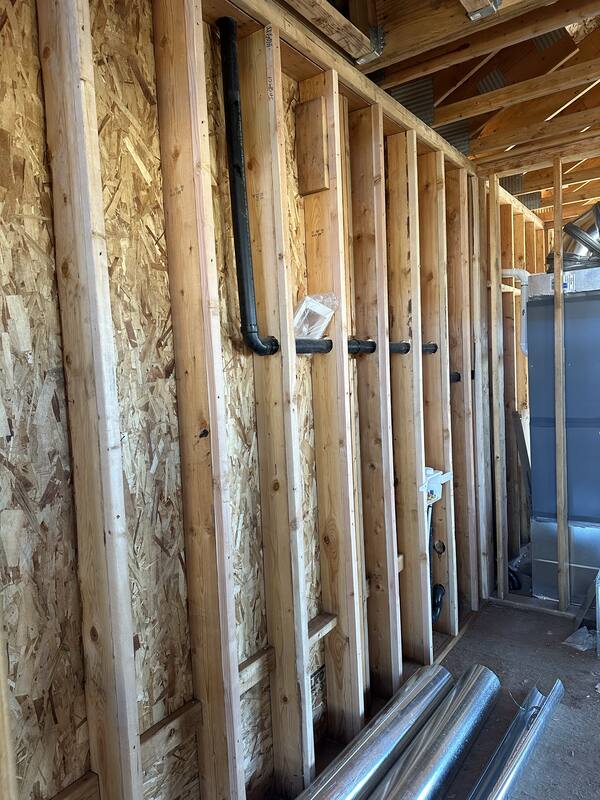
Short answer: air filtration in a new Idaho home should be a MERV 13 filter in a 4-inch or deeper cabinet at the air handler, sized so the filter is not fighting the blower. Idaho code requires a ventilation system in every new house and never names a filter rating, so the number is the builder’s call, not the inspector’s. In smoke season that choice is the whole ballgame.
Contents
- Does Idaho code require air filtration in a new house?
- What does a MERV rating actually mean?
- What MERV should a new Idaho custom home have?
- Why does a 1-inch filter choke a brand-new furnace?
- What is a media filter cabinet, and do I need one?
- Does a better filter help with wildfire smoke?
- Does my HRV or ERV need its own filter?
- What does air filtration cost to put in and keep running?
- Do I need a whole-house purifier, a UV light, or an ionizer?
- What air filtration will not fix
- How I spec air filtration on a SwagerBuilds house
- What to ask your builder before the mechanical rough-in
- Air filtration FAQ
Does Idaho code require air filtration in a new house?
No. Idaho requires a filter to exist in a central system, and it stops there. It never tells you how good that filter has to be.
Here is the part most people never hear. Idaho adopts the 2018 International Residential Code with its own amendments at IDAPA 24.39.30, and amendment 03.h throws out the national language and replaces it with one flat sentence: dwelling units shall be provided with whole-house mechanical ventilation in accordance with Section M1505.4. The national code only triggers that requirement if the house tests tight. Idaho removed the trigger. Every new Idaho dwelling gets a ventilation system, period. I wrote up how that sizing works in the whole house ventilation guide.
Now read those two facts together, because nobody in this market does. Your new house is required to have a fan whose entire job is pulling outdoor air inside. And not one line of Idaho’s amendments mentions filters, filtration, or MERV. I went through them. The word does not appear.
So in August, when the valley fills with smoke off a fire in central Idaho or western Montana, code has guaranteed you a machine bringing that air in and has said nothing at all about cleaning it. That gap is filled by whoever specs the mechanical system. On my jobs that is me.
The only places real numbers show up are voluntary programs. ENERGY STAR certified new homes require MERV 6 or better. EPA Indoor airPLUS and DOE Zero Energy Ready Home require MERV 8 or better. Those are floors written for the whole country, not answers for a valley that gets a month of smoke a year.
What does a MERV rating actually mean?
MERV stands for Minimum Efficiency Reporting Value. In plain English: out of 100 particles of a given size that hit the filter, how many does it catch? Higher number, more caught. The test behind it is ASHRAE 52.2, and it only scores particles between 0.3 and 10 microns.
Why that window matters: a human hair is about 70 microns. Wildfire smoke is mostly PM2.5, meaning 2.5 microns and under. Pollen and dust sit up at the big end. So a filter can be great at dust and nearly useless at smoke, and the single MERV number hides that unless you look at the breakdown. Here are EPA’s minimum efficiencies by particle size.
| MERV | 0.3 to 1.0 micron | 1.0 to 3.0 micron | 3.0 to 10 micron | What it is really for |
|---|---|---|---|---|
| 1 to 4 | not rated | not rated | under 20% | Keeping fuzz off the blower. Not air quality. |
| 6 | not rated | not rated | 35% or more | ENERGY STAR floor. Big dust only. |
| 8 | not rated | 20% or more | 70% or more | Indoor airPLUS floor. Dust, pollen, some mold spores. |
| 11 | 20% or more | 65% or more | 85% or more | Starts touching fine particles. Pet dander. |
| 13 | 50% or more | 85% or more | 90% or more | Smoke, fine dust, most of what you care about. |
| 14 | 75% or more | 90% or more | 95% or more | Better on smoke. Needs a system built for it. |
| 16 | 95% or more | 95% or more | 95% or more | Clean-room territory. Rare in a house. |
Read down the first column. Everything below MERV 11 is simply not rated for the 0.3 to 1.0 micron band, which is where smoke lives. That is the whole argument for 13 in this valley, and it is why I do not treat the ENERGY STAR floor as an answer here.
One more term, because a salesman will use it on you. HEPA is not a MERV rating. A true HEPA filter catches 99.97% of particles at 0.3 microns. It also chokes a residential blower, which is why HEPA belongs in a portable unit or a dedicated bypass, not jammed into your furnace slot.
What MERV should a new Idaho custom home have?
MERV 13, in a deep cabinet. That is my default on every house, and I will tell you exactly when I deviate.
EPA’s own guidance is to use at least MERV 13 if you are upgrading, and then to go as high as the fan and the filter slot can handle. The second half of that sentence is the one builders skip. A MERV 16 filter in a 1-inch slot is worse than a MERV 8 done right, because the system cannot move air through it and you end up with a cold bedroom, a short-cycling furnace, and a blower motor that dies early.
Where I go up: a client with a documented sensitivity, or a house sited low in the valley where smoke settles and holds. Then I look at 14, and I size the cabinet and the return for it from the start rather than bolting it on.
Where I stay at 13 and spend the money elsewhere: almost always. Thirteen in a 4-inch cabinet, with return ducts sized to keep the air moving slowly through it, outperforms a higher number squeezed into a system that was never drawn for it. The filter is one line on the mechanical plan, and the plan is where this gets won or lost. That coordination happens during the design phase, before anybody signs a construction number.
Why does a 1-inch filter choke a brand-new furnace?
Because air has to be pushed through it, and pushing costs pressure. The filter is typically 20% to 50% of the total pressure drop in a residential system, per the Department of Energy’s Building America guidance on high-MERV filters. That is one component eating up to half your budget.
The budget is small. Most residential systems want total static pressure no higher than 0.4 to 0.5 inches of water column. A standard PSC blower motor starts losing airflow around 0.5. An ECM motor is happiest between 0.3 and 0.5 and will keep straining past that, which is how you get a burned-out motor in year six instead of year twenty.
Now the numbers that settle the 1-inch argument. Same manufacturer, same MERV 7 media, measured at 300 feet per minute:
| Filter depth | Pressure drop at 300 FPM | Share of a 0.5 in. w.c. budget |
|---|---|---|
| 1 inch | 0.20 in. w.c. | 40% |
| 2 inch | 0.13 in. w.c. | 26% |
| 4 inch | 0.12 in. w.c. | 24% |
Nothing changed but thickness, and the 1-inch filter costs you almost twice the pressure. The reason is surface area. A 4-inch pleat gives roughly twice the media area of a 2-inch pleat, so the same volume of air crawls through instead of being forced through. The target face velocity is 200 to 400 feet per minute, with 500 as the hard ceiling.
And here is the fact that kills the usual objection. A high MERV rating does not automatically mean high resistance. Filter design and area matter more than the number. A 4-inch MERV 12 runs about 0.2 in. w.c. at 300 FPM, which is the same as that 1-inch MERV 7. You get five MERV steps for free by making the filter bigger.
This is also why the fix is never “just buy a better filter at the hardware store.” If the slot is 1 inch, a MERV 13 in that slot is a compromise. The real fix is a cabinet, and cabinets get installed at mechanical rough-in, not after you move in.
What is a media filter cabinet, and do I need one?
A media filter cabinet is a sheet-metal box built into the return duct right before the air handler, deep enough to hold a 4-inch, 5-inch, or thicker filter instead of the 1-inch slot that comes stamped into the equipment. It is the single highest-value piece of air filtration hardware in a house, and it costs almost nothing when it goes in during construction.
What it buys you, in order of how much the client notices:
- You can actually run MERV 13. The depth gives you the media area to do it without strangling the blower.
- Filter changes drop from monthly to quarterly. More media means more loading capacity before pressure climbs. DOE guidance is roughly every three months on a normal house.
- The blower lasts. Lower static pressure for the life of the equipment.
- It seals. A proper cabinet has a gasketed door. A 1-inch slot usually leaks air around the filter frame, which means a share of your air never gets filtered at all. That bypass leak is the quiet reason a good filter underperforms.
The one thing it costs you is space. A deep cabinet plus service clearance needs a real mechanical room, not a closet somebody found after the floor plan was done. That is a design decision, and on my jobs we make it while the plans are still on the screen.
If you want more area without a deeper cabinet, the other move is a return box that holds two filters side by side, or simply a physically larger filter. Both need the duct drawn that way from the start. Retrofitting either one into a finished house means opening ceilings.
Does a better filter help with wildfire smoke?
Yes, and in this valley that is the main reason to spend the money. Smoke is the one air-quality problem here that is severe, annual, and completely outside your control.
Wildfire smoke is dominated by PM2.5, particles 2.5 microns and smaller, and a good share of that mass sits down in the 0.3 to 1.0 micron band. Go back to the MERV table. A MERV 8 filter has no rated efficiency in that band at all. A MERV 13 catches at least half of it on every pass, and a house recirculating its air several times an hour gets a lot of passes.
EPA’s own wildfire indoor air quality guidance says the same thing in homeowner terms: keep windows and doors shut, set the system to recirculate, use a MERV 13 filter if possible, run a portable air cleaner that does not produce ozone, and stop adding particles indoors by cooking, burning candles, or lighting the wood stove during a smoke event.
Three things I would add from working through smoke seasons here.
Your fresh-air intake needs a plan. Code gave you a ventilation system that runs on a timer. During a bad smoke stretch you want to be able to shut it down or switch to recirculation without climbing in the attic. That means a control the homeowner can reach, specified at rough-in, not a dip switch inside the unit.
Keep spare filters. A smoke week loads a filter like a normal month. Buy them in the spring, before the valley buys them out in August.
The envelope does half the work. A leaky house pulls smoke through every gap regardless of what is in the filter cabinet. Air sealing and insulation detail are part of your air filtration strategy whether anybody calls it that. Same for the water-resistive barrier and the windows.
Smoke season is one piece of a bigger pattern. If you are new to the area, read what the Eastern Idaho climate does across a full year and how I build for wildfire. Idaho DEQ publishes the monitoring data and issues the advisories.
Does my HRV or ERV need its own filter?
Yes, and this is where I see the most expensive mistakes.
An HRV or ERV is a second air path into your house that does not necessarily go through the furnace filter. If the unit is ducted independently, outdoor air enters through whatever filter came in the box, which on a lot of units is a washable screen or a low MERV panel. You can have a beautiful MERV 13 cabinet on the furnace and a separate fan quietly delivering unfiltered August air to your bedrooms.
| How the ventilation is ducted | Where the air filtration happens | What I check |
|---|---|---|
| Fresh air dumped into the furnace return, upstream of the cabinet | The main MERV 13 cabinet handles everything | Blower has to run for ventilation to be filtered. Verify the control logic. |
| HRV or ERV fully ducted on its own supply and return | Only the unit’s own filters | Can the unit take a higher MERV cartridge, and what does that do to its rated airflow? |
| Exhaust-only ventilation | Nowhere. Makeup air comes in through leaks. | Not something I spec on a custom home here. |
My preference on a Teton Valley house is an ERV with a filter cartridge on the outdoor-air side that I can upgrade, plus the MERV 13 cabinet on the air handler. Two stages, and the smoke has to get through both. The tradeoff is that higher-MERV cartridges cut the unit’s rated airflow, so the unit has to be selected a size up front. Again: a plan decision, not a field decision.
The sizing math and the HRV-versus-ERV call are in the ventilation post. Short version for a cold dry climate like ours: an ERV, because cold air is dry air and you do not want to haul the indoor humidity out all winter.
What does air filtration cost to put in and keep running?
In a new build, the hardware is a rounding error and the operating cost is real but small. The expensive version is the one you retrofit.
These are market figures, not SwagerBuilds pricing. They come from a May 2026 HVAC cost survey and are national, so read them as orders of magnitude.
| Item | Market range | Typical |
|---|---|---|
| Whole-house media filter cabinet, installed | $250 to $1,800 | $500 to $900 |
| Custom cabinet or retrofit into finished ductwork | $400 to $2,000 | $900 |
| Stepping media from MERV 8 to 11 up to MERV 13 to 16 | adds $50 to $400 | per filter |
| Replacement filter, 4-inch or deeper media | $30 to $300 each | $95 |
| Annual filter spend, normal house | $120 to $250 | two to three changes |
| Annual filter spend, pets plus a hard smoke season | about $380 | four changes |
What is not in those numbers: the duct and return sizing that lets a deep filter work, the mechanical-room square footage, the homeowner-reachable ventilation control, and the ERV cartridge upgrade. On a custom home those are design and coordination items, not line items you buy at a counter. They are also the difference between a system that performs and a box full of expensive filters.
For what the whole house runs, construction on a SwagerBuilds home in Teton Valley or Idaho starts at $400 per square foot and goes up. The breakdown is in the Teton Valley cost post and the Idaho cost post. Design is a fixed design fee, quoted per project.
Do I need a whole-house purifier, a UV light, or an ionizer?
Usually no, and I will not sell you one. A correctly sized MERV 13 in a deep cabinet does most of the work that these add-ons promise, at a fraction of the price and with no moving parts.
The honest breakdown:
- Portable air cleaners. These are genuinely useful, especially in a bedroom during a smoke event. EPA treats them as a real tool and specifically says to pick one that does not produce ozone. Buy one sized for the room, not the house.
- UV lights in the ductwork. Aimed at microbes on the coil, not at particles. They do nothing for smoke or dust. Not on my standard spec.
- Ionizers and electronic air cleaners. Some generate ozone as a byproduct, and ozone is a lung irritant. If a contractor cannot hand you third-party test data on ozone output, that is your answer.
- Whole-house HEPA bypass. Real technology, real cost, real ducting. It makes sense for a client with a documented medical need. For everyone else the money goes further in the envelope.
If you want to go deeper on what a portable unit can and cannot do, EPA’s guide to air cleaners and filters in the home is the straight version, and it leads with the thing nobody selling equipment leads with: fix the source first, ventilate second, filter third.
What air filtration will not fix
A filter catches particles. That is the entire job description. Four things in a new house that air filtration does not touch.
Radon. It is a gas that comes up out of the ground, and no filter in your furnace does anything to it. That is a sub-slab system, roughed in before the concrete goes down. Two out of five Idaho homes test above the EPA action level, which is why I rough in a passive system on every house. The full story is in the radon post, and the foundation choice interacts with it, covered in basement versus crawl space versus slab.
Combustion gases. Carbon monoxide is a gas. Detectors and correct venting handle it. A filter does not.
Off-gassing from new materials. A new house smells like a new house because of what is in the cabinets, the glues and the finishes. Standard filter media does not remove those compounds. Choosing low-emission materials and running the ventilation system handle it, and the smell fades over the first months.
Humidity. Winter here is cold and dry, and a filter has no opinion about moisture. That is an ERV, a humidifier, or both, decided at design.
I would rather tell you that up front than have you buy a two-thousand-dollar air cleaner expecting it to solve a radon reading.

How I spec air filtration on a SwagerBuilds house
Twenty years in construction, and I am involved in every phase of every build, which means the mechanical plan crosses my desk before anybody orders equipment. Here is the standard I hold it to.
- MERV 13 media, 4-inch cabinet minimum, gasketed door, located where a homeowner can reach it without a ladder.
- Return ducts sized for face velocity in the 200 to 400 FPM range, so the filter is not the bottleneck. That is a duct-design input, calculated, not guessed.
- Static pressure measured at commissioning. Supply plus return, with a manometer, with the filter in. If the total is over roughly 0.5 in. w.c., something gets fixed before I hand over keys.
- ERV with an upgradeable outdoor-air cartridge, and the unit selected a size up so the better cartridge does not starve it.
- A ventilation control the owner can actually operate during a smoke week, labeled, with the filter sizes written inside the mechanical room door.
- Construction filters pulled and replaced before occupancy. Drywall dust destroys a filter, and the one that ran during the build does not stay in the house.
None of that is exotic. It is coordination, and it only happens if somebody owns it. We handle plan development, engineering coordination and the mechanical design in-house, so the air filtration decision gets made once, on paper, instead of three times in the field. For the broader envelope list, start with the nine energy-efficient features worth paying for, then the heat pump versus furnace call.
What to ask your builder before the mechanical rough-in
Print these. Ask them before the ducts go in, because after insulation the answers get expensive.
- What MERV is the filter, and how deep is the cabinet?
- What face velocity did the duct design assume through the filter?
- Will you measure total static pressure at commissioning with the filter installed, and will you give me the number?
- Does the fresh-air system run through the main filter, or does it have its own?
- Can the ERV take a higher MERV cartridge, and was it sized with that cartridge in mind?
- Where is the filter, and can I change it without a ladder?
- Who pulls the construction filter before I move in?
If a builder gets vague on numbers two and three, you have learned something. Those are the two that separate a designed system from a pile of equipment. The same instinct applies to the electrical panel and well water pressure. Ask for the calculation, not the reassurance. More questions like these are in the final walkthrough checklist.
Air filtration FAQ
Is MERV 13 too restrictive for a residential furnace?
Not in a properly sized cabinet. The restriction comes from media area, not the MERV number. A 4-inch MERV 12 measures about 0.2 in. w.c. at 300 FPM, the same as a 1-inch MERV 7. Put MERV 13 in a 1-inch slot and yes, you have a problem. Put it in a 4-inch or 5-inch cabinet with the return sized for it and the blower never notices.
How often should I change the filter in a new Idaho home?
About every three months on a deep media filter, per Department of Energy guidance, and more often with pets, allergies, or a hard smoke season. Change it immediately if it is collapsed, damp, or making the system noisy. During the first year after construction, check it sooner, because build dust lingers.
Does Idaho require a specific MERV rating in a new house?
No. Idaho adopts the 2018 IRC with amendments at IDAPA 24.39.30, and none of those amendments mention filters, filtration, or MERV. Idaho does require whole-house mechanical ventilation in every new dwelling, with no blower-door trigger, so every new house has a system bringing outdoor air in. The filter rating on that system is the builder’s decision.
Will a MERV 13 filter keep wildfire smoke out of my house?
It removes a large share of the smoke particles that pass through it, and that is the single most effective mechanical step you can take. It is not a seal. EPA guidance pairs the MERV 13 filter with closed windows, recirculation, a portable air cleaner with no ozone output, and not adding smoke indoors. A tight, well-sealed envelope does as much work as the filter does.
Can I add a media filter cabinet to a house that is already finished?
Usually yes, if there is room at the air handler and the return duct can be opened up. Market figures for a custom cabinet or retrofit run roughly $400 to $2,000 nationally, versus a few hundred dollars when it goes in during construction. The harder problem is that retrofitting a cabinet does not fix undersized return ducts, which is the real constraint in most houses.
Want this handled before the ducts go in?
Air filtration is a thirty-minute conversation during design and a demolition job afterward. If you are planning a custom home in Teton Valley, Eastern Idaho or Jackson Hole, I will walk you through the mechanical plan before anybody orders equipment.
Call me at (208) 520-0636 or get in touch here. If you want the full picture first, here is how we build custom homes.
Built different. Built right. Built by SwagerBuilds.