
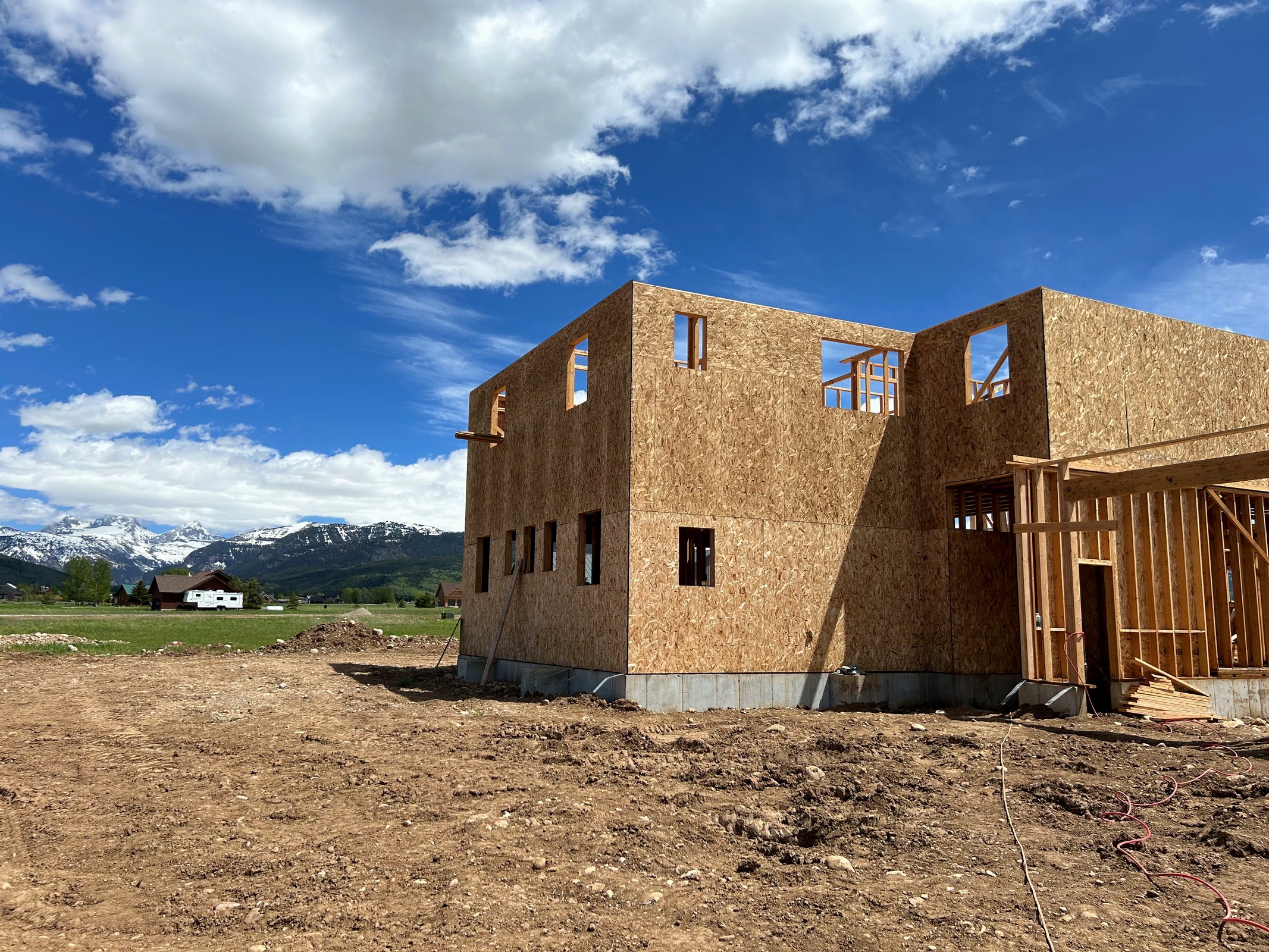
I get asked this on most first calls, and the person asking usually expects me to say build. I’m a builder, after all.
The honest answer in Teton Valley in 2026 is that building is rarely cheaper. It’s often better, and those are different questions. Here’s how to tell which one you’re actually asking.
The comparison most people run is wrong
The usual version: “That existing house is listed at $1.4M, and I can build for $400 a foot, so a 2,500 SF house is $1M. Building saves me $400,000.”
That comparison is missing the land, every soft cost, and 14 to 18 months of carrying. The listed house includes all of it. A fair comparison looks like this:
| Building | Buying |
|---|---|
| Lot purchase | Included in list price |
| Construction (starts at $400/SF conditioned, Idaho side) | Included |
| Site work, well, septic, driveway, utilities | Included |
| Design, engineering, survey, permits | Included |
| Landscape, window coverings, appliances, furnishings | Landscape and often appliances included |
| Construction loan interest across 14–18 months | None |
| Your housing during the build | None |
| Your time across the project | A few weeks of shopping and closing |
Run it that way and the gap narrows fast, and on a straightforward house it often closes entirely. The full list of what sits outside the per-square-foot number is here.
Why building usually isn’t cheaper here specifically
- Land is a large share of the number. A buildable Teton Valley lot with views is a serious purchase before a single shovel moves. In many markets land is 15% of the project. Here it can be far more.
- Site development is expensive. Well, septic, a long driveway, and a power line extension on a rural parcel add up before the foundation exists. Real numbers here.
- Snow-load engineering isn’t optional. Structure designed for 60 to 100+ psf costs more than the same house on the valley floor in a warmer market.
- The build window is short. Winter compresses the schedule and adds cost, which is why timelines run 14 to 18 months. What actually drives 14 vs 22 months.
- You pay interest the whole time. On a seven-figure build across 18 months, that alone can exceed what people assume they’re saving.
Where building genuinely wins
- The inventory doesn’t exist. This is the real reason most of my clients build. At the upper end of this valley, the house you want frequently isn’t for sale at any price, and when it is, three other people want it.
- You already own the lot. If the land is bought, the math changes completely — you’re comparing construction plus soft costs against a full list price. Building on your own lot.
- The existing house needs major work. A 1990s house that needs systems, envelope, and layout changes can cost more to fix than to build new, and you still end up with a 1990s house.
- You want specific performance. Envelope, air sealing, and mechanical systems designed for this climate. You cannot buy that in existing stock here, and retrofitting it is expensive.
- Nothing gets deferred to you later. New construction means you aren’t inheriting somebody’s deferred maintenance, and you know exactly what’s behind the drywall.
Where buying wins outright
Five situations where I’d tell you to buy, and have:
- You need to be in within a year. A job, a school year, a family situation. Design plus permits plus construction doesn’t compress below about 18 months here, and pretending otherwise sets you up to be angry at month fourteen.
- You found a house that’s genuinely close. If an existing home hits 85% of what you want, the last 15% will not be worth 18 months and a construction loan.
- Your budget only works on the optimistic version. If the numbers require everything to go right, buy a known quantity instead.
- It’s a short-hold property. Building has transaction friction on both ends. If you plan to be out in three to five years, buying is usually the cleaner play.
- You don’t want to make decisions. Even a well-run build asks real things of you. If that sounds like a burden rather than an interesting project, that’s useful self-knowledge. How involved you actually need to be.
The Jackson-side wrinkle
Across the pass the calculation changes shape. Jackson Hole construction starts at $1,000 per square foot and goes up, and land is in a different universe again — but so is the existing inventory. Build-versus-buy in Teton County WY is usually decided by lot availability and review timelines rather than by cost.
Which is why a number of my clients run the hybrid: buy or build on the Idaho side and accept the drive. The Jackson Hole cost picture and the two markets compared directly.
How to actually decide
- Price the build honestly, all-in. Land plus construction plus roughly 35–50% on top for everything else, plus interest across the build.
- Shop the actual inventory for 90 days. Not Zillow browsing — real showings. You’ll learn quickly whether what you want exists.
- Put a number on the gap. If building costs more, decide what the difference buys: the right lot, the right layout, the performance, the fact that nothing is somebody else’s deferred problem.
- Be honest about the timeline and your tolerance. This is the factor that changes the answer most often, and the one people discount most.
If you land on buying, I’d rather you buy. A client who built when they should have bought is unhappy for 18 months and tells people about it.
Frequently asked questions
Is it cheaper to build or buy a house in Teton Valley?
Building is rarely cheaper in Teton Valley once the comparison is run fairly. A listed home includes land, site development, soft costs, landscape, and appliances, while a per-square-foot construction figure includes none of those, and building adds 14 to 18 months of construction loan interest plus your housing during that period. Building often wins on fit and quality rather than on price.
What makes building in Teton Valley more expensive than other markets?
Land is a large share of the total, rural site development adds well, septic, long driveways and utility extensions, snow-load engineering at 60 to 100+ psf costs more than standard structural design, and the short build window means timelines of 14 to 18 months with interest accruing throughout.
When does building make more sense than buying?
When the inventory you want does not exist, which is the most common reason at the upper end of this market; when you already own the lot; when an existing home needs systems, envelope, and layout work that would cost more than building new; when you want envelope and mechanical performance you cannot buy in existing stock; and when you do not want to inherit deferred maintenance.
How long does building take compared to buying?
Buying is a few weeks of shopping plus a closing. Building in Teton Valley runs roughly 14 to 18 months of construction, plus 4 to 6 months of design and permitting before that. If you need to be in the house within a year, buying is effectively the only option.
Does the build-versus-buy answer change in Jackson Hole?
Yes. On the Wyoming side construction starts at $1,000 per square foot and land costs are in a different range, but so is existing inventory. The decision there is usually driven by lot availability and review timelines rather than by cost comparison. Some buyers run a hybrid and build on the Idaho side instead, accepting the commute.
Run the numbers with me
Book a 15-minute planning call. Bring the listing you’re considering and the lot you’re considering, and we’ll price both honestly — including when the answer is buy.
— Bryce Swager, owner and lead builder, SwagerBuilds. Rigby, Idaho.