
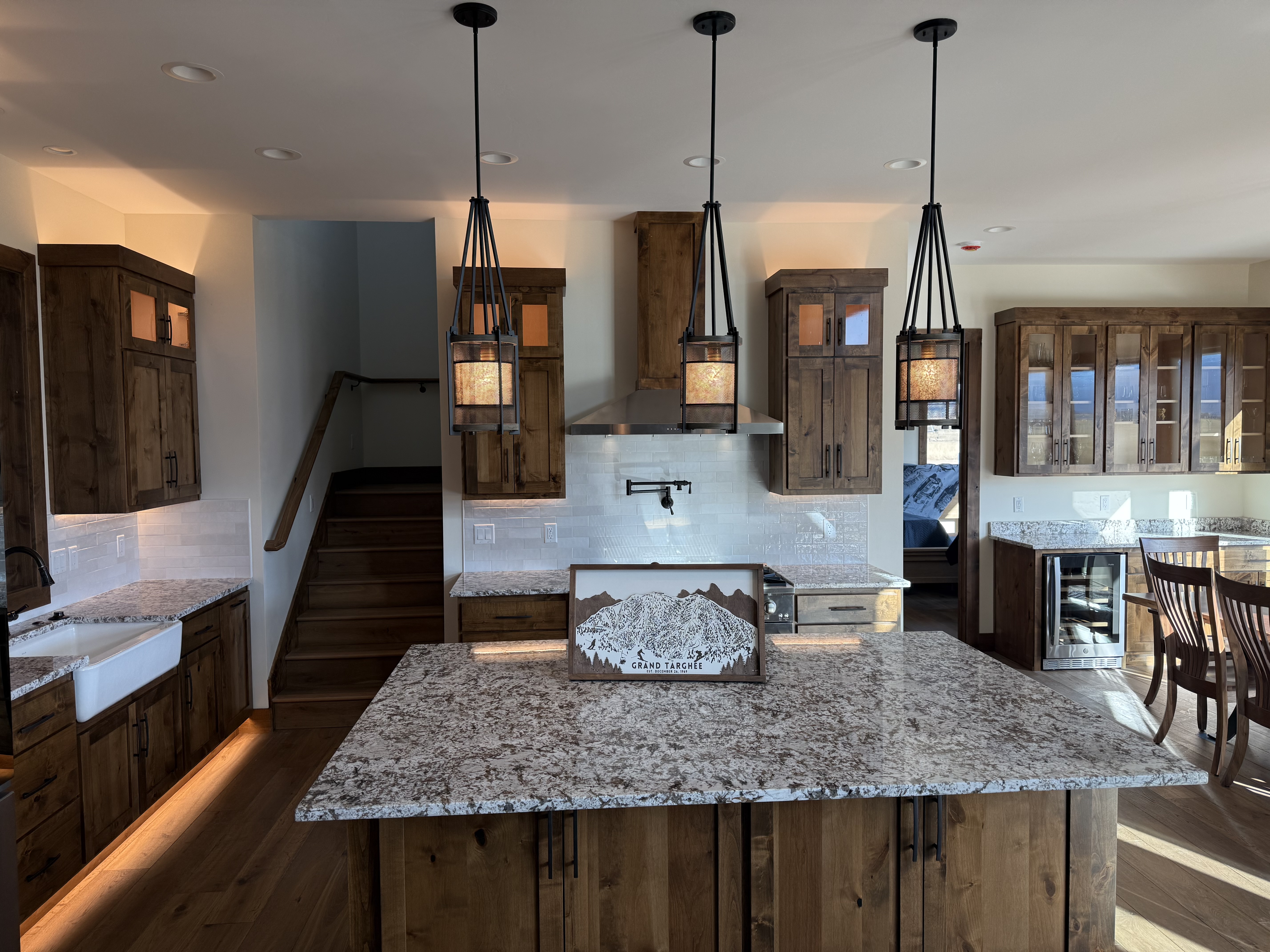
If you live in San Francisco, Palo Alto, Marin, Newport Beach, or anywhere else in California, and you’re thinking about building a second home in Teton Valley — Driggs, Victor, Tetonia, or Alta — this guide is for you. Specifically for you.
I get on a Zoom every week with a California family who’s flown into Jackson once or twice, fallen for the west side of the Tetons, and started running the numbers. The questions are always the same: what does it really cost compared to California, how long will it take, do my California architect’s drawings work in Idaho, and — the question nobody says out loud — can I actually trust a builder 800 miles away.
I’m Bryce Swager. I own SwagerBuilds, based in Rigby, Idaho. We build custom homes in Teton Valley and across Eastern Idaho. About a third of our active projects right now are owned by California families building their second home here. This post is the honest version of the conversation we have on that first Zoom.
How Idaho build costs actually compare to California
The first thing to know: Teton Valley is not the cost-relief story you might be told over dinner in Atherton. It’s still cheaper than Bay Area or Orange County construction — but the gap is smaller than buyers expect, and it’s been closing every year.
Here’s the realistic 2025 picture for a comparable, mid-to-high-finish home:
- Bay Area or Orange County custom: roughly $800–$1,400+ per square foot, depending on neighborhood and finish tier
- Teton Valley custom (Driggs / Victor): roughly $450–$800+ per square foot, with most second-home builds landing $500–$700/sqft
- Eastern Idaho — Idaho Falls, Rigby, Rexburg: roughly $300–$500/sqft for the same finish — but that’s not where most California families are buying
So a 3,500 sq ft Teton Valley second home with mid-to-high finishes typically runs $1.8M to $2.6M for the house alone, before land. Land in Driggs or Victor adds another $200K to $800K+ depending on lot, view, and acreage. Most California second-home builds we work on land in the $2M to $4M total range (house + land + site work). Higher-end builds regularly cross $5M total.
The cost gap vs. California is real, but it’s not the 50%+ savings some buyers expect from a Zillow scroll. Teton Valley trades cost more than Idaho Falls trades because the labor pool is smaller and competes with Jackson on the other side of the pass. Lumber, steel, and finished goods all carry an upcharge for freight. Snow load engineering raises every structural number. The honest cost gap vs. comparable California construction is closer to 30–45%, not 60%. For the full breakdown, the Idaho custom home cost guide walks every line item.
The Teton County permit timeline — what California buyers need to know
This is the part that surprises Californians the most. Not because Teton County, Idaho is slow — it’s actually faster than most California jurisdictions — but because the shape of the timeline is different. Plan review and permit issuance is typically 6–10 weeks for a clean engineering package, vs. 4–12+ months in many CA jurisdictions. Septic permitting through Eastern Idaho Public Health runs in parallel (add 2–6 weeks if soils tests get complicated). Plat-specific design review applies in many Driggs and Victor subdivisions — CC&Rs can dictate roof pitch, exterior materials, and color palette. Read them before you finalize plans. No CEQA equivalent. NEPA only matters on federal land, which most lots aren’t on.
The county follows the 2018 IRC with local amendments. The Teton County Idaho Building Department is reasonable to work with if your plans are clean. It is unforgiving if they’re not — which is the bigger point.
| Phase | Duration | Notes |
|---|---|---|
| Design + engineering | 3–6 months | Faster if you reuse an existing plan |
| Permits + soils + septic | 6–12 weeks | Runs partly parallel with design |
| Build (groundbreak to keys) | 12–16 months | Short build season at 6,200 ft |
| Punch list + landscape close-out | 2–4 months | Usually after move-in |
So from “we have a lot and a builder” to “we have keys” is typically 18–24 months. Plan to keep your California life going during that time — most clients fly in 2–4 times during the build.
Snow load, frost depth, water rights — the structural realities
This is where California architectural assumptions break down most often. Snow load. Ground snow loads in Driggs and Victor run 70 to 90 psf, some sites 100+. Trusses, foundations, and framing all change. Frost depth. Teton County engineers to a 42-inch frost depth. Foundations go deeper. Water rights. Idaho is a prior-appropriation water state. If your lot is on a well — most rural Teton Valley lots are — confirm water rights with the Idaho Department of Water Resources before closing. Confirm before closing on the lot. This is the single biggest mistake out-of-state buyers make. Septic. Soils tests through Eastern Idaho Public Health are required and can take weeks. Septic itself is typically a $25K–$60K line item, more on tougher soils. Floodplain. Check the FEMA Flood Map Service Center and the USGS National Hydrography Dataset before committing to a lot.
If you’re building from California: factor in one trip to Idaho before you close on the lot. Walking the site with your builder before purchase saves more money than any other single decision you can make in the first 60 days.
Will your California architect’s plans work in Teton Valley?
Sometimes. Mostly with modifications. Almost never as-is. The most common issues we see when a California architect’s drawings come in:
- Roof structure sized for CA snow loads (typically 30 psf or less) — re-engineered for 70–90 psf.
- Foundation has to go deeper for the 42″ frost depth.
- Insulation and envelope upgraded for Climate Zone 6 — typically R-30 walls, R-49+ roof, high-spec windows.
- Mechanical sized for mild winters has to handle real cold. Snow melt at entries and driveways is common.
- Roof pitch and shed direction — California flat-and-low aesthetics often reworked for snow shed and ice management.
Path 1: Keep your California architect, partner with an Idaho structural engineer. The CA architect drives design intent; an Idaho-licensed structural engineer adapts the package to local code. Cleanest path for high-design California families. Path 2: Use a Teton Valley architect from the start. Teton Valley architects know snow, ice, view orientation, and local design review by default. The wrong path is bringing CA drawings to Teton County and assuming nothing changes.
How we manage your build while you’re 800 miles away
The question nobody asks first but everyone has: can I really trust a builder I can’t show up unannounced to check on? The honest answer is yes — but only if the builder is set up for it. Most aren’t. Here’s what we do:
- Live job-site cameras on every active build. Log in from Palo Alto or Newport Beach and see what’s happening this minute.
- JobTread daily logs. Every day, your PM posts photos, notes, and what’s planned for tomorrow.
- Dedicated PM per job — not the owner. A project manager responsible for your specific build who you can text directly.
- Weekly Loom updates. A 5–10 minute walk-through of the week, every Friday. Watch it Saturday morning over breakfast.
- Full line-item budget visibility in JobTread. Every change order, every invoice, every PO. No mystery.
- Inspector schedule transparency. You know what inspections are coming and what passed.
That stack is what makes a remote build trustworthy. If a builder doesn’t have something like it, they’re not set up for California ownership. Walk. The deeper version of how this works is in How California Homeowners Manage a Custom Home Build From 800 Miles Away.
A realistic budget + timeline for a Bay Area or Orange County family
A realistic profile: family of 4–6, primary residence in SF Bay Area or Orange County, second home for family use 8–14 weeks/year with occasional rental, target 3,000–4,500 sq ft, 4–5 bed, 4–5 bath, garage for 2–3, ski/mudroom, bunk room, mid-to-high finish, real wood, real stone, comfortable but not Aspen-trophy.
Realistic budget: Land $300K–$800K. Site work + utilities $150K–$350K. House $1.8M–$2.8M. Landscape + driveway + finish exterior $150K–$400K. Furnishings (often forgotten) $150K–$400K. 10% contingency on hard costs. Total all-in: $2.6M to $4.8M.
Realistic timeline: Design + engineering 4–6 months. Permitting + site prep 2–3 months (parallel). Build 14–16 months. All-in from contract to keys: 20–24 months. Anything tighter is wishful thinking. Anything looser is bad planning.
Where to start as a California buyer
- Visit the valley in winter and summer. Driggs in February and Driggs in July are different towns.
- Walk lots with a local builder before buying. Site conditions move budget more than floor plans do.
- Confirm water rights and snow load on every lot you’re serious about — before you close.
- Decide between Driggs and Victor early. See Driggs vs Victor for Bay Area families.
- Get a real builder shortlist. Use How to Choose a Custom Home Builder in Idaho and the 12-question vetting checklist in The Honest Guide.
FAQ
How much does it cost for a California family to build a second home in Teton Valley?
For a mid-to-high-finish 3,000–4,500 sq ft home in Driggs or Victor, expect $2.6M to $4.8M all-in. House-only typically runs $500–$700/sqft. The cost gap vs. comparable Bay Area or Orange County construction is roughly 30–45%.
How long does it take to build a custom home in Teton Valley from California?
Plan on 20–24 months from contract to keys, including 4–6 months of design and engineering, 2–3 months of permitting (parallel), and 14–16 months of construction.
Can my California architect’s plans be used in Teton Valley?
With modifications, almost always. As-is, almost never. Snow load, frost depth, insulation, mechanical, and roof shed all need to be re-engineered for Climate Zone 6 and Teton County code.
How do I manage a custom home build remotely from California?
The minimum modern stack: live cameras, daily PM logs in JobTread, a dedicated PM, weekly Loom updates, and full line-item budget visibility. If your builder doesn’t have all five, they’re not set up for out-of-state ownership.
Is it better to build in Driggs or Victor as a Bay Area family?
Both work. Driggs has more restaurants, the airport, the rodeo grounds, and is closer to Grand Targhee. Victor is smaller, slightly more rural, and 15 minutes closer to Jackson over the pass.
Do I need water rights to build a second home in Teton Valley?
If your lot is on a well — most rural Teton Valley lots are — yes. Idaho is a prior-appropriation water state. Confirm with the Idaho Department of Water Resources before closing.
What’s the biggest mistake California buyers make in Teton Valley?
Closing on a lot before walking it with a local builder. Site conditions move the budget more than floor plans do.
Author: Bryce Swager — owner-builder at SwagerBuilds. Working with Bay Area and Orange County families to build second homes in Teton Valley since 2019.
Ready to talk through your Teton Valley second home? Book a 30-min planning call →
Leave a Reply