SwagerBuilds LLC · 4510 E 168 N, Rigby, ID 83442 · (208) 520-0636 · Idaho Contractor Registration RCE-57499

Tag: Victor Idaho

  • Financing a Custom Home in Teton Valley — What a 20-Year Builder Tells Clients

    Financing a Custom Home in Teton Valley — What a 20-Year Builder Tells Clients

    Financing a custom home in Teton Valley in 2026 usually means a construction-to-permanent loan from a regional bank, requiring 20-30 percent down, a fixed-price builder contract, and construction rates 1-2 points above conventional mortgage. A 20-year GC’s job isn’t to be your lender — but here’s what to know before you talk to a bank, and which questions actually matter for a Teton Valley construction loan.

    [Photo placeholder: Local Teton Valley bank branch or generic construction loan document]

    What Kind of Loan Do You Need for a Custom Home in Teton Valley?

    Two options. Construction-to-permanent (C2P) is the standard — one loan closes both construction and permanent mortgage. During construction: interest-only payments on drawn funds. At completion: converts to a standard mortgage. Single closing, single set of fees.

    Stand-alone construction loan is the alternative — 12-24 month construction financing that you refinance into a permanent mortgage at completion. Two closings, two sets of fees. Sometimes cheaper on the construction rate but usually more expensive total.

    Most Teton Valley clients go C2P. Two local Teton Valley banks and 3-4 regional Idaho/Wyoming banks offer them.

    How Much Do You Need to Put Down?

    20-30 percent typical. Some lenders count the value of the land you own toward the down payment — if your Driggs lot is worth $250K and the total project is $1.5M, that $250K of equity may count as 17% down against the loan.

    Jumbo construction loans (over $766K in 2026) typically require 25-30% down. In-town Teton Valley custom homes almost always trip jumbo thresholds.

    What Do Construction Loan Rates Look Like in 2026?

    Construction phase interest: 1-2 points above conventional 30-year mortgage rate. In 2026 that puts construction interest in the 8-10% range depending on the lender and credit profile. Permanent conversion rate: whatever conventional is at the conversion date, so you’re betting on the rate environment 12-18 months out.

    Some lenders offer rate-lock for the permanent conversion at contract signing. Extra 0.25-0.5 points but removes the biggest financing risk in the project.

    How Does the Draw Schedule Work?

    Lender releases construction funds in stages tied to project milestones. Typical Teton Valley draw schedule: 10% at foundation complete, 15% at framing complete, 15% at roof/envelope complete, 15% at rough-ins complete, 15% at drywall complete, 15% at finish carpentry complete, 15% at final inspection.

    Each draw requires bank inspection to verify work complete. Turnaround is typically 5-10 business days. A GC who’s done this before knows how to time draw requests to keep subcontractors paid without you carrying float.

    Why Do Lenders Prefer Fixed-Price Contracts?

    Because the total loan amount is knowable at underwriting. With a cost-plus contract, the lender can only estimate the ceiling — which usually means underwriting to a lower amount than the client actually needs, leaving a funding gap when cost overruns hit.

    Fixed-price with SwagerBuilds locks the number. Lender underwrites to that number. No mid-project “we need to increase the loan” conversations. Twenty years watching budgets blow up in this valley means we’ve seen plenty of cost-plus builds run out of loan mid-construction and force clients to bring in personal cash to finish.

    What Do Lenders Want From the Builder?

    Fixed-price contract with detailed cost breakdown. Proof of insurance (general liability minimum $2M, workers comp). References. A recent project audit showing on-time and on-budget performance. Willingness to work with the draw schedule and inspection process.

    SwagerBuilds provides all of that as standard. We’ve worked with every major Teton Valley construction lender.

    Which Banks Do Teton Valley Construction Loans?

    Local: two Teton Valley community banks with strong construction loan programs — they know the market, the sub base, and the timelines. Regional: 3-4 Idaho/Wyoming regional banks that lend into Teton Valley. National: some national lenders (through mortgage brokers) will do jumbo C2P for Teton Valley, though local lenders usually beat them on rate and flexibility.

    We’ll refer you to specific lenders during pre-construction based on your loan size, credit profile, and timeline. No commissions — just relationships from 20 years of Teton Valley construction.

    What Should You Do Before Talking to a Lender?

    Get a fixed-price builder contract or at minimum a signed pre-construction agreement so the lender knows you have a real project scoped. Have your land under contract or already owned. Have 2 years of tax returns and current pay stubs organized. Know your target total budget — lenders will ask.

    How Do I Get Started?

    Intake at swagerbuilds.com/start. During pre-construction we can introduce you to lenders, coordinate the fixed-price contract with their underwriting, and structure the draw schedule to fit your cash flow. See whole home remodel hub if you’re renovating instead, or pricing page.

    Frequently Asked Questions

    What kind of loan do I need for a Teton Valley custom home?

    Construction-to-permanent (C2P) is standard — one loan for construction and permanent mortgage.

    How much down payment do I need?

    20-30% typical. Land equity often counts toward down payment.

    What are 2026 construction loan rates?

    1-2 points above conventional 30-year, typically 8-10% during construction phase.

    Why do lenders prefer fixed-price contracts?

    The total loan amount is knowable at underwriting. Cost-plus creates funding gap risk mid-project.

    Do you work with local Teton Valley lenders?

    Yes. We refer to 2 local Teton Valley banks and 3-4 regional lenders that do construction loans in Driggs and Victor.

    Ready to Talk Financing and Building?

    20-year Rigby builder. Fixed-price contracts that lenders trust. Start your Teton Valley custom home here.

  • Custom Home Builder Cost in Driggs + Victor — Fixed vs Cost-Plus, What Locals Pay

    Custom Home Builder Cost in Driggs + Victor — Fixed vs Cost-Plus, What Locals Pay

    A custom home builder in Driggs or Victor typically bills one of two ways in 2026: fixed-price (locked number before contract, no allowances) or cost-plus (actual cost plus a 15-25% GC margin). Locals building here in the last 5 years overwhelmingly regret cost-plus. Here’s what each contract type actually costs and why fixed-price wins for anyone building in Teton Valley on a real budget.

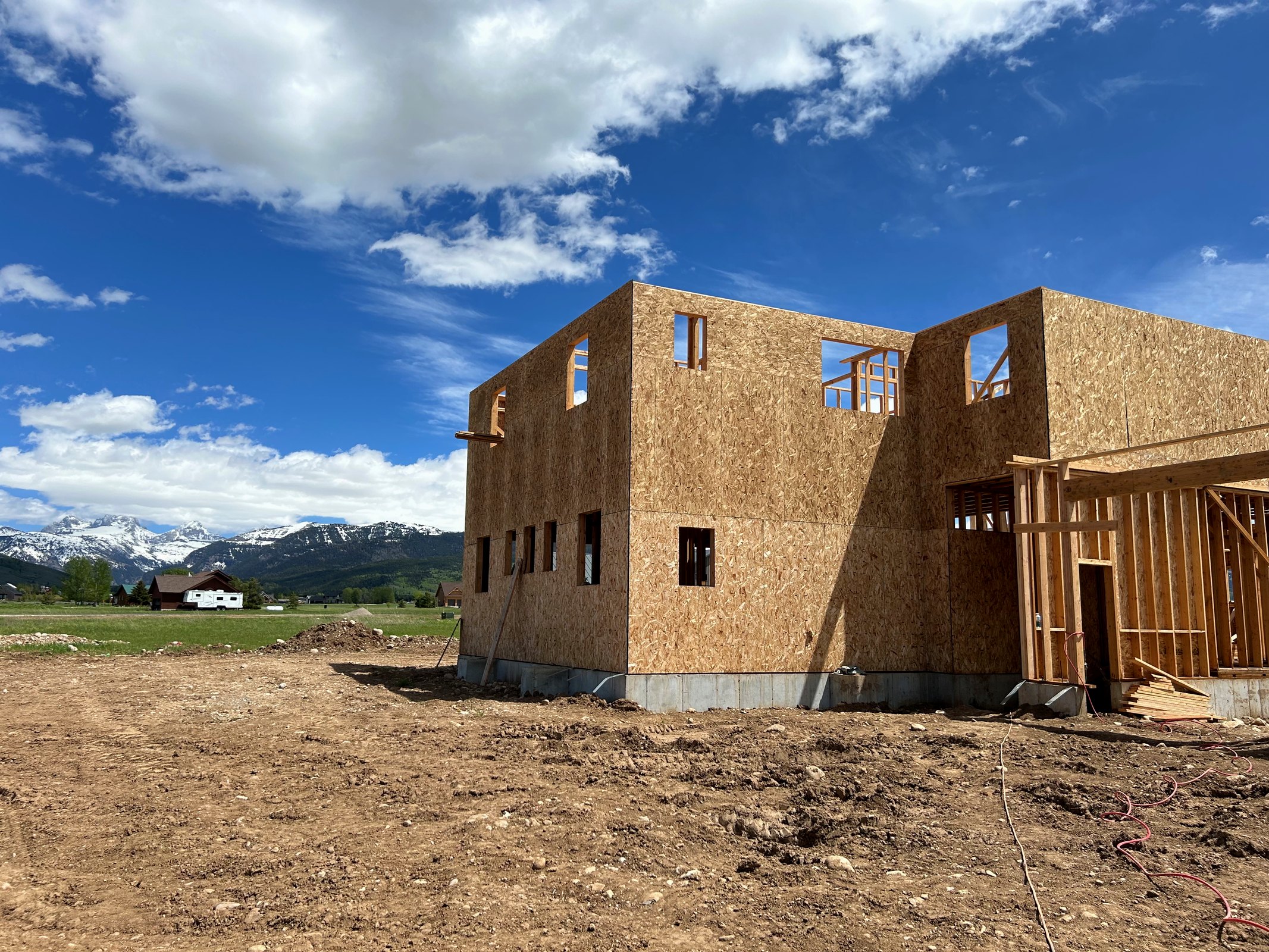
    [Photo placeholder: SwagerBuilds Driggs custom home under construction — framing stage]

    What Do Custom Home Builders Charge in Driggs and Victor?

    SwagerBuilds fixed-price construction starts at $400/SF and goes up, on conditioned square footage, in Driggs and Victor alike. That number covers the build itself (GC margin, subs, materials), and it’s fixed once the design is locked. One worked example: a 2,500 SF home at $400/SF is about $1M in construction. All-in (site work, permits, architect, landscape, furnishings) typically adds about 30%, roughly $1.3M.

    Cost-plus: quoted as “estimated cost” plus 15-25% GC margin. In what other builders publish, that estimated cost gets marketed as $280-$450/sq ft to look competitive, but the final number lands 20-60% higher than that estimate by the time surprises, allowances, and change orders shake out.

    Real math on cost-plus: builder quotes “estimated $1.2M plus 20% margin.” You sign at $1.44M expected. Final invoice: $1.9M-$2.1M. That’s not a boutique horror story — that’s the average outcome on Teton Valley cost-plus in the last 5 years.

    Why Does Cost-Plus Always Go Over?

    Three structural reasons. One: the estimate has allowances. “Cabinet allowance $60K” but you pick custom at $110K = $50K over. Multiply across 8-10 allowance line items. Two: the GC has no incentive to control cost — every dollar spent generates their margin, so pricier subcontractors and premium materials happen. Three: change orders are billed at cost plus the same margin, and there are always change orders on custom homes.

    The GC didn’t cheat you. The contract structure did. Cost-plus incentives are backwards — the GC wins when the project costs more. Twenty years watching budgets blow up in this valley says fixed-price is the only contract structure aligned with the client’s interests.

    Why Do Some Driggs Builders Only Offer Cost-Plus?

    Two reasons. Real reason: fixed-price requires 6-10 weeks of pre-construction work before a contract is signed. Most GCs can’t afford to invest that time on a job that might not close. Fake reason: “Every job has surprises so we can’t quote fixed-price.” That’s a signal they don’t do proper pre-construction inspection.

    Any GC who won’t quote fixed-price is telling you they don’t want to be accountable for the number.

    What Should a Real Fixed-Price Contract Include?

    Every SKU. Every subcontractor bid. Every permit and inspection fee. Every dumpster and porta-potty rental. Every hour of framing labor. Every plumbing fixture, cabinet door style, tile SKU, appliance model number, and paint color specification. If it’s in the drawings, it’s in the price. No allowances. No “TBD.” No “we’ll figure it out during construction.”

    Change orders are still possible — if you decide mid-build to upgrade the range or add a wine fridge, that’s a change order priced transparently and approved before work. The base contract stays intact.

    How Long Does a Real Pre-Construction Take?

    6-10 weeks for a custom home. Site walk, geotech if needed, custom home design refinement, structural engineering, mechanical planning, envelope engineering, product selection sessions with the client, subcontractor pricing walks, permit prep, fixed-price contract assembly.

    Pre-construction fee: a fixed design fee, quoted per project. Applied against the contract if you sign, refundable minus expenses if you walk. Non-negotiable for a builder committed to fixed-price.

    What Does JobTread Transparency Mean?

    Every invoice, every subcontractor payment, every change order, every schedule shift visible in your client portal in real time. You see the budget line-by-line. You see cash in vs cash out. You see where every dollar goes on the day it goes there. Not at a monthly meeting — the day it happens.

    That’s what “JobTread transparency — every dollar, every day” means. It’s the difference between a client who feels informed and a client who feels helpless.

    How Do I Compare Driggs and Victor Custom Home Builders?

    Ask three questions. Do you quote fixed-price? Do you do 6-10 weeks of real pre-construction before contract? Can I see your project management system (JobTread, Buildertrend, CoConstruct) with actual client data? Any “no” is a red flag.

    Then call three references from finished builds in the last 24 months and ask: did the final price match the contract? How were change orders handled? Would you use this builder again?

    How Do I Get a SwagerBuilds Fixed-Price Quote?

    Intake at swagerbuilds.com/start. Site walk, pre-construction, fixed-price contract in 8-12 weeks. See how pricing works and the full process.

    Frequently Asked Questions

    What do custom home builders cost in Driggs?

    Fixed-price $400 per square foot and up of conditioned space depending on spec. Cost-plus starts lower but finishes 20-60% higher than estimate on average.

    What’s the difference between fixed-price and cost-plus?

    Fixed-price locks the total number before contract. Cost-plus bills actual cost plus a 15-25% GC margin.

    Why do cost-plus builds go over budget?

    Allowances, misaligned incentives, and change order markup. Structural to the contract type, not the builder.

    How long is real pre-construction?

    6-10 weeks for a custom home. Fee: a fixed design fee, quoted per project.

    Can I see the budget in real time?

    Yes with SwagerBuilds. JobTread client portal shows every invoice, every payment, every schedule shift live.

    Ready for a Real Fixed-Price Custom Home Quote?

    20-year Rigby builder. Fixed-price. No allowances. JobTread transparency. Start your Driggs or Victor custom home here.

  • Cost to Build a Custom Home in Driggs, Idaho (2026 Update)

    Cost to Build a Custom Home in Driggs, Idaho (2026 Update)

    Primary bath with walk in glass shower and stone top vanity from the Arbogast custom home build by SwagerBuilds, Driggs, Idaho (Teton Valley), 2025

    If you’re trying to figure out what it actually costs to build a custom home in Driggs in 2026, the honest answer is $400 per square foot of conditioned space and up. A 3,500 sq ft custom build starts around $1.4M before land and goes up with finishes and site conditions. A higher end mountain modern with timber accents and big glass walls? $2.5M and up.

    That’s a wide range, and the reason isn’t builder margin. It’s the four cost drivers I’ll walk you through below. By the end of this guide, you’ll be able to ballpark your own build within about 10 percent before you ever sign a contract.

    I’m Bryce Swager, founder of SwagerBuilds. We’ve been building custom homes in Eastern Idaho since 2016, including a growing roster of luxury projects in Teton Valley and Jackson Hole. The numbers below come from real, current jobs, not a national average that gets quoted on every blog and ages out by spring.

    What does it cost to build a custom home in Driggs, Idaho in 2026?

    $400 per square foot of conditioned space and up for a luxury custom build. A typical 3,000 to 3,500 sq ft Teton Valley home runs $1.5M to $2.3M before land costs. Add 15 to 25 percent for site work, septic, well, and access if your lot is undeveloped. Land in Driggs ranges from $250K to $2M and up depending on view, acreage, and access.

    Why Driggs Costs More Than Idaho Falls (And Why It Should)

    If you’ve gotten quotes in Idaho Falls or Rexburg and now you’re getting Driggs numbers, the gap probably feels brutal. It’s not arbitrary. Building in Teton Valley is a different job than building on the valley floor, for four reasons.

    • Mountain logistics. Material delivery to Driggs is 60 to 90 minutes from the major suppliers. Concrete trucks, lumber yards, and equipment rentals all add freight.
    • Climate engineering. Teton Valley sees lows of 25 below, more than 12 feet of snow a year, and winds that hammer a roof line. Code minimum insulation gets you a comfortable home in Boise. In Driggs, code minimum gets you ice dams and a $900 heating bill. We build well above code here, and that costs more.
    • Subcontractor scarcity. Idaho Falls has more than 200 HVAC contractors. Teton Valley has fewer than 20 who’ll work on a luxury build, and the best ones are booked 9 to 12 months out. When the good crews are scarce, the price goes up.
    • Permitting and jurisdictional fees. Teton County permits cost more than the lower valley, especially with the new wildfire zone overlays.
    The Arbogast Home, framing stage with Teton Range backdrop from a full GC custom luxury home build, Driggs, Idaho (Teton Valley), 2025

    The honest builder math: the same scope of work prices roughly 45 percent higher in Driggs than in Idaho Falls. The home isn’t 45 percent nicer. The job is 45 percent harder — snow load engineering, a smaller trade pool, freight, and a shorter build season.

    The Real Cost Breakdown: Where Every Dollar Goes

    Here’s the actual line item split for a $1.8M Teton Valley custom home (3,500 sq ft, $515 a square foot). Numbers are 2026 averages from SwagerBuilds active jobs.

    Cost Category% of Total$ on $1.8M Build
    Site work (excavation, septic, well, drive)12%$216,000
    Foundation and framing18%$324,000
    Exterior (siding, roof, windows, doors)17%$306,000
    Plumbing, HVAC, electrical14%$252,000
    Interior finishes (flooring, trim, paint)12%$216,000
    Kitchen and bathrooms (cabinets, counters, fixtures)13%$234,000
    Permits, fees, insurance, builder overhead8%$144,000
    Builder profit6%$108,000
    Total100%$1,800,000

    A few things to notice. First, kitchen and bath finishes alone are $234K, and that’s a luxury but not over the top spec. Push toward Wolf, Sub-Zero, and stone slab counters and you’re at $350K easy. Second, builder profit is 6 percent, not 30. Anyone quoting you a 30 percent builder fee in Teton Valley is either misinformed or padding hard.

    The Arbogast Home, finished kitchen with custom alder cabinets and granite island from a full GC custom luxury home build, Driggs, Idaho (Teton Valley), 2025

    What Drives the $400 per square foot and up Spread

    Most of the price spread comes down to four specific decisions. Each one moves the needle 5 to 10 percent on total cost.

    • Glass to wall ratio. A standard window package on 3,500 sq ft runs $35,000 to $50,000. The big window mountain modern look with Marvin or Sierra Pacific 8 foot panels runs $90,000 to $130,000. That single decision is a $50,000 to $80,000 swing.
    • Roof complexity. A simple gable is cheapest. Hips with dormers, complex valleys, and exposed timber rafter tails run 25 to 35 percent more.
    • Mechanical systems. A standard 95 percent AFUE furnace with a ducted system is included. In floor radiant with a ducted HRV and a heat pump for shoulder seasons runs $40,000 to $65,000 extra. Worth it for the efficiency, but a real budget lever.
    • Cabinet and millwork level. Big box semi custom cabinets run $45,000 to $60,000 for a full house. Local custom millwork, built for the job out of real wood, runs $90,000 to $140,000.

    If you want to spend less, the highest leverage cuts are usually scaling back the window package, simplifying the roof, and using semi custom cabinets in the secondary spaces like the laundry and mudroom. That’s typically $80,000 to $120,000 back into the budget without the home looking cheap.

    Hidden Costs Most Builders Won’t Bring Up

    These don’t show on a builder estimate, but they hit your wallet just as hard. Plan for them or you’ll be over budget by $80,000 to $200,000 when you move in.

    • Septic system in Teton County: $18,000 to $35,000 depending on soil and lot. Often $45,000 and up if you need a pressure dosed mound system.
    • Well drilling: $15,000 to $25,000 typical. If you hit a dry hole or have to drill past 600 feet, $35,000 to $55,000.
    • Access road and snow plowing: $10,000 to $30,000 to build. Then $3,000 to $6,000 a winter for plowing if you’re not on a county maintained road.
    • Propane tank and line: $4,000 to $8,000. Most Teton lots aren’t on natural gas.
    • Soft costs: architect ($25,000 to $75,000), interior designer ($15,000 to $50,000), construction loan interest, county impact fees, and builder’s risk insurance. Easily another $80,000 to $150,000 total.

    Real Project Spotlight: The Arbogast Build

    The Arbogast home in Driggs is one of our recent benchmark projects. 3,200 sq ft modern mountain on 5 acres, glass heavy with timber accents, in floor radiant, and a custom kitchen built around entertaining.

    The Arbogast Home, full height custom stone fireplace, built in walnut shelving, and timber mantel. SwagerBuilds craftsmanship detail, Driggs, Idaho.

    Final numbers:

    • Land cost: $640K (5 acres, west facing Teton view)
    • Site work, septic, and well: $185K
    • Build cost: $1,920K, about $600 a square foot including the high end finish package
    • Soft costs: $115K (architect, designer, financing, insurance)
    • Total all in: $2,860K

    The Arbogasts came in $40K under their $2.9M budget, finished on schedule, and moved into a home that’s already appraising 8 percent above project cost. That’s what a clean Teton Valley luxury build looks like in 2026.

    Common Questions About Building in Driggs

    How much does it cost to build a 2,500 sq ft custom home in Driggs?

    Between $1.0M and $1.6M for a luxury build, plus land. At the lower end you’re getting builder grade finishes. At the upper end, real custom millwork, premium windows, and high efficiency mechanicals.

    Is it cheaper to buy or build in Teton Valley?

    In 2026, building is roughly 5 to 15 percent cheaper per square foot than buying comparable luxury inventory in Driggs and Victor, but only if you already own the land or buy a good lot. Add the land cost and they’re close to even, with the build giving you exactly what you want.

    How much should I budget for upgrades and change orders?

    Plan 8 to 12 percent of total build cost. On a $1.8M build, that’s $145,000 to $215,000 for the inevitable “let’s change this” decisions during construction. Builders who tell you they never have change orders aren’t being honest about how a real custom build actually goes.

    What’s the cheapest way to build in Driggs without it looking cheap?

    Three biggest levers: simplify the roof line, use a smaller premium window package paired with bigger windows in only the great room, and put your custom millwork budget into the kitchen and primary bath only. You can save $150,000 to $250,000 and still get a knockout home.

    How long will it take to build my custom home in Driggs?

    10 to 16 months from contract signing to keys in hand for most luxury builds. We break down every phase in How Long Does It Take to Build a Custom Home in Idaho.


    Ready to talk numbers on your build?

    If you’re inside 12 months of breaking ground in Driggs, Victor, Tetonia, or Felt, let’s talk. We do a free 30 minute discovery call where we look at your land, your wishlist, and your budget, and tell you straight whether the math works.

    Schedule a discovery call

    Or DM “BUILD” to @swagerbuilds on Instagram and we’ll send you a sample budget breakdown for a Teton Valley build at your size.